
Provisional attachment under Section 83 of the GST Act – Power “draconian”, to be strictly construed – Opinion must rest on tangible material showing attachment is “necessary”, not merely expedient – Proceedings must be pending against the person whose property is attached – Rule 159(5): right to object and right to a hearing are both mandatory – Commissioner’s order not appealable under Section 107, writ maintainable – Attachment ends when the final order is passed
Whether a writ petition lies against an order of provisional attachment under Section 83 of the Himachal Pradesh Goods and Services Tax Act, 2017 (HPGST Act), and whether the attachment of the assessee’s receivables, made before any proceeding against it had begun, was a valid exercise of the power.
The appeal was allowed. The Himachal Pradesh High Court’s judgment dated 1 January 2021, which had dismissed the writ petition as not maintainable, was set aside. The writ petition was allowed, and the orders of provisional attachment dated 28 October 2020 were quashed.
A provisional attachment under Section 83 is valid only if the Commissioner forms an opinion, on tangible material, that attachment is necessary to protect the government revenue, and only while a specified proceeding is pending against the person whose property is attached. The person must be allowed both to file objections and to be heard under Rule 159(5), and the Commissioner must pass a reasoned order on the objections. The order is not appealable under Section 107(1), so a writ petition under Article 226 lies against it.
The leading Supreme Court judgment on provisional attachment of bank accounts and receivables under GST. Section 83 was amended from 1 January 2022 to apply after the initiation of any proceeding under Chapters XII, XIV or XV and to cover persons specified in Section 122(1A), but the Court’s tests of necessity, tangible material and a mandatory hearing continue to govern the exercise of the power.
| Case Name | M/s Radha Krishan Industries v. State of Himachal Pradesh & Ors. (SC, 2021) |
| Court | Supreme Court of India (Civil Appellate Jurisdiction) |
| Bench | Dr D.Y. Chandrachud and M.R. Shah, JJ. (judgment by Dr D.Y. Chandrachud, J.) |
| Case Number | Civil Appeal No. 1155 of 2021 (arising out of SLP (C) No. 1688 of 2021) |
| Judgment Date | 20 April 2021 |
| Neutral Citation | 2021 INSC 266 |
| Reported Citation | [2021] 3 SCR 406 |
| Arising From | High Court of Himachal Pradesh, Writ Petition No. 5648 of 2020, judgment dated 1 January 2021 |
| Relevant Provisions | Sections 2(4), 5(3), 70, 74, 83 and 107 of the HPGST Act, 2017 (identical to the corresponding sections of the CGST Act, 2017); Rule 159 of the HPGST Rules, 2017 and Forms GST DRC-22 and DRC-23; Article 226 of the Constitution |
| Period | 2017-18 and 2018-19 (attachment orders dated 28 October 2020) |
| Judgment Source | Official judgment, Supreme Court of India (PDF) |
Facts of the Case: Radha Krishan Industries v. State of Himachal Pradesh (SC, 2021)
The concept in brief. Section 83 of the GST Acts allows the Commissioner to attach any property of a taxable person, including a bank account, on a provisional basis to protect the revenue before the tax demand is finally determined. When this case arose, the power was available only while proceedings under six named sections were pending; the trigger was widened from 1 January 2022. The attachment lapses after one year (Section 83(2)). Rule 159 prescribes the procedure: the order is issued in Form GST DRC-22, and the person whose property is attached may object within seven days under Rule 159(5).
- The appellant manufactures lead at Kala-Amb, Himachal Pradesh, and has been registered under GST since 1 July 2017 (para 4).
- One of its suppliers, GM Powertech, was investigated for claiming input tax credit (ITC) on invoices of fake firms. Its partners were arrested on 3 December 2018, and a demand of ₹39.48 crore was later confirmed against it. GM Powertech had no business establishment or property in Himachal Pradesh (paras 6, 10 and 57).
- In January 2019, the Joint Commissioner provisionally attached ₹5 crore payable to the appellant by a customer. After the appellant’s representation, the attachment was withdrawn on 30 January 2019 (para 8).
- On 21 October 2020, the Commissioner delegated his power under Section 83 to the Joint Commissioner under Section 5(3). On 28 October 2020, the Joint Commissioner again attached the appellant’s receivables from two customers, Fujikawa Power and Deepak International, alleging an ITC fraud of ₹5,03,82,554 (paras 11 and 58).
- The appellant’s objections were rejected on 6 November 2020 without a hearing. The show cause notice under Section 74(1) against the appellant was issued only on 27 November 2020, a month after the attachment (paras 12, 13 and 58).
- The High Court dismissed the writ petition on 1 January 2021 because an appeal lay under Section 107 (paras 15 to 17). While the appeal was pending in the Supreme Court, an ex parte order under Section 74(9) confirmed a demand of ₹8,30,27,218 on 18 February 2021 (para 67).
Questions Before the Supreme Court on Provisional Attachment
The Court framed two questions (para 21):
- Was a writ petition under Article 226 maintainable against the orders of provisional attachment?
- If so, were the orders of provisional attachment a valid exercise of the power under Section 83?
The Court did not decide the merits of the demand under Section 74(9), which was under appeal (para 22).
03 · SubmissionsArguments of the Assessee and the Revenue
Assessee’s Arguments
- The order was passed under a power vested in the Commissioner. An appeal against the Commissioner’s order lies to the GST Appellate Tribunal, which had not been constituted, so the writ petition was the only remedy (para 19, B.1(i)).
- The objections were rejected without a hearing, contrary to Rule 159(5) (para 19, B.1(iv)).
- Section 83 requires a proceeding to be pending against the appellant. The attachment was made before the show cause notice was issued (para 19, B.2(ix) and (x)).
- There was no material to show that the appellant would dispose of its assets. Proceedings against the supplier could not justify attaching the appellant’s property (para 19, B.2(iv) and (v)).
- A second attachment on the same facts, after the first was withdrawn, was in substance a review that the Act does not permit (para 19, B.2(xi) and (xii)).
Revenue’s Arguments
- An efficacious appeal lay under Section 107, and the special leave petition had become infructuous after the order under Section 74(9) (para 20(i)).
- GM Powertech had no property in Himachal Pradesh, so the attachment was needed to avoid a similar loss of revenue (para 20(vi)).
- Once objections were filed, a hearing was at the Commissioner’s discretion (para 20(ix)).
- No prior notice is required before a provisional attachment, and the statute fixes no limit on the amount that may be attached (para 20(xi) and (xv)).
Supreme Court Decision on Provisional Attachment Under Section 83
The Supreme Court allowed the appeal and quashed the orders of provisional attachment. It held that the Joint Commissioner acted as the delegate of the Commissioner, who is not an “adjudicating authority” under Section 2(4), so no appeal lay under Section 107(1) and the writ petition was maintainable. On the merits, it held that the power under Section 83 is draconian and its conditions must be strictly fulfilled. The Commissioner must form an opinion, on tangible material, that attachment is necessary to protect the government revenue, and necessity means more than expediency. In this case, the file noting disclosed no material for that opinion, the objections were rejected without the hearing that Rule 159(5) requires, and no proceeding was pending against the appellant when its receivables were attached. Proceedings against its supplier could not support an attachment of the appellant’s property. The Court also held that the attachment came to an end once the final order under Section 74(9) was passed (paras 62 to 72).
A writ lies because no appeal lies against the Commissioner’s order
Section 107(1) provides an appeal against a decision or order of an “adjudicating authority”. Section 2(4) excludes the Commissioner from that definition. The Joint Commissioner exercised the Commissioner’s power under Section 83(1) on delegation under Section 5(3). His order was therefore not appealable under Section 107(1), and a writ under Article 226 was the only remedy (paras 61 and 62). The Court also restated that an alternative remedy does not bar a writ where there is a breach of natural justice, the order is wholly without jurisdiction, a fundamental right is in issue or the vires of a law is challenged (para 27).
The opinion must rest on tangible material showing necessity
The Court described the power as “draconian” and held that its exercise depends on a “strict and punctilious observance” of the statutory conditions (para 48). The words “it is necessary so to do” mean that the revenue can be protected only by attachment; mere expediency is not enough. Section 83 does not authorise “preemptive strikes” on property simply because it is available to attach (para 49). The opinion must be based on tangible material with a live link to the need for attachment, and the extent of the attachment must be proportionate to its purpose (paras 50 and 51). Before attaching, the Commissioner must form an opinion that the assessee is likely to defeat the demand (para 72(v)).
The proceeding must be pending against the person whose property is attached
Section 83(1), as it then stood, allowed attachment only during the pendency of proceedings under Sections 62, 63, 64, 67, 73 or 74. The attachment of 28 October 2020 preceded the show cause notice of 27 November 2020. The Court rejected the argument that proceedings against GM Powertech were enough, because that reading would expand a draconian power that must be construed restrictively. The attachment was therefore ultra vires Section 83 (paras 67 and 68).
Rule 159(5) gives two cumulative rights: objection and hearing
Under Rule 159(5), the person whose property is attached may object that the property “was or is not liable to attachment”, and is entitled to an opportunity of being heard. The two rights are cumulative, and the hearing is not at the Commissioner’s discretion (paras 55, 56 and 64). The Commissioner must pass a reasoned order on the objections. The Court also read into the rule a right to object that the attachment is excessive and to offer alternative security, and it said that objections may extend to the nature of the property attached. Whether to accept alternative security is for the Commissioner to decide (para 56).
The attachment ends when the final order is passed
Because Section 83 operates only during the pendency of proceedings, the provisional attachment must cease once a final order under Section 74(9) is passed (para 70). The appellant had filed an appeal with the pre-deposit of 10% under Section 107(6), so recovery of the balance stood stayed under Section 107(7) (paras 69 and 72(xii)).
A withdrawn attachment cannot be repeated on the same grounds
The first attachment had been withdrawn on 30 January 2019 after considering the appellant’s representation. The second attachment rested on the same grounds, without any material change in circumstances. The Court held this to be an additional ground for setting it aside (para 71).
 05 · Binding Rule
Ratio Decidendi: Provisional Attachment Requires Necessity, Tangible Material and a Hearing
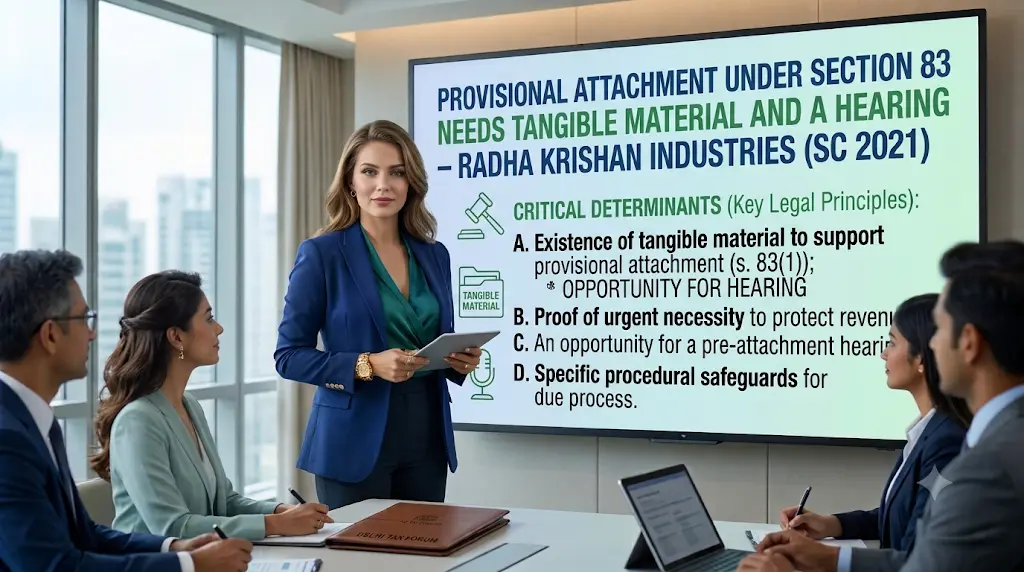
The power of provisional attachment under Section 83 is draconian, and its statutory conditions must be strictly fulfilled. The Commissioner must form an opinion, based on tangible material, that attachment is necessary to protect the government revenue. A proceeding under the specified provisions must be pending against the taxable person whose property is attached. Rule 159(5) entitles that person both to file objections and to be heard, and the Commissioner must decide the objections by a reasoned order. An order of provisional attachment passed by the Commissioner, or by an officer as the Commissioner’s delegate, is not appealable under Section 107(1), so a writ petition under Article 226 is maintainable.
Position After the Judgment: Section 83 Widened From 1 January 2022
Section 115 of the Finance Act, 2021 (13 of 2021) substituted Section 83(1) of the CGST Act. The substituted sub-section came into force on 1 January 2022, the date appointed by Notification No. 39/2021-Central Tax, dated 21 December 2021. It now reads that attachment may be ordered “after the initiation of any proceeding under Chapter XII, Chapter XIV or Chapter XV”, and it extends to property belonging to “the taxable person or any person specified in sub-section (1A) of section 122”.
- What has changed. The trigger is no longer limited to proceedings under six named sections; it covers any proceeding under the chapters on assessment (XII), inspection, search, seizure and arrest (XIV) and demands and recovery (XV). Property of a person specified in Section 122(1A), who retains the benefit of certain transactions covered by Section 122(1) and at whose instance they are conducted, may now also be attached. Section 122(1A) itself was in force from 1 January 2021, but Section 83 did not refer to it until 2022. The Court’s holding in para 68, that the proceeding must be pending against the person whose property is attached, must now be read with this extension.
- What still applies. The words “is of the opinion that for the purpose of protecting the interest of the Government revenue it is necessary so to do” are unchanged. The Court’s tests of necessity, tangible material, proportionality, a mandatory hearing under Rule 159(5) and a reasoned order therefore continue to govern every provisional attachment. A proceeding under the specified chapters must still have been initiated before the attachment.
 07 · Takeaways
Key Takeaways on Provisional Attachment Under GST
- Provisional attachment is valid only if it is necessary, not merely convenient. The Court held that the Commissioner’s opinion must rest on tangible material showing that the revenue cannot be protected without attachment. In practice: ask for the material and the file noting on which the opinion was formed, and challenge an order that records only the amount and the allegation.
- The hearing under Rule 159(5) is a right, not a favour. The Court held that objection and hearing are cumulative safeguards, and the objections must be decided by a reasoned order. In practice: file objections within seven days of the attachment and ask in writing for a personal hearing; a rejection without one is open to a writ.
- The taxpayer can object to the extent of the attachment and offer other security. The Court read these rights into Rule 159(5). In practice: show that the attachment exceeds the likely demand, or offer a bank guarantee or other property, and ask for the bank account or receivables to be released.
- The attachment must end when the final order is passed. The Court held that a provisional attachment cannot survive the order under Section 74(9), and that recovery is stayed once the pre-deposit under Section 107(6) is paid. In practice: after the final order, file the appeal with the pre-deposit and seek release of the attachment immediately.
- Since 1 January 2022, the power reaches further, but the safeguards remain. Section 83(1) now applies after the initiation of any proceeding under Chapters XII, XIV or XV and extends to persons covered by Section 122(1A). In practice: for an attachment made after that date, test it against the amended trigger, and continue to insist on necessity, tangible material, a hearing and a reasoned order.
Practitioner checklist: reviewing an order of provisional attachment
- Check that a proceeding under Chapter XII, XIV or XV was initiated before the date of the attachment order, and that the property belongs to the taxable person or to a person specified in Section 122(1A).
- Check that the order was passed by the Commissioner, or by an officer to whom the power was validly delegated.
- Check whether the order or file noting records tangible material showing that attachment is necessary to protect the revenue.
- File objections in writing within seven days under Rule 159(5), ask for a personal hearing, and offer alternative security where possible.
- Check whether one year has passed since the order, because the attachment then ceases under Section 83(2).
- Where an earlier attachment was withdrawn, check whether the new order records any change in circumstances (para 71).
- Once a final order is passed, seek release of the attachment and file the appeal with the pre-deposit under Section 107(6).
FAQs on Provisional Attachment Under Section 83 After Radha Krishan
Can the GST department attach a bank account before issuing a show cause notice?
Not unless a qualifying proceeding has already started. In Radha Krishan Industries (SC, 2021), the Supreme Court quashed an attachment made before the show cause notice because no proceeding was pending against the assessee. Since 1 January 2022, Section 83(1) applies after the initiation of any proceeding under Chapters XII, XIV or XV, which include inspection, search and seizure proceedings.
Is a personal hearing mandatory before objections to a provisional attachment are rejected?
Yes. The Supreme Court held that Rule 159(5) gives two cumulative rights, to file objections and to be heard, and that the Commissioner must decide the objections by a reasoned order.
Is a writ petition maintainable against an order of provisional attachment under GST?
Yes. The Court held that an order passed by the Commissioner, or by an officer as the Commissioner’s delegate, is not an order of an “adjudicating authority” and so is not appealable under Section 107(1). A writ petition under Article 226 is therefore the remedy.
Related Posts
10 · SourcesAuthoritative Sources
- Original judgment: Radha Krishan Industries v. State of Himachal Pradesh (SC, 2021), Civil Appeal No. 1155 of 2021 (Supreme Court of India, PDF)
- Statutory provisions: Sections 2(4), 5(3), 74, 83, 107 and 122(1A), CGST Act, 2017 (India Code: select the section); Rule 159, CGST Rules, 2017; Article 226 of the Constitution of India
- Amending Act: Section 115 of the Finance Act, 2021 (13 of 2021) (substitution of Section 83(1) of the CGST Act)
- Notification: Notification No. 39/2021-Central Tax, dated 21 December 2021 (Sections 108, 109 and 113 to 122 of the Finance Act, 2021 in force from 1 January 2022)
How to find this judgment on the Supreme Court website
On the Supreme Court of India website, open Case Status and use any one of three searches: Case Number (case type Civil Appeal, number 1155, year 2021), Diary Number (1775, year 2021) or Party Name (“Radha Krishan Industries”). Complete the security code. The judgment dated 20-04-2021 in M/s Radha Krishan Industries v. State of Himachal Pradesh & Ors. appears in the Judgment column. On the Digital SCR portal, search the party name “Radha Krishan Industries”: Civil Appeal No. 1155/2021, [2021] 3 SCR 406, 2021 INSC 266.
Editorial Note: This case law digest is intended for informational and educational purposes. Readers should consult the original judgment and applicable law before relying on the legal position for a specific matter.