GSTR-2A mismatch – Input tax credit (ITC) reversed because invoices did not appear in the supplier’s Form GSTR-1 – Purchaser held valid tax invoices, received the supply and paid the price and tax to the supplier – No enquiry against the supplier – Demand of ₹6,50,511 for 2017-18 set aside as arbitrary – Revenue must first proceed against the supplier; buyer’s ITC reversed only in exceptional cases – CBIC press releases of 4 May 2018 and 18 October 2018 – Arise India (Delhi HC) applied – Single Judge’s order relegating the appellant to appeal set aside – SLP dismissed (SC, 2023) given the small demand
Whether a purchaser’s ITC can be reversed only because the supplier did not report the invoices in Form GSTR-1, so that they did not appear in the purchaser’s Form GSTR-2A, when the purchaser holds valid tax invoices, received the supply and paid the tax to the supplier.
The intra-court appeal was allowed. The Single Judge’s order of 21 June 2023, which had relegated the assessee to a statutory appeal, was set aside, and the demand order dated 20 February 2023 was quashed. The authorities were directed to proceed first against the supplier, and against the assessee only in the exceptional circumstances described in the CBIC press release.
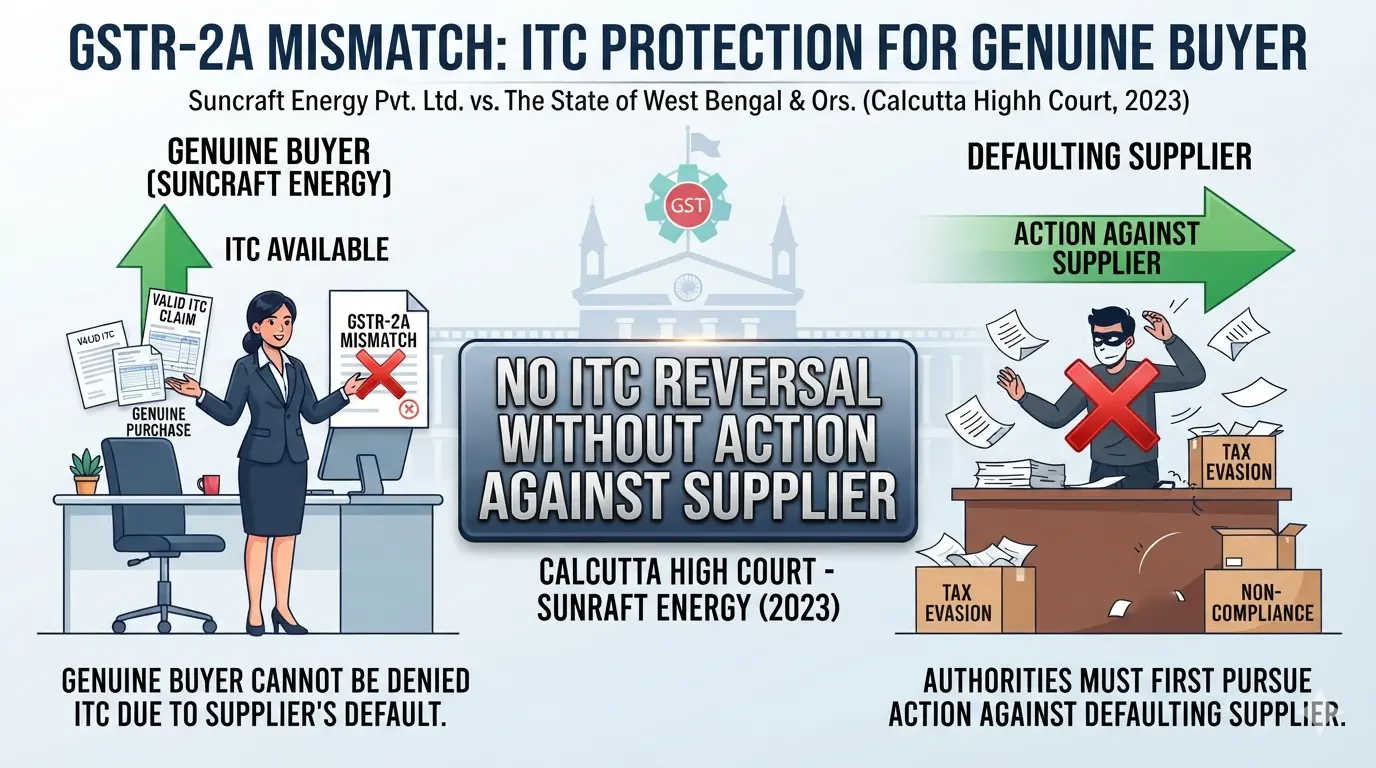
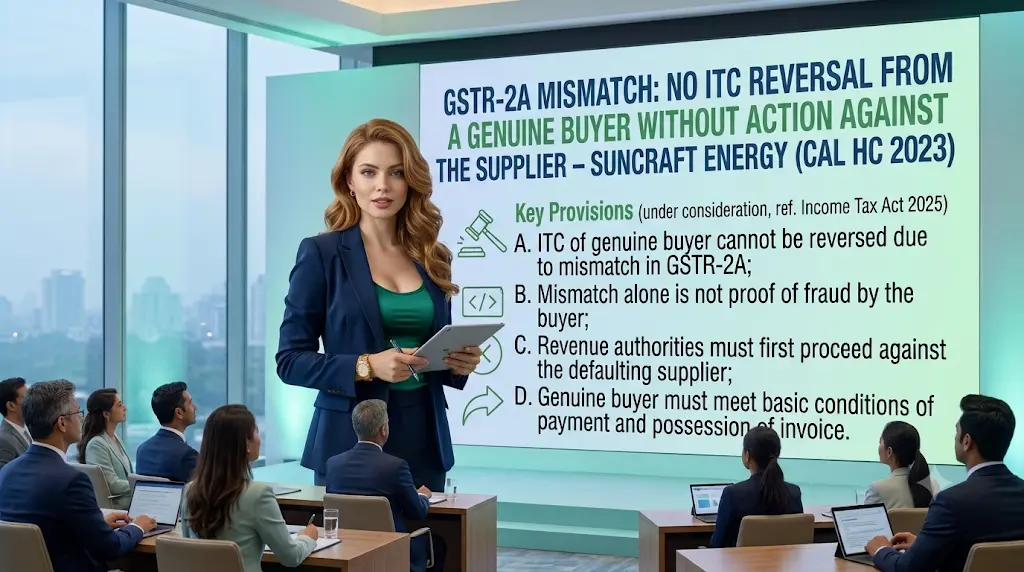
A purchaser’s ITC cannot be reversed merely because the supplier’s invoice does not appear in Form GSTR-2A, where the purchaser holds valid tax invoices, received the goods or services and paid the price with tax to the supplier. The tax authority must first proceed against the supplier, and may reverse the purchaser’s credit only in exceptional cases such as collusion, a missing supplier, closure of the supplier’s business or a supplier without adequate assets.
A leading High Court judgment on GSTR-2A mismatch demands for the early GST years. Since 1 January 2022, Section 16(2)(aa) makes the appearance of the supplier’s invoice details in the recipient’s statement a condition for ITC, so the judgment’s reasoning applies most directly to periods before that date.
| Case Name | Suncraft Energy Pvt. Ltd. & Anr. v. Assistant Commissioner, State Tax, Ballygunge Charge & Ors. (Cal HC, 2023) |
| Court | High Court at Calcutta (Civil Appellate Jurisdiction, Appellate Side, Division Bench) |
| Bench | T.S. Sivagnanam, CJ and Hiranmay Bhattacharyya, J. (judgment by T.S. Sivagnanam, CJ) |
| Case Number | MAT 1218 of 2023 with I.A. No. CAN 1 of 2023, arising out of WPA 12153 of 2023 |
| Judgment Date | 2 August 2023 (reserved on 21 July 2023) |
| Neutral Citation | 2023:CHC-AS:43758-DB |
| Arising From | Single Judge’s order dated 21 June 2023 in WPA 12153 of 2023; adjudication order dated 20 February 2023 of the Assistant Commissioner, State Tax, Ballygunge Charge |
| Relevant Provisions | Sections 16(2), 61 and 73 of the West Bengal Goods and Services Tax Act, 2017 (WBGST Act), which correspond to the same sections of the CGST Act, 2017; Forms GSTR-1, GSTR-2A and GSTR-3B |
| Period | Financial Year 2017-18 |
| Judgment Source | Judgment of the Calcutta High Court (PDF) · Download |
Facts of the Case: Suncraft Energy Pvt. Ltd. v. Assistant Commissioner, State Tax (Cal HC, 2023)
The concept in brief. Under GST, a supplier reports its sales invoices in Form GSTR-1. Those details then appear in the buyer’s Form GSTR-2A, an auto-drafted statement of purchases. The buyer claims ITC in its monthly return, Form GSTR-3B. When the ITC claimed in Form GSTR-3B is more than the ITC shown in Form GSTR-2A, tax officers often issue notices to reverse the difference. This “GSTR-2A mismatch” is one of the most common GST disputes for the early GST years.
- Suncraft Energy bought installation and commissioning services from a registered supplier (the fourth respondent). It paid the supplier the value of the supply along with the tax, and held valid tax invoices (paras 1 and 4).
- Some of the supplier’s invoices did not appear in Suncraft’s Form GSTR-2A for 2017-18, because the supplier had not reported them in Form GSTR-1 (paras 1 and 7).
- After a scrutiny of returns under Section 61, a notice dated 3 August 2022 and a show cause notice dated 6 December 2022 proposed to recover the excess ITC, based on the difference between Form GSTR-2A and Form GSTR-3B for purchases from that supplier. Suncraft replied to the notice on 24 August 2022 and to the show cause notice on 6 and 11 January 2023 (para 1).
- By order dated 20 February 2023, a demand of tax of ₹6,50,511 with interest and penalty was confirmed under Section 73. No enquiry or recovery was made against the supplier (paras 1 and 9).
- Suncraft’s writ petition was disposed of by a Single Judge on 21 June 2023, with a direction to file a statutory appeal within 15 days, which the appellate authority was to decide without rejecting it on limitation. Suncraft appealed to the Division Bench (para 1 of the judgment and the Single Judge’s order).
Question Before the Calcutta High Court on GSTR-2A Mismatch
Could the tax officer reverse Suncraft’s ITC, and demand the tax again, only because the supplier had not shown the invoices in Form GSTR-1, without first taking any action against the supplier who had collected the tax?
03 · SubmissionsArguments of the Assessee and the Revenue
Assessee’s Arguments
- Suncraft fulfilled every condition in Section 16(2): it held tax invoices, received the services, and paid the price and tax to the supplier within the time allowed (para 4).
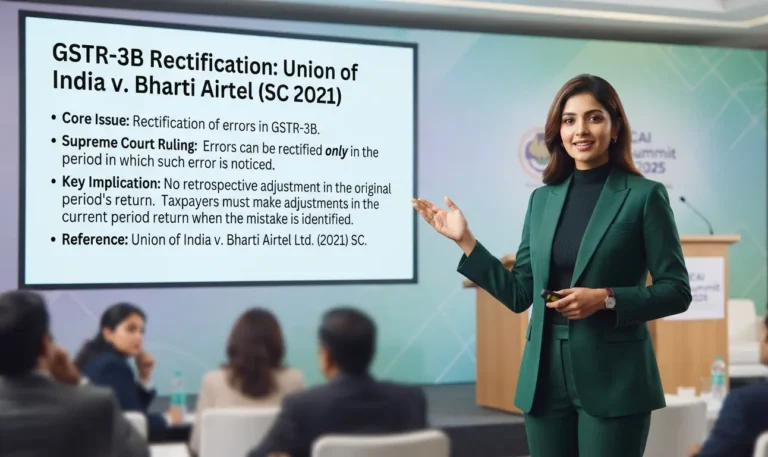
- Form GSTR-2A is only a facilitator for self-assessment, as the Supreme Court held in Union of India v. Bharti Airtel Ltd. (SC, 2021) (paras 4 and 6).
- CBIC’s press releases of 4 May 2018 and 18 October 2018 state that there is no automatic reversal of ITC from the buyer and that Form GSTR-2A does not affect ITC availed on self-assessment (paras 4 and 5).
Revenue’s Arguments
- The judgment does not record separate submissions for the State. The show cause notice alleged that, because the supplier had not shown the invoices in Form GSTR-1, the tax charged had not actually been paid to the Government, so the condition in Section 16(2)(c) was not met (para 7).
Calcutta High Court Decision on ITC Reversal for GSTR-2A Mismatch
The Calcutta High Court allowed the appeal, set aside the Single Judge’s order and quashed the demand of ₹6,50,511 for 2017-18. It noted that the show cause notice did not dispute that Suncraft held tax invoices or that it had received the services, and that Suncraft had proved payment of the price and tax to the supplier with invoices and bank statements. The officer had ignored that evidence and had taken no action against the supplier, contrary to CBIC’s press releases, which say that Form GSTR-2A is a taxpayer facilitation and that ITC is not to be reversed automatically from the buyer. The Court held this action arbitrary. It directed the authorities to proceed first against the supplier, and against Suncraft only in exceptional cases such as collusion, a missing supplier, closure of the supplier’s business or a supplier without adequate assets (paras 7 to 10).
The undisputed conditions of Section 16(2) were met
Section 16(2), as it applied to 2017-18, allowed ITC where the purchaser held a tax invoice, had received the supply, the tax had been paid to the Government, and the purchaser had filed its return (para 3). The show cause notice did not allege that Suncraft lacked a tax invoice, and there was no denial that it had received the services. Suncraft had produced the invoices and its bank statement to show payment of the price and tax to the supplier (paras 7 and 8).
Form GSTR-2A is a facilitation, not a condition
The Court relied on the CBIC press release of 18 October 2018, which clarified that furnishing details in Form GSTR-1 and viewing them in Form GSTR-2A “is in the nature of taxpayer facilitation” and does not affect the taxpayer’s ability to avail ITC on self-assessment. It also relied on the Supreme Court’s statement in Bharti Airtel (SC, 2021) that Form GSTR-2A is only a facilitator for self-assessment (paras 5 and 6).
No automatic reversal from the buyer
The CBIC press release of 4 May 2018 clarified that there shall be no automatic reversal of ITC from the buyer on non-payment of tax by the seller. Recovery is to be made from the seller, and reversal from the buyer is an option only for exceptional situations such as a missing dealer, closure of the supplier’s business or a supplier without adequate assets (paras 5 and 8).
The pre-GST principle in Arise India continues under GST
The Court followed Arise India Ltd. v. Commissioner of Trade and Taxes (Delhi HC, 2017), decided under the Delhi VAT Act. There, credit could not be denied to a purchasing dealer who had bona fide bought from a registered dealer against proper tax invoices; the remedy was to proceed against the defaulting seller, unless collusion was shown. The Revenue’s special leave petition against that judgment was dismissed on 10 January 2018. The Court held that the scheme of ITC “continues to remain the same” under GST, although procedures and forms have changed (para 6).
The officer’s action was arbitrary
The officer ignored the invoices and bank statement and did not act against the supplier. The Court held that action to be arbitrary. Unless the officer can show collusion between the buyer and supplier, or that the supplier is missing, has closed its business or lacks assets, the buyer cannot straight away be directed to reverse its ITC (para 9).
05 · Binding RuleRatio Decidendi: No ITC Reversal From a Bona Fide Buyer Without Action Against the Supplier
Where a purchaser holds valid tax invoices, has received the supply and has paid the price and tax to a registered supplier, its ITC cannot be reversed only because the supplier’s invoices are not reflected in Form GSTR-1 and Form GSTR-2A. The tax authority must first proceed against the supplier who collected the tax. The purchaser’s ITC may be reversed only in exceptional circumstances, such as collusion between the purchaser and the supplier, a missing supplier, closure of the supplier’s business or a supplier without adequate assets.
SLP dismissed. The State’s special leave petitions, SLP (C) Nos. 27827–27828 of 2023, were dismissed by the Supreme Court (B.V. Nagarathna and Ujjal Bhuyan, JJ.) on 14 December 2023 (read the order). The Court declined to interfere “having regard to the facts and circumstances of this case(s) and the extent of demand being on the lower side”. The dismissal gives no reasons on the legal question, so the law declared remains that of the Calcutta High Court.
TaxProof note. The judgment concerned 2017-18, before Section 16(2)(aa) was inserted. It relied on CBIC press releases and on a pre-GST VAT judgment, rather than on any provision of the GST Acts that expressly requires action against the supplier first.
Position After the Judgment: Section 16(2)(aa) From 1 January 2022
Section 16(2)(aa) of the CGST Act, inserted by Section 109 of the Finance Act, 2021 (13 of 2021) with effect from 1 January 2022, adds a further condition for ITC: the details of the invoice or debit note must have been furnished by the supplier in its statement of outward supplies and communicated to the recipient in the manner specified under Section 37.
- Periods up to 31 December 2021. The Section 16(2)(aa) condition did not exist, so Suncraft Energy applies directly to GSTR-2A mismatch demands for 1 July 2017 to 31 December 2021.
- Periods from 1 January 2022. Where the supplier has not reported the invoice, the recipient now fails a statutory condition for ITC. The argument that Form GSTR-2A is a mere facilitation is much weaker for these periods, although the principle that the Revenue should first proceed against a supplier who collected the tax can still be urged on the facts.
CBIC Circular for 2017-18 and 2018-19. Circular No. 183/15/2022-GST dated 27 December 2022, issued under Section 168(1), tells Central Tax officers how to deal with a difference between ITC in Form GSTR-3B and Form GSTR-2A for FY 2017-18 and 2018-19. It covers four situations: the supplier did not file Form GSTR-1; it left the supply out of Form GSTR-1; it reported the supply as B2C; or it used the wrong GSTIN of the recipient.
- What the officer verifies. The officer first asks for the invoices concerned and checks that the recipient holds the tax invoice, received the supply and paid the value and tax to the supplier, and also checks reversals under Sections 17 and 18 and the time limit in Section 16(4) (para 4).
- Proof that the supplier paid the tax. Where the difference for a supplier in the financial year exceeds ₹5 lakh, the recipient produces a certificate from a Chartered Accountant or Cost Accountant, with UDIN, that the supplies were made and the supplier paid the tax in Form GSTR-3B. Up to ₹5 lakh, a certificate from the supplier itself is enough (paras 4.1.1 and 4.1.2).
- Exception for 2017-18. The relaxation does not apply to ITC claimed in a Form GSTR-3B filed after the due date for September 2018 and up to the due date for March 2019, if the supplier had not reported the supply in Form GSTR-1 by the due date for March 2019 (para 4.2).
- Which cases it covers. It applies to ongoing scrutiny, audit and investigation proceedings, and to pending adjudication or appeal, for those two years. It does not reopen completed proceedings (para 6). It is clarificatory and “shall not be used in the interpretation of the provisions of law” (para 5).
The Circular is addressed to Central Tax officers. Suncraft’s demand was raised by a State Tax officer under the WBGST Act, so in a State Tax case check whether the State has issued a corresponding circular. The judgment does not refer to the Circular. On the figures in the judgment, a demand of ₹6,50,511 relating to one supplier for 2017-18 would fall in the band above ₹5 lakh, so a CA or CMA certificate would be the document the officer asks for. For pending 2017-18 and 2018-19 cases, the Circular and Suncraft Energy work together: the Circular gives the officer a route to accept the ITC, and the judgment supports the argument that the supplier should be pursued first.
Key Takeaways on GSTR-2A Mismatch and ITC Reversal
- A GSTR-2A mismatch alone does not justify reversing a genuine buyer’s ITC. The Court quashed a demand based only on the difference between Form GSTR-2A and Form GSTR-3B, where the buyer had invoices and proof of payment. In practice: in a reply to a mismatch notice for a period before 1 January 2022, file the tax invoices, proof of receipt and bank statements showing payment of tax to the supplier.
- The Revenue must first proceed against the supplier. The Court directed that recovery be made from the supplier who collected the tax, and from the buyer only in exceptional cases. In practice: ask the officer in writing to state what action has been taken against the supplier, and object if the order is silent on it.
- Exceptional cases still allow reversal from the buyer. The Court listed collusion, a missing supplier, closure of business and a supplier without adequate assets. In practice: collect evidence that the supplier is active and solvent, such as its registration status and filing history, to show that no exceptional case exists.
- The protection is strongest for periods before 1 January 2022. Section 16(2)(aa) now makes reporting by the supplier a condition for ITC. In practice: for current periods, reconcile purchases with the portal statement every month and follow up with suppliers before claiming ITC.
Practitioner checklist: replying to a GSTR-2A mismatch notice
- Identify the period: before 1 January 2022, or after Section 16(2)(aa) came into force.
- List each invoice in the mismatch, with the supplier’s GSTIN, date, taxable value and tax.
- Attach the tax invoices, proof of receipt of goods or services, and bank statements showing payment of the price and tax.
- Check the supplier’s registration status and return filing history on the GST portal.
- For FY 2017-18 and 2018-19, obtain the certificate required by Circular No. 183/15/2022-GST: from a CA or CMA, with UDIN, where the difference for a supplier exceeds ₹5 lakh in the year, or from the supplier where it is ₹5 lakh or less.
- Cite Suncraft Energy (Cal HC, 2023) and the CBIC press releases of 4 May 2018 and 18 October 2018, and ask for action against the supplier first.
- If an order confirms the demand without dealing with this evidence, challenge it in appeal, relying on Suncraft Energy.
FAQs on GSTR-2A Mismatch After Suncraft Energy
Can ITC be reversed only because the invoice is not in GSTR-2A?
Not for a genuine buyer, on the reasoning in Suncraft Energy (Cal HC, 2023). The Calcutta High Court quashed such a reversal for 2017-18, where the buyer held tax invoices, received the supply and paid the tax to the supplier, and directed the Revenue to proceed against the supplier first. The Supreme Court dismissed the State’s SLP on 14 December 2023, citing the facts and the small amount of the demand, without ruling on the legal question. For pending cases of 2017-18 and 2018-19, Circular No. 183/15/2022-GST also lets the officer accept the ITC on a CA or CMA certificate (difference above ₹5 lakh per supplier) or a supplier’s certificate (up to ₹5 lakh).
When can the department recover ITC from the buyer instead of the supplier?
Only in exceptional cases. The Court referred to collusion between the buyer and the supplier, a missing supplier, closure of the supplier’s business or a supplier without adequate assets, as described in the CBIC press release of 4 May 2018.
Does Suncraft Energy apply to ITC claimed after 1 January 2022?
Not fully. From 1 January 2022, Section 16(2)(aa) requires the supplier’s invoice details to be furnished and communicated to the recipient before ITC can be taken, so a missing invoice now fails a statutory condition. Suncraft Energy applies most directly to earlier periods.
Related Posts
10 · SourcesAuthoritative Sources
- Original judgment: Suncraft Energy Pvt. Ltd. v. Assistant Commissioner, State Tax, Ballygunge Charge (Cal HC, 2023), MAT 1218 of 2023, 2023:CHC-AS:43758-DB (Calcutta High Court, PDF) · Download the judgment
- Statutory provisions: Sections 16, 61 and 73, CGST Act, 2017 (India Code: select the section); corresponding sections of the WBGST Act, 2017
- SLP order: Assistant Commissioner of State Tax, Ballygunge Charge v. Suncraft Energy Pvt. Ltd. (SC, 2023), SLP (C) Nos. 27827–27828 of 2023, order dated 14 December 2023 (Supreme Court of India, PDF) · Download the order
- Circular: Circular No. 183/15/2022-GST dated 27 December 2022 (CBIC, PDF)
- Amending Act: Section 109 of the Finance Act, 2021 (13 of 2021), inserting Section 16(2)(aa) with effect from 1 January 2022
- Authorities relied on: Union of India v. Bharti Airtel Ltd. (SC, 2021); Arise India Ltd. v. Commissioner of Trade and Taxes (Delhi HC, 2017); CBIC press releases dated 4 May 2018 and 18 October 2018
How to find this judgment on the Calcutta High Court website
On eCourts High Court services, select Calcutta High Court and Appellate Side, then Court Orders → Party Name. Enter “Suncraft Energy” and year 2023, and complete the captcha. The judgment dated 02-08-2023 in MAT/1218/2023 appears in the list. Its neutral citation is 2023:CHC-AS:43758-DB.
Editorial Note: This case law digest is intended for informational and educational purposes. Readers should consult the original judgment and applicable law before relying on the legal position for a specific matter.