Section 2(15) general public utility – Charitable purpose – Proviso to Section 2(15) (w.e.f. 1 April 2009) – Trade, commerce or business for a cess, fee or other consideration – Predominant object test of Surat Art Silk discarded – Quantitative limit of 20% of total receipts – Cost-basis or nominal mark-up test
Whether, after the amendment of Section 2(15) by the Finance Act, 2008, an entity advancing an object of general public utility loses its charitable status if it carries on activities in the nature of trade, commerce or business for consideration.
Mixed. Urban development authorities, housing boards, improvement trusts, ICAI, the seed certification agencies, ERNET and NIXI succeeded; the Revenue’s appeals against GS1 India were allowed; the cricket associations’ and AEPC’s cases were remitted to the Assessing Officer; and the Tribune Trust’s appeal was dismissed.
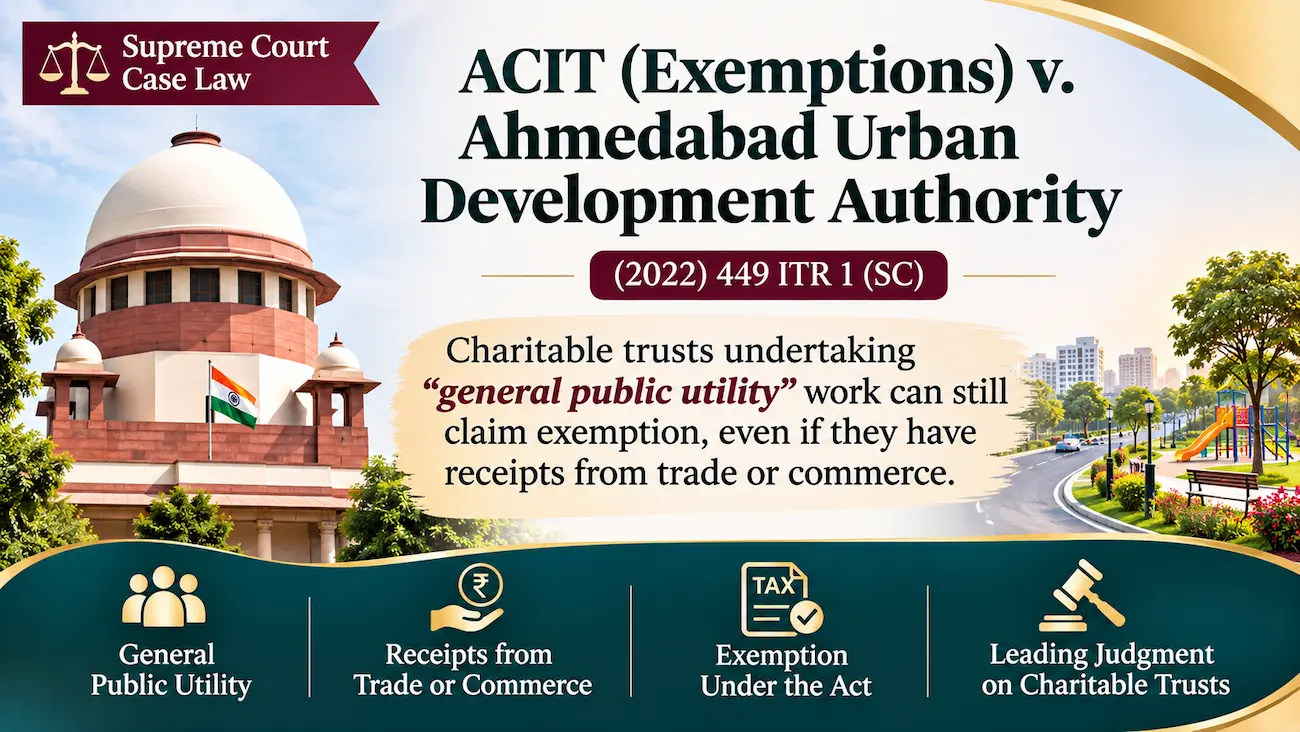
An entity advancing general public utility cannot carry on trade, commerce or business, or services in relation to them, for any consideration, except where the activity is undertaken in the actual course of achieving its object and the receipts from it do not exceed the quantitative limit (now 20% of total receipts). Charges on a cost basis or with only a nominal mark-up are not trade, commerce or business; charges markedly above cost are.
The controlling Supreme Court judgment on Section 2(15) general public utility after 2008. The same tests govern the conditions for commercial activity by GPU organisations in Section 346 of the Income-tax Act, 2025.
| Case Name | Assistant Commissioner of Income Tax (Exemptions) v. Ahmedabad Urban Development Authority (SC, 2022), with connected appeals |
| Court | Supreme Court of India (Civil Appellate Jurisdiction) |
| Bench | U.U. Lalit, CJI, S. Ravindra Bhat and P.S. Narasimha, JJ. (judgment by S. Ravindra Bhat, J.) |
| Case Number | Civil Appeal No. 21762 of 2017 and connected appeals |
| Judgment Date | 19 October 2022; clarified by order dated 3 November 2022 in M.A. No. 1849 of 2022, 2022 INSC 1155, [2022] 8 SCR 581 |
| Neutral Citation | 2022 INSC 1112 |
| Reported Citation | [2022] 15 SCR 899; (2022) 449 ITR 1 (SC) |
| Relevant Provision | Section 2(15) and its provisos, read with Sections 10(23C), 10(46), 11(4A) and 13(8), Income-tax Act, 1961 |
| Income-tax Act, 2025 | Section 2(23)(g) (general public utility as a charitable purpose); Section 346 (commercial activity by GPU organisations, including the 20% limit); Sections 344 and 345 (old Sections 11(4) and 11(4A)) |
| Assessment Year | Various assessment years in the lead and connected appeals |
| Judgment Source | Judgment dated 19.10.2022 (PDF) · Clarification order dated 03.11.2022 (PDF) |
Facts of the Case: ACIT v. Ahmedabad Urban Development Authority (SC, 2022)
The concept in brief. Section 2(15) defines “charitable purpose” to include relief of the poor, education, medical relief and other specified heads, and a residuary head: the “advancement of any other object of general public utility” (GPU). Only the GPU head carries a restriction on business. From 1 April 2009, a GPU entity is not charitable if it carries on trade, commerce or business, or renders services in relation to them, for a cess, fee or other consideration, unless the proviso is satisfied. The Section 2(15) general public utility question is how strictly this restriction applies.
- Under the 1961 Act as originally enacted, a GPU object qualified only if it did not involve “the carrying on of any activity for profit”. In Addl. CIT v. Surat Art Silk Cloth Manufacturers’ Association (SC, 1979), the Court held that what mattered was the predominant object, so that incidental profit-making did not defeat charitable status.
- The Finance Act, 2008 inserted the proviso to Section 2(15), with effect from 1 April 2009, and later amendments set a receipts limit of ₹10 lakh (from 2009), ₹25 lakh (from 2012) and then 20% of the total receipts of the year (from 1 April 2016), and required the activity to be in the course of the “actual carrying out” of the GPU object.
- A large batch of appeals came before the Court from several High Courts, involving six categories of entities: statutory corporations and authorities, statutory regulators, trade promotion bodies, non-statutory bodies performing public functions, sports associations and private trusts. Civil Appeal No. 21762 of 2017, the Revenue’s appeal against the Ahmedabad Urban Development Authority, was the lead matter.
- AUDA, set up under the Gujarat Town Planning and Urban Development Act, 1976, develops land and allots plots, with about 15% sold by public auction. Its revenue is kept in a statutory fund and audited by the State’s Accountant General. The Revenue contended that such receipts arose from activities in the nature of business, defeating exemption.
Question Before the Supreme Court on Section 2(15) General Public Utility
The Court had to interpret the amended definition of “charitable purpose” in Section 2(15) for GPU entities, read with Sections 10(23C), 10(46), 11(4A) and 13(8), and apply it to each category of assessee.
03 · SubmissionsArguments of the Assessee and the Revenue
Assessees’ Arguments
- Statutory bodies such as AUDA, GIDC and the Gujarat Housing Board carry on no business: their activities are fixed and regulated by statute, prices are controlled, and any surplus is retained in a statutory fund for further development, not distributed.
- Fees fixed by law for essential public services, and charges that only recover cost, are not consideration for trade or business.
- Regulators such as ICAI perform statutory functions in the public interest; coaching and other services are nominally priced and integral to their objects.
Revenue’s Arguments
- Parliament amended Section 2(15) to stop the abuse of the GPU head by entities carrying on large commercial activities while claiming to promote public utility.
- The restriction applies only to the GPU head, and any involvement in trade, commerce or business for consideration defeats exemption, whatever the use of the profit.
- Fees for services such as professional courses are services in relation to trade, commerce or business and fall within the proviso.
Supreme Court Decision and Reasoning
The Supreme Court disposed of the batch of appeals, partly in favour of each side, and held that, after the 2008 amendment, an entity advancing an object of general public utility cannot carry on any activity in the nature of trade, commerce or business, or render services in relation to them, for a cess, fee or other consideration, and that the predominant object test laid down in Surat Art Silk no longer applies to such entities. The prohibition is relaxed only by the proviso, whose two conditions must both be met: the activity must be undertaken in the actual course of achieving the GPU object, and the receipts from it must not exceed the quantitative limit, now 20% of the total receipts of the year. The Court further held that charging amounts on a cost basis or nominally above cost is not trade, commerce or business, and only charges markedly or significantly above cost bring the activity within the restriction. Applying this test, it held that statutory authorities performing public functions, such as AUDA, housing boards and improvement trusts, and statutory regulators such as ICAI, are prima facie not engaged in business, and decided their cases in their favour, while allowing the Revenue’s appeals against GS1 India, which earned significantly high receipts from services to trade, and remitting the cricket associations’ cases to the Assessing Officer. The Court directed that the assessing authorities must examine the records year by year to decide whether the receipts exceed cost with a nominal mark-up and, if so, whether the quantitative limit has been breached.
The predominant object test is discarded
Under Surat Art Silk, so long as the predominant object of a GPU entity was charitable, incidental profits from non-charitable activity were permissible if fed back into the object. The amended Section 2(15), in negative language, now bars a GPU entity from any activity in the nature of trade, commerce or business for consideration, so “the idea of a predominant object among several other objects, is discarded” (paras 152 and 153). The words “in the nature of” extend the bar to activities resembling business, and the word “irrespective” makes the application of the income irrelevant (paras 150 and 151).
The two limbs of the proviso are conjunctive
The proviso lets a GPU entity carry on such activity only if it is undertaken in the actual course of carrying out the GPU object and the receipts from it stay within the limit. Both conditions must be satisfied (para 153). Section 11(4A), which requires business to be incidental and separately accounted for, is read harmoniously with Section 2(15), and Section 13(8) and the related provisos reaffirm this reading (para 253, A.4).
Predominant object charitable · incidental profit allowed · profit to be applied to the object · no receipts limit
No trade, commerce or business for consideration · exception only if in actual course of the object and receipts ≤ 20% of total receipts · application of profit irrelevant
Cost basis or nominal mark-up is not business
The Court held that a charge on a cost basis or nominally above cost for an activity advancing GPU cannot be considered trade, commerce or business; only charges markedly or significantly above cost fall within “cess, or fee, or any other consideration” (para 253, A.3). If statutory rates for essential services such as water, food grains, medicines or road maintenance were treated as business receipts, the quantitative limit could be exceeded and the higher cost would pass to the public, defeating the GPU object (para 177).
Statutory authorities and regulators
Amounts charged by statutory corporations and boards for essentially public functions, such as housing, industrial development, water supply, town planning and food distribution, are prima facie not business receipts, consistent with the larger bench judgments in Ramtanu Co-operative Housing Society and NDMC. The Assessing Officer must still check whether charges are significantly above cost and a nominal mark-up (para 253, B.1 and B.2). Statutory regulators such as ICAI, which prescribe curriculum, examine and discipline professionals, are likewise prima facie not engaged in business, unless particular services are priced markedly above cost (para 253, C.1).
Exemption under Sections 10(46) and 10(23C) is independent
A body not covered by Section 10(20A) or Section 10(46) is not for that reason barred from claiming to be a GPU charity, as these provisions confer different though overlapping benefits (para 180). “Commercial” in Section 10(46)(b) has the same meaning as trade, commerce or business in Section 2(15), but Section 10(46) has no quantified limit, so the Central Government must decide case by case (para 253, B.3 and B.4).
Category-wise results
| Category | Entities | Result |
|---|---|---|
| Statutory authorities and corporations | AUDA and other development authorities, housing boards, improvement trusts, GIDC, Gujarat Maritime Board | Revenue’s appeals rejected |
| Statutory regulators and certifiers | ICAI; Rajasthan and Andhra Pradesh seed certification agencies | Decided for the assessees |
| Trade promotion body | AEPC | Remitted to the Assessing Officer |
| Non-statutory public bodies | ERNET and NIXI; GS1 India | ERNET and NIXI for the assessees; GS1 India for the Revenue |
| Sports associations | Gujarat, Saurashtra, Baroda, Rajkot and Rajasthan cricket associations | Remitted to the Assessing Officer |
| Private trusts | Tribune Trust (advertisement income) | Assessee’s appeal dismissed |
The clarification order of 3 November 2022
On the Revenue’s application seeking liberty to redo past assessments, the Court clarified that its conclusions apply to the assessment years before it, and where the appeals were decided against the Revenue, they are final. For years the Court was not called upon to decide, the authorities must apply the law declared, having regard to the facts of each year. No further clarification was given (M.A. No. 1849 of 2022, paras 4 to 6).
Reading the cost-basis test in practice (TaxProof analysis)
The judgment gives no percentage for a “nominal mark-up”, and the Court leaves it to year-by-year scrutiny of the records. That makes the entity’s own activity-wise cost data, not its objects clause, the decisive evidence. Conversely, GS1 India, which issues barcodes to businesses, lost because its services were for trade and commerce, its fee receipts were significantly high, and it produced no figures to show cost-based charging (para 217), even though the Court accepted that its functions were of general public utility.
05 · Binding RuleRatio Decidendi: No Business for Consideration Beyond the 20% Proviso
After 1 April 2009, an entity whose charitable purpose is the advancement of an object of general public utility is not charitable if it carries on any activity in the nature of trade, commerce or business, or renders any service in relation to them, for a cess, fee or other consideration, irrespective of how the income is applied, unless the activity is undertaken in the actual course of achieving the object and the receipts from it do not exceed the quantitative limit in the proviso. Amounts charged on a cost basis or nominally above cost are not consideration for trade, commerce or business; whether charges are significantly above cost is to be decided on the records of each year.
Position Under the Income-tax Act, 2025 (Sections 2(23), 344 to 346 and 351)
Section 2(23) of the Income-tax Act, 2025 defines “charitable purpose” to include relief of the poor, education, yoga, medical relief, preservation of environment, preservation of monuments and, in clause (g), “the advancement of any other object of general public utility”. Unlike Section 2(15) of the 1961 Act, the definition itself no longer carries the restriction on trade, commerce or business.
The restriction now sits in the provisions on commercial activities by registered non-profit organisations. Under Section 346, an organisation carrying out the advancement of any other object of general public utility shall not carry out any commercial activity unless (a) it is undertaken in the course of actual carrying out of the GPU object, (b) the aggregate receipts from such activities do not exceed 20% of the total receipts of the relevant tax year, and (c) separate books of account are maintained. Other registered non-profit organisations are governed by Section 345, which permits commercial activity only if it is incidental to their objectives and separate books are kept (the old Section 11(4A)), and Section 344 empowers the Assessing Officer to determine the income of a business undertaking held as property (the old Section 11(4)).
AUDA continues to govern what counts as such activity: charges on a cost basis or with a nominal mark-up are not trade, commerce or business, and the conditions are cumulative. The change is in where the rule is placed, the use of the term “commercial activity”, the express requirement of separate books in Section 346(c), and the consequences of a breach. Since 1 April 2026, a contravention of Section 346 is no longer a “specified violation” under Section 351(1)(b), the words “or 346” having been omitted by Act No. 4 of 2026, so a breach of the GPU conditions does not by itself expose the organisation to cancellation of registration under Section 351(2); a contravention of Section 345 by other organisations still does.
 07 · Takeaways
Key Takeaways on Section 2(15) General Public Utility
- The objects clause no longer protects you. A charitable predominant object does not save a GPU entity that carries on business for consideration. The test is what the entity actually does and charges each year.
- Maintain activity-wise cost records. Charges at cost or with a nominal mark-up are not business. Keep costing for each fee-based service so you can show this to the Assessing Officer.
- Monitor the 20% limit every year. Where some activity is business-like, track its receipts against 20% of total receipts and keep separate books, since both limbs of the exception must be met.
- Statutory bodies start with a presumption, not an exemption. Development authorities and regulators are prima facie not in business, but the Assessing Officer can still examine whether charges are significantly above cost.
- Each year is decided on its own facts. The clarification order confirms that later years are assessed by applying the law declared to that year’s records, so a favourable result for one year does not settle the next.
Related Posts
09 · SourcesAuthoritative Sources
- Original judgment: ACIT (Exemptions) v. Ahmedabad Urban Development Authority (SC, 2022), Civil Appeal No. 21762 of 2017 (Supreme Court of India, PDF)
- Clarification order: M.A. No. 1849 of 2022 in Civil Appeal No. 21762 of 2017, order dated 3 November 2022, 2022 INSC 1155 (PDF)
- Statutory provisions: Section 2(23), Income-tax Act, 2025 · Section 344 · Section 345 · Section 346 · Section 351, Income-tax Act, 2025 (Income Tax Department)
- Authorities referred to: Addl. CIT v. Surat Art Silk Cloth Manufacturers’ Association (SC, 1979) · Indian Chamber of Commerce v. CIT (SC, 1975) · Lok Shikshana Trust v. CIT (SC, 1975) · Thanthi Trust v. CIT (SC, 2001) · Gujarat Maritime Board v. CIT (SC, 2007) · Ramtanu Co-operative Housing Society v. State of Maharashtra (SC, 1970) · NDMC v. State of Punjab (SC, 1996)
How to find this judgment on the Supreme Court website
On the Supreme Court of India website, go to Case Status → Diary Number, enter 37657 and year 2017, and complete the security code. The judgment dated 19-10-2022 in Assistant Commissioner of Income Tax (Exemptions) v. Ahmedabad Urban Development Authority appears in the Judgment column, and the clarification order dated 03-11-2022 is listed under the same case. Both can also be found on the Digital SCR portal by searching the party name “Ahmedabad Urban Development”: the judgment at [2022] 15 SCR 899, 2022 INSC 1112, and the clarification order at [2022] 8 SCR 581, 2022 INSC 1155.
Editorial Note: This case law digest is intended for informational and educational purposes. Readers should consult the original judgment and applicable law before relying on the legal position for a specific matter.