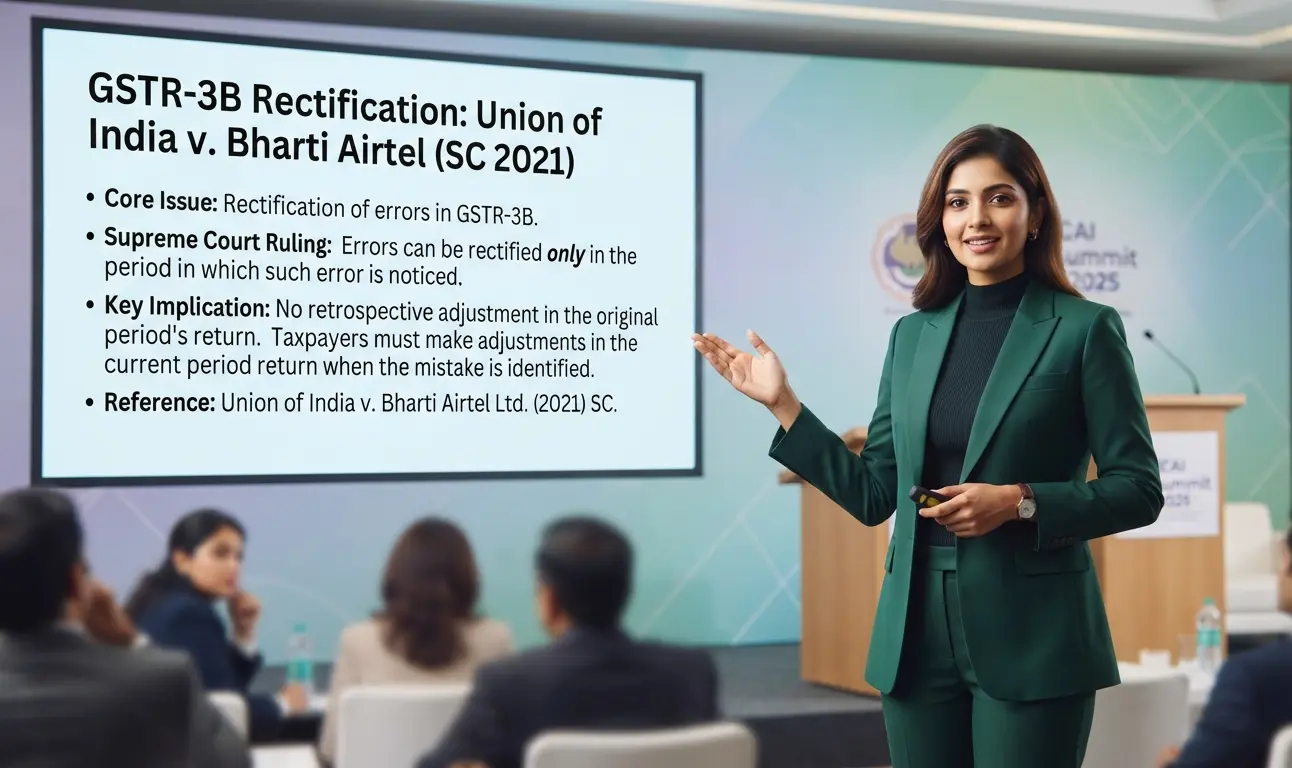
GSTR-3B rectification – Form GSTR-3B is a return under Section 39 – Errors to be rectified only in the return for the period in which they are noticed, under Section 39(9) as it then stood – Self-assessment of input tax credit (ITC) and output tax liability rests on the taxpayer’s own books, not on Form GSTR-2A – Choice to pay output tax in cash cannot later be reversed – No swapping of electronic cash ledger and electronic credit ledger entries – Paragraph 4 of Circular No. 26/26/2017-GST upheld – Delhi High Court reversed
Whether a registered person can rectify Form GSTR-3B for the very months in which an error occurred (July to September 2017), so as to use ITC in place of output tax already paid in cash, or whether rectification is allowed only in the return for the period in which the error is noticed under Section 39(9) of the CGST Act.
The Union of India’s appeal was allowed. The Delhi High Court’s judgment of 5 May 2020, which had read down paragraph 4 of Circular No. 26/26/2017-GST and allowed Bharti Airtel to rectify its returns for July to September 2017, was set aside, and the writ petition was dismissed.
Under Section 39(9) as it applied to July to September 2017, an error in Form GSTR-3B could be rectified only in the return for the month or quarter in which the error was noticed, and not by amending the return for the period to which the error related. A taxpayer who chooses to pay output tax in cash cannot later swap that payment for ITC, because the Act provides no mechanism to switch entries between the electronic cash ledger and the electronic credit ledger.
The leading Supreme Court judgment on GSTR-3B rectification. It settles that Form GSTR-3B is a return for all purposes, that portal glitches do not excuse self-assessment from the taxpayer’s own records, and that the mode of paying tax, once chosen, is final. Section 39(9) has since been amended to require rectification “in such form and manner as may be prescribed”, with a time limit of 30 November following the end of the financial year.
| Case Name | Union of India v. Bharti Airtel Ltd. & Ors. (SC, 2021) |
| Court | Supreme Court of India (Civil Appellate Jurisdiction) |
| Bench | A.M. Khanwilkar and Dinesh Maheshwari, JJ. (judgment by A.M. Khanwilkar, J.) |
| Case Number | Civil Appeal No. 6520 of 2021 (arising out of SLP (C) No. 8654 of 2020) |
| Judgment Date | 28 October 2021 |
| Neutral Citation | 2021 INSC 684 |
| Reported Citation | [2021] 10 SCR 825 |
| Arising From | Delhi High Court, W.P. (C) No. 6345 of 2018, judgment dated 5 May 2020 |
| Relevant Provisions | Sections 2(46), 16, 37, 38, 39(9), 41, 49, 59 and 168(1) of the CGST Act, 2017; Rule 61(5) of the CGST Rules, 2017; Circular No. 26/26/2017-GST dated 29 December 2017 (paragraph 4) |
| Period | July to September 2017 |
| Judgment Source | Official judgment, Supreme Court of India (PDF) |
Facts of the Case: Union of India v. Bharti Airtel Ltd. (SC, 2021)
The concept in brief. The CGST Act, as enacted, planned a system of matched invoices: suppliers would file Form GSTR-1, recipients would see those details in Form GSTR-2A and confirm them in Form GSTR-2, and Form GSTR-3 would be generated from both. When that system could not start on 1 July 2017, the Government introduced Form GSTR-3B, a summary self-assessed return, as a stop-gap. Section 39(9), as it stood in 2017, allowed a registered person to correct an omission or incorrect particulars in a return, but only in the return for the period in which the error was noticed.
- Bharti Airtel filed its Form GSTR-3B returns for July, August and September 2017 on 31 August, 20 September and 16 October 2017 (paras 6 and 8).
- Circular No. 7/7/2017-GST dated 1 September 2017 had said that errors in Form GSTR-3B could be corrected through Forms GSTR-1 and GSTR-2 of the same month. Circular No. 26/26/2017-GST dated 29 December 2017 kept that circular in abeyance, and its paragraph 4 said that differences for past months should be reported in the current month’s return (paras 7, 10 and 11).
- Form GSTR-2A became operational only in September 2018. Bharti Airtel then said it realised it had enough ITC for July to September 2017, but had paid output tax in cash, an excess cash payment of about ₹923 crore (paras 13 and 16).
- It sought to rectify the July to September 2017 returns so that the cash paid would return to its electronic cash ledger. The Delhi High Court read down paragraph 4 of the Circular and allowed that rectification on 5 May 2020 (paras 16 and 17).
- During the writ proceedings, Notification No. 49/2019-Central Tax dated 9 October 2019 substituted Rule 61(5) from 1 July 2017, providing that a person who files Form GSTR-3B need not file Form GSTR-3. Its validity was not challenged (para 14).
Question Before the Supreme Court on GSTR-3B Rectification
The central question was whether paragraph 4 of Circular No. 26/26/2017-GST, which allows errors in Form GSTR-3B to be corrected only in the current month’s return, conflicts with the CGST Act, and whether a taxpayer can rectify the return for the very months in which an error occurred to replace a cash payment with ITC (paras 32 and 37).
03 · SubmissionsArguments of the Revenue and the Assessee
Assessee’s Arguments
- Form GSTR-3B was only a stop-gap. Section 39(9) is tied to the matching process under Sections 37 and 38, which never operated, so it does not apply to Form GSTR-3B (para 26).
- The Department cannot benefit from its own failure to operationalise Forms GSTR-2 and GSTR-3, which forced taxpayers to pay in cash despite available ITC (para 27).
- Only after Form GSTR-2A became available in September 2018 did complete data for July to September 2017 become known. Denying rectification amounts to collecting tax twice (paras 25 and 28).
Revenue’s Arguments
- Every registered person must self-assess output tax and ITC from its own books and records. The common portal is only an enabler, and its malfunction does not displace that duty (paras 20 to 22).
- Section 39(9) expressly provides that errors are rectified in the return for the period in which they are noticed (para 22).
- Paying output tax in cash or through ITC is the taxpayer’s own option, and the Act has no mechanism to swap cash ledger and credit ledger entries afterwards. Allowing it would cause a “chaotic situation” in tax administration (para 24).
Supreme Court Decision on GSTR-3B Rectification
The Supreme Court allowed the Union of India’s appeal, set aside the Delhi High Court’s judgment and dismissed Bharti Airtel’s writ petition. It first rejected the objections to jurisdiction and held that the Circular was validly issued, because it notified decisions of the Board under Section 168(1). On the merits, it held that a registered person must self-assess its ITC and output tax from its own books and records, and is not dependent on auto-populated data on the common portal. Non-operation of Form GSTR-2A was therefore a “flimsy plea”. Form GSTR-3B is a return under Section 39, and Section 39(9), as it then stood, permitted rectification only in the return for the month or quarter in which the error was noticed. Paragraph 4 of the Circular restates that rule and does not conflict with the Act. Bharti Airtel had chosen to pay output tax of about ₹923 crore in cash, and that choice could not be reversed by swapping cash ledger and credit ledger entries, which the Act does not permit (paras 30 to 52).
Self-assessment rests on the taxpayer’s own records, not on the portal
The Court held that the High Court had not asked the “cardinal question”: whether the taxpayer was wholly dependent on auto-generated portal data to pay its output tax. The answer was “an emphatic No” (para 32). A registered person must maintain books of account and records under Chapter VII of the CGST Rules, and those agreements, invoices and books are the primary source for self-assessment. The common portal is “only a facilitator” (para 33). Self-assessment of ITC under Sections 16 and 41 and of tax under Section 59 is done by the taxpayer, and the role of the tax authorities arises only at verification (paras 33 to 35). Non-operation of Form GSTR-2A was therefore “a feeble excuse” (para 36).
Form GSTR-3B is a return, and Section 39(9) governs its rectification
The Court rejected the argument that Form GSTR-3B fell outside Section 39(9). Form GSTR-3B is prescribed as a return under Section 39 read with Rule 61, and it remains a return “for all purposes” although filed as a stop-gap (paras 39 and 40). The Court disagreed with the Gujarat High Court in AAP & Co. v. Union of India, which had treated Form GSTR-3B as only a temporary arrangement (para 41).
The Circular restates Section 39(9) and needs no reading down
Reading down paragraph 4 of the Circular would arise only if it conflicted with the Act. Section 39(9), as it then stood, said that an omission or incorrect particulars could be corrected in the return for the month or quarter in which they were noticed, and the Circular restates that position. The High Court was wrong to hold that no provision restricts rectification to the period in which the error is noticed (paras 37 and 50).
The choice to pay in cash cannot be reversed by swapping ledgers
Paying output tax in cash or by using ITC is “a matter of option”. Once exercised, it cannot be reversed unless the Act and Rules permit reversal or swapping of entries, and they do not (para 37). Bharti Airtel, with full knowledge from its own books, chose to pay in cash and could not “resile from the legal option already exercised” (para 38).
The ITC is postponed, not denied
The Court stressed that the taxpayer is not denied ITC. The credit “remains intact in the electronic credit ledger” and can be used in subsequent returns, including in the next financial year, so the effect is “only a postponement of availment of ITC” (para 47). Unilateral changes to past returns would also have a cascading effect on suppliers and recipients (para 48).
High Court decisions on portal glitches did not help the assessee
The Delhi High Court had relied on decisions that granted relief for technical failures, such as Adfert Technologies (P&H HC) on TRAN-1 filing and Panduranga Stone Crushers (AP HC) on ITC reported in the wrong column. The Court held that these decisions did not affect its conclusion. Inability to access the portal to file a return in time is “entirely different” from a claim to adjust tax already paid voluntarily in cash (paras 42 to 46).
05 · Binding RuleRatio Decidendi: GSTR-3B Errors Are Rectified Only in the Period They Are Noticed
Form GSTR-3B is a return under Section 39 of the CGST Act read with Rule 61. Under Section 39(9) as it stood for July to September 2017, an omission or incorrect particulars in it could be rectified only in the return for the month or quarter in which the error was noticed, and not in the return for the period to which it related. A registered person self-assesses ITC and output tax from its own books and records, and the non-availability of Form GSTR-2A does not excuse that duty. The choice to discharge output tax in cash is the taxpayer’s option and cannot be reversed by swapping entries between the electronic cash ledger and the electronic credit ledger. Paragraph 4 of Circular No. 26/26/2017-GST is consistent with the Act.
Position After the Judgment: Section 39(9) Amended
The Court applied Section 39(9) in its original form, because the dispute concerned July to September 2017. The provision has since been amended in three ways.
- Manner of rectification (from 1 February 2019). Section 17 of the Central Goods and Services Tax (Amendment) Act, 2018 (31 of 2018) replaced the words “in the return to be furnished for the month or quarter during which such omission or incorrect particulars are noticed” with “in such form and manner as may be prescribed”. The statute itself no longer fixes the return in which a correction is made; that is now left to the Rules.
- Link to Sections 37 and 38 removed (from 1 October 2022). Section 105 of the Finance Act, 2022 (Act 6 of 2022) replaced the opening words “Subject to the provisions of sections 37 and 38, if” with “Where”.
- Longer time limit (from 1 October 2022). Under the proviso, as amended by Section 105 of the Finance Act, 2022, no rectification is allowed after the thirtieth day of November following the end of the financial year to which the details pertain, or the actual date of furnishing the annual return, whichever is earlier.
What still applies. The Court’s holdings that Form GSTR-3B is a return, that self-assessment rests on the taxpayer’s own books, and that a cash payment of output tax cannot be swapped for ITC are unaffected; the CGST Act still contains no provision for such a swap. Separately, Section 16(2)(aa), inserted by Section 109 of the Finance Act, 2021 from 1 January 2022, now allows ITC only where the supplier has furnished the invoice details and they have been communicated to the recipient under Section 37. Portal data therefore matters more for ITC eligibility than it did in 2017, but the duty to self-assess from one’s own records is unchanged.
Bona fide clerical errors: Aberdare Technologies (SC, 2025) (TaxProof analysis). On 21 March 2025, the Supreme Court dismissed the Revenue’s special leave petition in Central Board of Indirect Taxes and Customs v. Aberdare Technologies Pvt. Ltd. (SLP (C) Diary No. 6332 of 2025; read the order), against a Bombay High Court judgment dated 29 July 2024. The Court called that judgment “just and fair, as there is no loss of revenue”. It observed that the right to correct clerical or arithmetical errors flows from the right to do business, that a software limitation is not a good justification for denying correction, and that the Board must re-examine the timelines for correcting bona fide errors. The order does not refer to Bharti Airtel, and it is an order dismissing a special leave petition, not a judgment on appeal. The two can be read together: Bharti Airtel bars a taxpayer from reversing its own choice to pay in cash, while Aberdare Technologies concerns genuine clerical or arithmetical mistakes where the Revenue loses nothing.
 07 · Takeaways
Key Takeaways on GSTR-3B Rectification
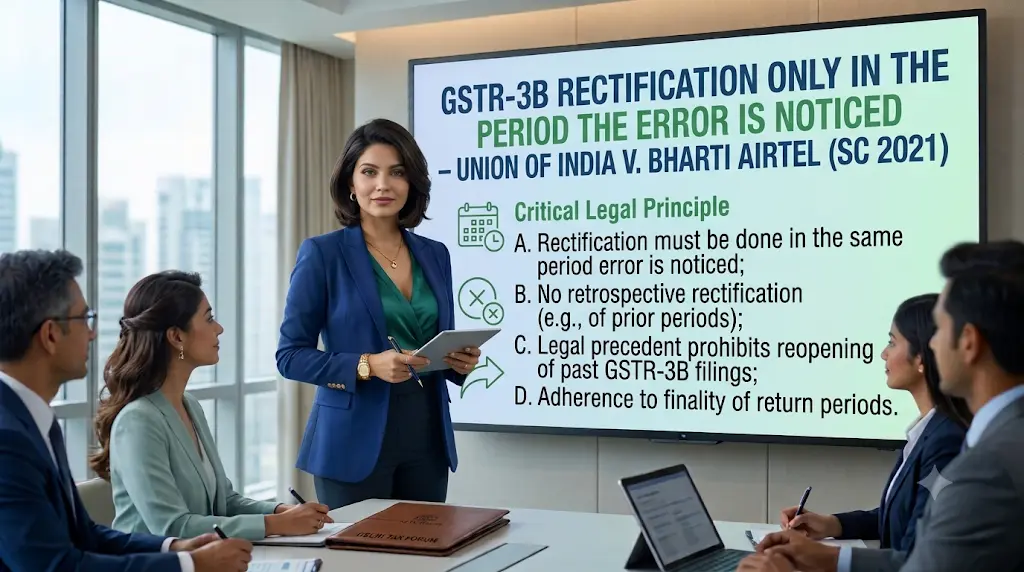
- Errors in Form GSTR-3B are corrected going forward, not by reopening past returns. The Court held that Section 39(9), as it then stood, allowed rectification only in the return for the period in which the error was noticed, and upheld paragraph 4 of the Circular on that basis. In practice: report a missed ITC claim or a missed liability in a later Form GSTR-3B, in the manner now prescribed, and within the time limit of 30 November following the end of the financial year or the annual return date, whichever is earlier.
- Paying tax in cash is a final choice. The Court held that a taxpayer who pays output tax in cash cannot later swap that payment for ITC. In practice: before filing Form GSTR-3B, check the electronic credit ledger and decide the payment mode deliberately, because cash paid in place of available ITC cannot be recovered by rectification.
- Portal problems do not excuse self-assessment. The Court held that the taxpayer’s own books and records, not Form GSTR-2A, are the primary basis for ITC and tax. In practice: reconcile purchase registers with supplier invoices and with the portal statement every month before filing. Since 1 January 2022, Section 16(2)(aa) also requires that the supplier’s invoice details have been communicated to you before ITC is taken.
- Unused ITC stays in the credit ledger. The Court described the result as a postponement of ITC, not a denial, because the credit remains available for later returns. In practice: where credit was left unclaimed, use it against output tax in later periods instead of seeking to reopen old returns.
- Circulars that restate the Act will be upheld. The Court held that a CBIC circular issued under Section 168(1) is valid where it restates the statutory position. In practice: when challenging a circular, show a real conflict with the Act or Rules; hardship alone will not succeed.
Practitioner checklist: correcting an error in Form GSTR-3B
- Identify the error and the month or quarter in which it was noticed.
- Report the correction in a later Form GSTR-3B, in the form and manner prescribed, not by trying to reopen the return for the original period.
- Check that the correction is made by 30 November following the end of the financial year, or before the annual return is filed, whichever is earlier (proviso to Section 39(9)).
- Pay interest on any additional output tax, as Section 39(9) requires.
- Do not ask to convert a past cash payment into ITC; the Court held that no such mechanism exists.
- For a genuine clerical or arithmetical error found after the time limit, with no loss of revenue, consider seeking relief on the basis of Aberdare Technologies (SC, 2025).
FAQs on GSTR-3B Rectification After Bharti Airtel
Can a GSTR-3B return be revised for an earlier month?
No. In Bharti Airtel (SC, 2021), the Supreme Court held that an error in Form GSTR-3B could be rectified only in the return for the month or quarter in which it was noticed, under Section 39(9), and not by revising the return of the earlier month. Since 1 February 2019, Section 39(9) requires rectification in the form and manner prescribed, but it still provides no route to reopen a filed return to swap a cash payment for ITC.
Can output tax paid in cash be converted into ITC later?
No. The Court held that paying tax in cash or through ITC is the taxpayer’s option, and the CGST Act has no mechanism to swap entries between the electronic cash ledger and the electronic credit ledger. The unused ITC remains in the credit ledger for later use.
What is the time limit to rectify an error in GSTR-3B?
Under the proviso to Section 39(9), as amended by Section 105 of the Finance Act, 2022 from 1 October 2022, no rectification is allowed after 30 November following the end of the financial year to which the details pertain, or the actual date of filing the annual return, whichever is earlier. For a bona fide clerical or arithmetical error with no loss of revenue, the Supreme Court in Aberdare Technologies (SC, 2025) declined to interfere with a High Court judgment in the taxpayer’s favour.
Related Posts
10 · SourcesAuthoritative Sources
- Original judgment: Union of India v. Bharti Airtel Ltd. (SC, 2021), Civil Appeal No. 6520 of 2021 (Supreme Court of India, PDF)
- Statutory provisions: Sections 2(46), 16, 39, 41, 49, 59 and 168, CGST Act, 2017 (India Code: select the section); Rule 61, CGST Rules, 2017
- Later order: Central Board of Indirect Taxes and Customs v. Aberdare Technologies Pvt. Ltd. (SC, 2025), SLP (C) Diary No. 6332 of 2025, order dated 21 March 2025 (Supreme Court of India, PDF) · Download the order
How to find this judgment on the Supreme Court website
On the Supreme Court of India website, open Case Status and use any one of three searches: Case Number (case type Civil Appeal, number 6520, year 2021), Diary Number (13465, year 2020) or Party Name (“Bharti Airtel”). Complete the security code. The judgment dated 28-10-2021 in Union of India v. Bharti Airtel Ltd. & Ors. appears in the Judgment column. On the Digital SCR portal, search the party name “Bharti Airtel”: Civil Appeal No. 6520/2021, [2021] 10 SCR 825, 2021 INSC 684.
Editorial Note: This case law digest is intended for informational and educational purposes. Readers should consult the original judgment and applicable law before relying on the legal position for a specific matter.