

IGST on ocean freight – Import of goods on CIF basis – Freight paid by the foreign seller to a foreign shipping line – Reverse charge on the Indian importer under Notifications 8/2017 and 10/2017-Integrated Tax (Rate) – Composite supply under Sections 2(30) and 8 of the CGST Act – Separate levy on the service element struck down – GST Council recommendations under Article 279A – Persuasive value
Whether an Indian importer who buys goods on a CIF basis can be made liable, on a reverse charge basis, to pay IGST on the ocean freight that the foreign seller pays to a foreign shipping line, when IGST is already paid at import on the value of the goods, which includes that freight.
The Union of India’s appeals were dismissed. The Gujarat High Court’s judgment of 23 January 2020, which had struck down the levy of IGST on ocean freight in the hands of importers, was upheld.
In a CIF contract, the supply of goods and the supply of transportation and insurance services form one composite supply by the foreign exporter to the Indian importer. IGST is payable on that composite supply at the time of import. A separate levy of IGST on the transportation service, in the hands of the same importer, violates Section 8 read with Section 2(30) of the CGST Act and the scheme of GST.
The leading Supreme Court authority on composite supply and on the legal status of GST Council recommendations. The Court held that the recommendations are not binding on Parliament and the State Legislatures when they enact law, although the Government is bound by them when it makes rules under the GST Acts.
| Case Name | Union of India & Anr. v. M/s Mohit Minerals Pvt. Ltd. Through Director (SC, 2022), with connected appeals |
| Court | Supreme Court of India (Civil Appellate Jurisdiction) |
| Bench | Dr D.Y. Chandrachud, Surya Kant and Vikram Nath, JJ. (judgment by Dr D.Y. Chandrachud, J.) |
| Case Number | Civil Appeal No. 1390 of 2022 and connected appeals |
| Judgment Date | 19 May 2022 |
| Neutral Citation | 2022 INSC 596 |
| Reported Citation | [2022] 9 SCR 300 |
| Arising From | Gujarat High Court, Division Bench judgment dated 23 January 2020 |
| Relevant Provisions | Sections 5(1), 5(3), 5(4) and 13(9), IGST Act, 2017; Sections 2(30), 2(93) and 8, CGST Act, 2017; Articles 246A, 269A and 279A of the Constitution; Entry 9 of Notification No. 8/2017-Integrated Tax (Rate) and Serial No. 10 of Notification No. 10/2017-Integrated Tax (Rate), both dated 28 June 2017 |
| Period | From 1 July 2017 |
| Judgment Source | Official judgment, Supreme Court of India (PDF) |
Facts of the Case: Union of India v. Mohit Minerals Pvt. Ltd. (SC, 2022)
The concept in brief. Under a CIF (cost, insurance and freight) contract, the foreign seller arranges and pays for shipping and insurance, and the price paid by the Indian buyer includes them. At import, customs duty and IGST are charged on the value of the imported goods, which includes the CIF price, so freight is already taxed as part of the goods. A composite supply is a supply of two or more goods or services that are naturally bundled, with one of them as the principal supply; Section 8 of the CGST Act taxes it as a supply of the principal item. The question in this case was whether the Government could also charge IGST on ocean freight separately, as a service received by the importer.
- The respondents imported non-coking coal from Indonesia, South Africa and the USA by sea on a CIF basis and sold it to domestic industries. They paid customs duty, and IGST on import, on the CIF value of the coal, which included ocean freight (para 2).
- Under a CIF contract, the foreign shipping line invoices the foreign exporter for freight; the Indian importer is not a party to that contract and pays no freight to the shipping line (para 2).
- Entry 9 of Notification No. 8/2017-Integrated Tax (Rate) levied IGST at 5% on the transportation of goods in a vessel from a place outside India up to the customs station of clearance in India. Serial No. 10 of Notification No. 10/2017-Integrated Tax (Rate) made the importer liable to pay that tax on a reverse charge basis (paras 3 and 4). Where the freight amount was not known, the taxable value was fixed at 10% of the CIF value of the goods (para 93).
- The importers did not dispute IGST on freight where they imported on an FOB basis and paid the shipping line themselves (para 5). The Gujarat High Court, on 23 January 2020, held the two notifications invalid, and the Union of India appealed.
Question Before the Supreme Court on IGST on Ocean Freight
The Court framed the dispute as whether an Indian importer can be made liable to pay IGST, on a reverse charge basis, on the ocean freight paid by the foreign seller to a foreign shipping line (para 1). To answer it, the Court also examined the legal status of the GST Council’s recommendations, on which the notifications were issued.
03 · SubmissionsArguments of the Assessee and the Revenue
Importers’ Arguments
- Section 5(3) of the IGST Act lets the Government specify only the categories of supply on which tax is paid by reverse charge; Parliament itself has fixed the recipient as the person liable, so the Government cannot name a different person.
- Under Section 2(93) of the CGST Act, the recipient of a service supplied for consideration is the person who pays the consideration. In a CIF contract, that is the foreign exporter, not the Indian importer.
- Freight is already part of the CIF value on which IGST is paid at import, so a second levy on the same freight is double taxation and contrary to the principle of composite supply.
Union of India’s Arguments
- Article 269A and the IGST Act treat a supply in the course of import as an inter-State supply, and Section 5(1) lays down every element of the levy: taxable event, person, rate and value.
- Sections 5(3) and 5(4) of the IGST Act authorise the Government to specify supplies taxed by reverse charge and the person liable; Notification 10/2017 validly identifies the importer as the recipient.
- The supply of goods and the supply of shipping services are separate transactions under separate contracts, so the principle of composite supply does not apply.
Supreme Court Decision and Reasoning
The Supreme Court dismissed the Union of India’s appeals and upheld the Gujarat High Court’s judgment, holding that the levy of IGST on ocean freight in the hands of the Indian importer is invalid. The Court accepted that the import of goods on a CIF basis is an inter-State supply, that the importer can be treated as the recipient of the shipping service, and that the notifications were within the powers conferred by Sections 5(3) and 5(4) of the IGST Act. It held, however, that in a CIF contract the supply of goods is accompanied by the supply of transportation and insurance services, for which the foreign exporter is responsible, so that all of them form one composite supply by the exporter to the importer, on which IGST is already paid at import. A separate levy of IGST on the transportation service, in the hands of the same importer, therefore violates Section 8 read with Section 2(30) of the CGST Act and the scheme of GST. The Court also held that the recommendations of the GST Council have only persuasive value for Parliament and the State Legislatures, although the Government is bound by them when it makes rules under the CGST and IGST Acts.
The import is an inter-State supply, and the importer can be the recipient
Reading Sections 2(11) and 13(9) of the IGST Act with Section 2(93) of the CGST Act, the Court held that the import of goods under a CIF contract is an inter-State supply that can be subject to IGST, with the importer as the recipient of the shipping service (para 148(ii)). The specification of the importer in Notification 10/2017 was only clarificatory, because the Acts already define reverse charge and the recipient who pays it (para 148(iii)).
The notifications were validly issued
The Court rejected the argument of excessive delegation. Section 5(4) of the IGST Act allows the Central Government to specify a class of registered persons as recipients, so the notifications fell within the powers conferred by Sections 5(3) and 5(4) (para 148(iv)). The levy therefore did not fail for want of statutory power; it failed because of its conflict with the composite supply provisions.
Shipping is part of a composite supply under a CIF contract
In a CIF contract, the seller is responsible for transporting and insuring the goods, so the service of transportation forms part of the bundle of supplies made by the foreign exporter to the Indian importer. IGST is payable on that composite supply under Section 5(1) of the IGST Act read with Section 8 and Section 2(30) of the CGST Act. Levying IGST again on the service component would contradict Section 8 and the scheme of GST (para 145).
IGST on imported coal on CIF value (freight included) + separate 5% IGST on freight, payable by the importer under reverse charge
Goods + freight + insurance = one composite supply by the exporter · IGST paid once at import · separate levy on freight invalid
The Union could not treat the contracts as linked and separate at once
The Court noted that the Union treated the two contracts as connected when it identified the importer as the recipient of the shipping service, but as independent when it argued that composite supply did not apply. It held that the Union “cannot be heard to urge arguments of convenience” by taking both positions (para 144). Section 7(3) of the CGST Act allows the Government to notify a supply of goods as a supply of services or vice versa, but there is no power to split a composite supply into separate supplies of goods and services (para 145).
GST Council recommendations are persuasive, not binding
The Court held that the recommendations of the GST Council under Article 279A are not binding on the Union and the States. Parliament deleted the proposed Article 279B and did not give Article 279A a non-obstante clause; Article 246A gives Parliament and the State Legislatures simultaneous power to legislate on GST, so the recommendations are the product of a collaborative dialogue and are recommendatory in nature. The Government is, however, bound by them when it exercises its rule-making power under the CGST and IGST Acts (para 148(i)).
What the judgment decided, and what it left open (TaxProof analysis)
The appeals were decided on the composite supply ground in para 148(v); the Court upheld the notifications on every other challenge. The judgment concerned imports on a CIF basis, where freight is already part of the value on which IGST is paid at import. The importers expressly did not dispute their liability to IGST on freight when they import on an FOB basis, where the importer itself contracts with and pays the shipping line (para 5), so the ruling does not cover FOB imports.
05 · Binding RuleRatio Decidendi: No Separate IGST on Freight in a CIF Import
Where goods are imported on a CIF basis, the supply of goods together with the supply of transportation and insurance services by the foreign exporter is a composite supply to the Indian importer, on which IGST is payable at import. A separate levy of IGST on the transportation service, imposed on the importer by reverse charge, violates Section 8 read with Section 2(30) of the CGST Act and is invalid. The Government has no power to split a composite supply into separate supplies of goods and services.
The Court’s conclusion that GST Council recommendations bind the Government in rule-making but only persuade Parliament and the State Legislatures (para 148(i)) is a separate conclusion of the three-judge bench on Article 279A. The appeals themselves turned on the composite supply ground in para 148(v).
Position After the Judgment: IGST on Ocean Freight Removed
The law has since been brought in line with the judgment. With effect from 1 October 2023, the Government amended the IGST rate notifications so that importers no longer pay IGST on ocean freight by reverse charge. Notification No. 13/2023-Integrated Tax (Rate), dated 26 September 2023 and issued under Section 5(3) of the IGST Act on the recommendations of the GST Council, omitted Serial No. 10 of Notification No. 10/2017-Integrated Tax (Rate) with effect from 1 October 2023.
The principle of the judgment continues to apply: the Government cannot tax a part of a composite supply separately when the composite supply has already been taxed, and GST Council recommendations bind only the Government’s rule-making.
 07 · Takeaways
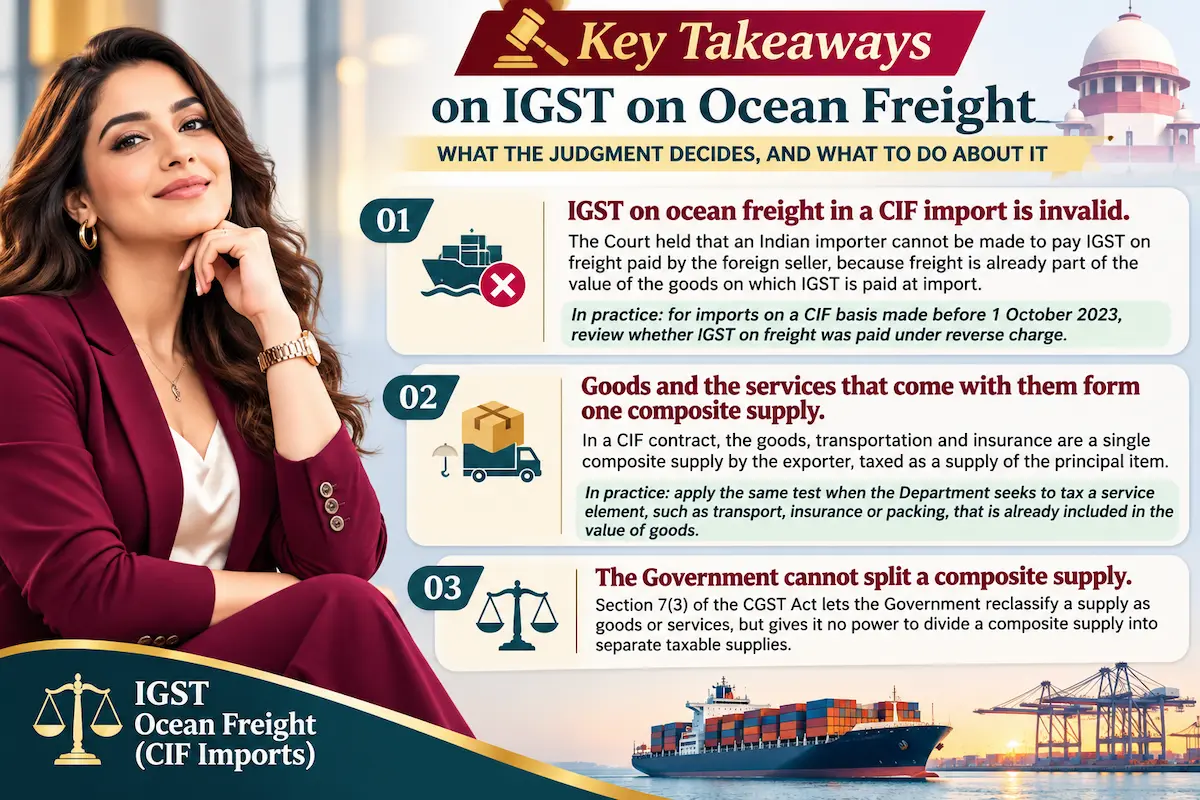
Key Takeaways on IGST on Ocean Freight
- IGST on ocean freight in a CIF import is invalid. The Court held that an Indian importer cannot be made to pay IGST on freight paid by the foreign seller, because freight is already part of the value of the goods on which IGST is paid at import. In practice: for imports on a CIF basis made before 1 October 2023, review whether IGST on freight was paid under reverse charge.
- Goods and the services that come with them form one composite supply. In a CIF contract, the goods, transportation and insurance are a single composite supply by the exporter, taxed as a supply of the principal item. In practice: apply the same test when the Department seeks to tax a service element, such as transport, insurance or packing, that is already included in the value of goods.
- The Government cannot split a composite supply. Section 7(3) of the CGST Act lets the Government reclassify a supply as goods or services, but gives it no power to divide a composite supply into separate taxable supplies. In practice: where a notification taxes a component of a bundled supply separately, test it against Section 8 of the CGST Act.
- GST Council recommendations bind the Government, not the legislatures. The recommendations are persuasive for Parliament and the State Legislatures, but the Government is bound by them when it makes rules and notifications under the GST Acts. In practice: when examining a notification, check whether it follows the Council’s recommendation, because the Government is bound by the Council’s recommendations when it makes rules and notifications.
- The levy has been withdrawn, and the ruling covers CIF imports only. IGST on ocean freight by reverse charge was removed from 1 October 2023. The importers in this case accepted that IGST is payable on freight under an FOB contract, where the importer itself pays the shipping line. In practice: do not cite this ruling for FOB imports made before 1 October 2023.
Related Posts
09 · SourcesAuthoritative Sources
- Original judgment: Union of India v. Mohit Minerals Pvt. Ltd. (SC, 2022), Civil Appeal No. 1390 of 2022 (Supreme Court of India, PDF)
- Statutory provisions: Sections 2(30), 2(93), 7 and 8, CGST Act, 2017; Sections 5 and 13, IGST Act, 2017 (CBIC GST Acts: select the Act and section from the menu); Articles 246A, 269A and 279A of the Constitution of India
- Notifications: Notification No. 8/2017-Integrated Tax (Rate) and Notification No. 10/2017-Integrated Tax (Rate), both dated 28 June 2017; Notification No. 13/2023-Integrated Tax (Rate), dated 26 September 2023 (CBIC)
How to find this judgment on the Supreme Court website
On the Supreme Court of India website, go to Case Status → Diary Number, enter 23083 and year 2020, and complete the security code. The judgment dated 19-05-2022 in Union of India & Anr. v. M/s Mohit Minerals Pvt. Ltd. appears in the Judgment column. It can also be found on the Digital SCR portal by searching the party name “Mohit Minerals”: Civil Appeal No. 1390/2022, [2022] 9 SCR 300, 2022 INSC 596.
Editorial Note: This case law digest is intended for informational and educational purposes. Readers should consult the original judgment and applicable law before relying on the legal position for a specific matter.