
Section 68 burden of proof – Cash credits of ₹1,50,000 shown as hundi loans from three Calcutta creditors – Confirmation letters, discharged hundis and income tax particulars of creditors produced – Summons under Section 131 returned “left” – Creditors known to the department as income tax assessees – Revenue did not enquire into their source of income or creditworthiness – Tribunal’s finding that the assessee discharged its burden not unreasonable or perverse – Finding based on some evidence raises no question of law under Section 256(2) – Penalty under Section 271(1)(c) fell with the addition
Whether a question of law arose from the Tribunal’s finding that the assessee had discharged its burden under Section 68 for loans from three creditors, where the assessee gave their names, addresses and income tax particulars but could not produce them, and the Revenue made no further enquiry.
The Revenue’s appeals were dismissed with costs. The Orissa High Court was right in refusing to direct the Tribunal to state a case under Section 256(2), both on the addition of ₹1,50,000 and on the penalty.
No. Where the assessee has given the names, addresses and income tax particulars of its creditors, and the Revenue, knowing them to be income tax assessees, does not examine their source of income or creditworthiness, a Tribunal’s finding that the assessee discharged its burden under Section 68 is not unreasonable or perverse. A finding of fact based on some evidence raises no question of law.
A leading Supreme Court judgment on the Section 68 burden of proof, often cited where the assessee has identified its creditors but the Assessing Officer has not followed up. Since 2022, the law requires the lender to explain the source of a loan as well, so the judgment applies with changes to loans today.
| Case Name | Commissioner of Income-tax, Orissa v. Orissa Corporation (P) Ltd. (SC, 1986) |
| Court | Supreme Court of India (Civil Appellate Jurisdiction) |
| Bench | R.S. Pathak and Sabyasachi Mukharji, JJ. (judgment by Sabyasachi Mukharji, J.) |
| Case Number | Civil Appeal Nos. 1379–1380 (NT) of 1974 (Diary No. 60396/1974) |
| Judgment Date | 19 March 1986 |
| Neutral Citation | 1986 INSC 50 |
| Reported Citation | [1986] 1 SCR 979; 1986 Supp SCC 110; (1986) 159 ITR 78 |
| Arising From | Orissa High Court, S.J.C. Nos. 85 and 116 of 1972, order dated 31 October 1973 |
| Relevant Provisions | Sections 68, 131, 256(2) and 271(1)(c), Income-tax Act, 1961 |
| Income-tax Act, 2025 | Section 102 (unexplained credits), which corresponds to Section 68 |
| Assessment Year | 1962-63 (accounting year ended 31 December 1961) |
| Judgment Source | Official judgment (Supreme Court of India, PDF) |
Facts of the Case: CIT v. Orissa Corporation (SC, 1986)
The concept in brief. Under Section 68, where a sum is credited in the assessee’s books and the assessee offers no explanation of its nature and source, or the explanation is not satisfactory to the Assessing Officer, the sum may be taxed as income. For a loan, the assessee usually explains the credit by identifying the lender. The Section 68 burden of proof question is how much the assessee must do, and when the burden shifts to the Revenue to test the evidence. In 1986, a dispute reached the High Court only as a question of law, referred by the Tribunal or called for by the High Court under Section 256.
- The assessee, a private limited company, kept its accounts by the calendar year. For the year ended 31 December 1961 (assessment year 1962-63), its books showed cash credits of ₹1,50,000 as loans under hundis from three individual creditors of Calcutta (SCR p. 983).
- The assessee produced confirmation letters, the discharged hundis and particulars of the creditors, whose general index numbers were with the Income-tax Department. Notices under Section 131 to the creditors, issued at the assessee’s request, came back unserved with the endorsement “left” (SCR pp. 983–984).
- The Income-tax Officer found inconsistencies in the confirmation letters, said they did not inspire confidence, and observed that most “Hundiwallas” were not genuine bankers but name lenders. He added ₹1,50,000 as unproved cash credit. The Assistant Appellate Commissioner dismissed the appeal, and a penalty of ₹50,000 was imposed under Section 271(1)(c) (SCR pp. 983–984).
- The Tribunal deleted the addition and the penalty. It held that the failure to produce the creditors did not automatically mean the amounts were undisclosed income. The creditors were income tax assessees who had admitted in their own assessments that they lent their names to various assessees, but the list they gave did not include this assessee (SCR pp. 983–984).
- The Tribunal refused to state a case, and the Orissa High Court rejected the Revenue’s applications under Section 256(2) on 31 October 1973. The Revenue appealed by special leave (SCR pp. 982 and 984).
Question Before the Supreme Court on Section 68 Burden of Proof
The Revenue’s questions asked whether the assessee discharged its initial onus merely by producing confirmation letters and hundis, and whether the Tribunal was right in deleting ₹1,50,000 and the penalty. The Supreme Court had to decide whether these questions were questions of law that the High Court should have required the Tribunal to refer (SCR pp. 982 and 984).
03 · SubmissionsArguments of the Revenue and the Assessee
Revenue’s Arguments
- Under Section 68, the onus in such cases was on the assessee, and the assessee had not discharged it, so questions of law arose (SCR p. 984).
- The Income-tax Officer had found inconsistencies in the confirmation letters, the creditors could not be served, and hundi lenders were widely known to be name lenders (SCR p. 984).
Assessee’s Case (as recorded below)
- The judgment does not record separate submissions for the assessee. Its case before the Tribunal was that it had produced confirmation letters, discharged hundis and the creditors’ income tax particulars, and had itself asked for summons under Section 131 (SCR pp. 983–984).
Supreme Court Decision and Reasoning
The Supreme Court dismissed the Revenue’s appeals with costs. It held that the assessee had given the names and addresses of the creditors, that the Revenue knew they were income tax assessees whose index numbers were on its files, and that the Revenue, apart from issuing summons under Section 131 at the assessee’s instance, did not pursue the matter or examine the creditors’ source of income to see whether they could have advanced the loans. In those circumstances the assessee “could not do any further”, and the Tribunal’s conclusion that the assessee had discharged its burden could not be called unreasonable, perverse or based on no evidence. Since a conclusion based on some evidence raises no question of law, the High Court was right in refusing to call for a reference, and the penalty question, which depended on the addition, failed with it (SCR pp. 987–988).
What Section 68 does
The Court noted that Section 68 had no counterpart in the 1922 Act. It “only gives statutory recognition to the principle that cash credits which are not satisfactorily explained might be assessed as income”. The section also allows an unexplained credit to be taxed as income of the previous year for which the books are kept, either as business profits or as income from other sources (SCR pp. 984–985).
No findings on suspicion
Relying on Lalchand Bhagat Ambica Ram v. CIT (SC, 1959), the Court restated that the Tribunal must not base its findings on “suspicions, conjectures or surmises”. In that case the alleged “hundi racket” was never proved; it was “only a suspicion of the Revenue”. The Income-tax Officer in the present case had also relied on a general belief that hundi lenders were name lenders (SCR pp. 984–986).
Rejecting an explanation does not always prove income
Citing Homi Jehangir Gheesta v. CIT (SC, 1961), the Court said that the character of a receipt as income is not established in every case by mere rejection of the assessee’s explanation. Where the circumstances of the rejection leave the only proper inference that the receipt is income, the assessing authority may draw it, and that inference is one of fact (SCR p. 986).
A good explanation cannot be rejected unreasonably
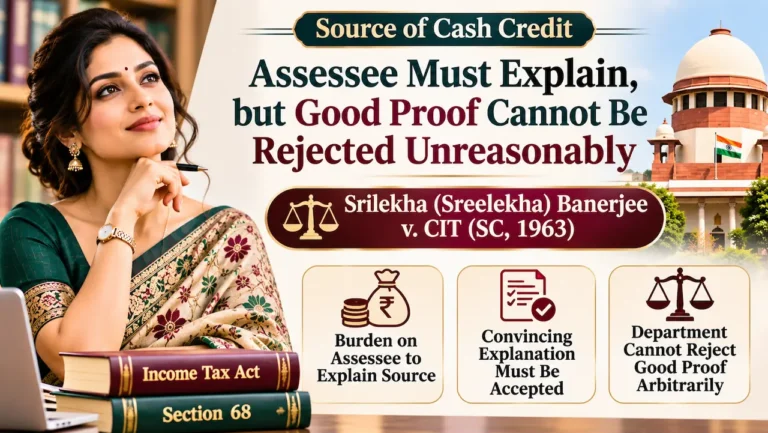
From Sreelekha Banerjee v. CIT (SC, 1963), the Court took the rule that the assessee must establish the source of the money if asked, and the department may then examine the evidence and the explanation. If the evidence is unconvincing, the explanation may be rejected. But “the department cannot by merely rejecting unreasonably a good explanation, convert good proof into no proof” (SCR pp. 986–987).
The Revenue did not follow up
The assessee had identified the creditors, and the Revenue knew they were income tax assessees. Apart from issuing summons at the assessee’s request, the Revenue did not examine their source of income or creditworthiness and made no effort to pursue them. In those circumstances “the assessee could not do any further” (SCR p. 987).
Some evidence, so no question of law
Following CIT v. Daulatram Rawatmull (SC, 1964), the Court held that the High Court cannot call for a reference if there is some evidence to support the Tribunal’s finding, even if it might reach a different conclusion on a re-appreciation of the evidence. The Tribunal’s conclusion was based on some evidence, so no question of law arose (SCR p. 987).
Applying the reasoning (TaxProof illustration). An assessee shows unsecured loans of ₹10,00,000 from two lenders for a year before 2022. It files confirmations, the lenders’ PAN and income tax returns, and bank statements showing payment by cheque. Summons to the lenders return unserved, and the Assessing Officer adds the loans without making any enquiry with the lenders’ own Assessing Officers.
Under Orissa Corporation. The assessee has identified the lenders and given the department the means to verify them. If the Revenue does not follow up, the Tribunal may find that the assessee discharged its burden, and that finding of fact will stand. For a loan taken in or after the year beginning 1 April 2022, the assessee must also obtain the lender’s explanation of the source of the funds (see Position Under the Income-tax Act, 2025).
Ratio Decidendi: A Tribunal Finding That the Section 68 Burden Was Discharged Is a Finding of Fact
Where the assessee has given the names and addresses of its creditors, and the Revenue knows them to be income tax assessees but does not examine their source of income or creditworthiness beyond issuing summons at the assessee’s instance, the Tribunal’s conclusion that the assessee has discharged its burden under Section 68 is not unreasonable, perverse or based on no evidence. A finding of fact based on some evidence raises no question of law, and the High Court cannot call for a reference merely because it might reach a different conclusion on the evidence.
TaxProof note. The judgment upheld a finding of fact; it does not hold that giving a creditor’s name and address always discharges the burden under Section 68. In CIT v. P. Mohanakala (SC, 2007), the Supreme Court described Orissa Corporation as a case where the Tribunal’s conclusion was “not unreasonable or perverse”, and read it, with the other earlier decisions, in the light of Sumati Dayal. Each case turns on what the assessee proved and what enquiry the Revenue made.
Position Under the Income-tax Act, 2025 (Section 102)
Section 102 of the Income-tax Act, 2025 carries forward Section 68. Under Section 102(1), a sum credited in the books for a tax year is charged to tax as income where the assessee offers no explanation of its nature and source, or the explanation is not satisfactory to the Assessing Officer.
- Loans now need the lender’s source. The Finance Act, 2022 added a proviso to Section 68 for loans and borrowings, from assessment year 2023-24. The explanation is deemed not satisfactory unless the person in whose name the credit is recorded also explains the source of the sum and the Assessing Officer accepts it. Section 102(2) of the 2025 Act carries this “source of source” rule forward. For loans after the change, identifying the lender, as in Orissa Corporation, is no longer enough by itself.
- Share capital. Section 102(3) applies a similar rule to share capital and premium of closely held companies, and Section 102(4) excludes venture capital funds and companies referred to in Schedule V.
- Appeals on facts. The reference procedure under Section 256 has been replaced by a direct appeal to the High Court on a substantial question of law under Section 260A of the 1961 Act. The rule that a finding of fact based on some evidence raises no question of law continues to apply.
Still applies: the Revenue cannot reject an explanation on suspicion alone, and where it has the means to verify the creditor and does not use them, a finding that the assessee discharged its burden can stand.
 07 · Takeaways
Key Takeaways on the Section 68 Burden of Proof
- Identifying the creditor shifts the focus to the Revenue’s enquiry. The assessee gave names, addresses and income tax particulars, and the Revenue did not test the creditors’ capacity. In practice: give the Assessing Officer every particular needed to verify the lender, and record any request for summons in writing.
- Non-production of the creditor is not conclusive. The Tribunal held, and the Court upheld, that failure to produce the creditors did not automatically make the credits income. In practice: if a summons returns unserved, file the creditor’s details again and ask the Assessing Officer to enquire through the creditor’s own assessment records.
- Suspicion is not evidence. The Tribunal declined to act on a general belief that hundi lenders were name lenders, noting that this assessee was not on the lenders’ own list, and the Court held that finding was not perverse. In practice: where an order relies on general reports or practices, ask what material links them to your transaction.
- The fight is won on facts before the Tribunal. A finding based on some evidence raises no question of law. In practice: place every document before the Tribunal; the High Court will not re-weigh the evidence.
- For loans taken now, prove the lender’s source too. Since the 2022 amendment, carried into Section 102(2), the lender must explain the source of the funds. In practice: collect the lender’s bank statement and source explanation when the loan is taken, not after a notice arrives.
Practitioner checklist: proving a loan credit under Section 68 (now Section 102)
- Loan confirmation with the lender’s name, address and PAN.
- Lender’s income tax return and computation for the year of the loan.
- Bank statements of both parties showing the payment and the repayment or interest.
- For loans in or after assessment year 2023-24: the lender’s own explanation of the source of the funds, with evidence.
- If a summons returns unserved, a written request to the Assessing Officer to verify the lender through the lender’s jurisdictional assessment records.
- Where an addition rests on general information about accommodation entries, a request for the specific material relied on and an opportunity to rebut it.
FAQs on Section 68 Burden of Proof After Orissa Corporation
Is a loan an unexplained credit if the lender does not respond to summons?
Not automatically, according to CIT v. Orissa Corporation (SC, 1986). Where the assessee has identified the lenders and the Revenue, knowing them to be income tax assessees, makes no enquiry into their source of income or creditworthiness, the Tribunal may find that the assessee discharged its burden, and that finding of fact will stand.
Does giving the lender’s name and address always discharge the burden under Section 68?
No. Orissa Corporation upheld a Tribunal finding on its facts, and in CIT v. P. Mohanakala (SC, 2007) the Supreme Court read it as a case where the Tribunal’s conclusion was not perverse. Each case depends on the evidence filed and the enquiry made.
Does Orissa Corporation still apply to loans under the Income-tax Act, 2025?
Yes, with changes. Section 102 of the 2025 Act carries forward Section 68, and Section 102(2) continues the 2022 rule that, for a loan or borrowing, the lender must also explain the source of the sum. Identifying the lender is now only the first step.
Related Posts
10 · SourcesAuthoritative Sources
- Original judgment: CIT v. Orissa Corporation (P) Ltd. (SC, 1986), Civil Appeal Nos. 1379–1380 (NT) of 1974 (Supreme Court of India, PDF)
- Statutory provisions: Sections 68, 131, 256(2), 260A and 271(1)(c), Income-tax Act, 1961; Section 102, Income-tax Act, 2025 (Income Tax Department)
- Authorities referred to: Lalchand Bhagat Ambica Ram v. CIT (SC, 1959), (1959) 37 ITR 288 · Homi Jehangir Gheesta v. CIT (SC, 1961), (1961) 41 ITR 135 · Sreelekha Banerjee v. CIT (SC, 1963), (1963) 49 ITR 112 · CIT v. Daulatram Rawatmull (SC, 1964), (1964) 53 ITR 574
- Later reference: CIT v. P. Mohanakala (SC, 2007), (2007) 291 ITR 278
How to find this judgment on the Supreme Court website
On the Supreme Court of India website, open the judgment search and choose Judgment Date. Enter 19-03-1986 as both the from and to date and complete the captcha. The case Commissioner of Income-tax, Orissa v. Orissa Corporation (P) Ltd. appears as Diary No. 60396/1974, bench Sabyasachi Mukharji, with the judgment dated 19-03-1986. On the Digital SCR portal, search the party name “Orissa Corporation” with the year 1986; it is reported as [1986] 1 S.C.R. 979, with the neutral citation 1986 INSC 50.
Editorial Note: This case law digest is intended for informational and educational purposes. Readers should consult the original judgment and applicable law before relying on the legal position for a specific matter.