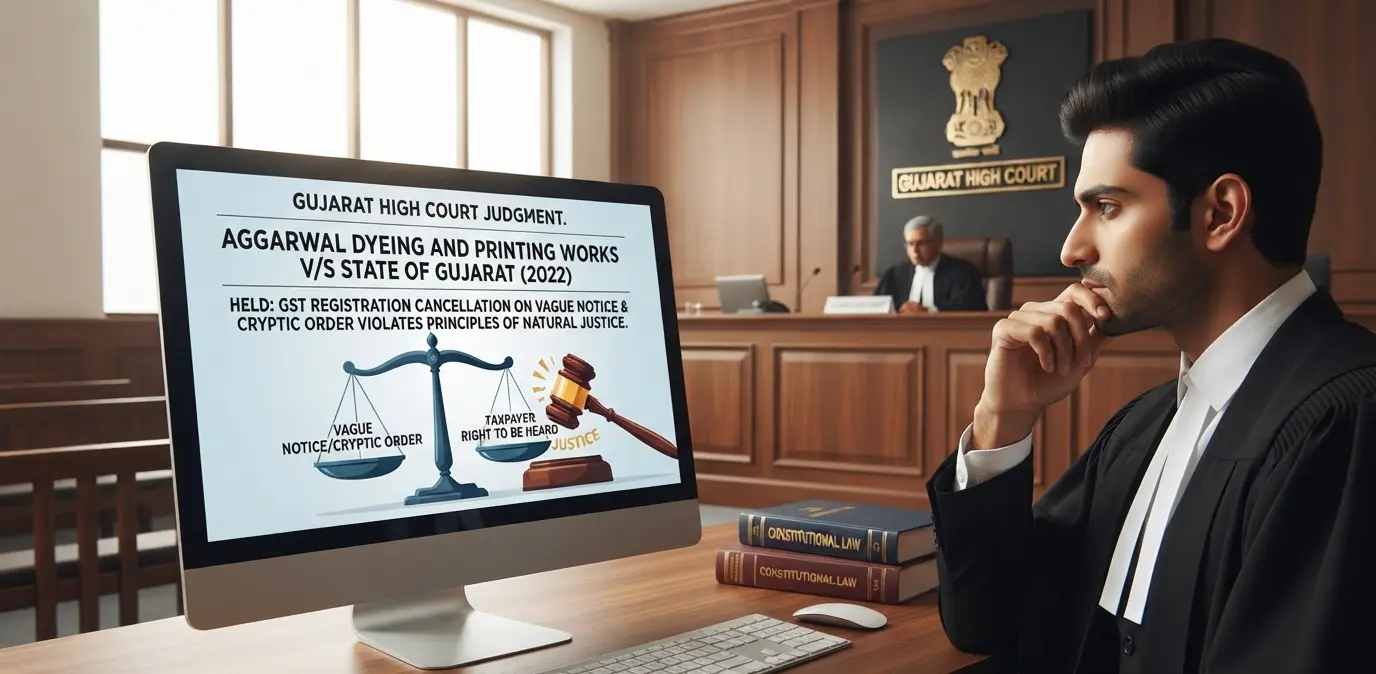
GST registration cancellation – Show cause notice in Form GST REG-17 giving only a one-line ground copied from the rules – Cancellation order non-speaking and cryptic – Principles of natural justice violated – Reasons are the “heart and soul” of an order – Show cause notices and cancellation orders in four writ petitions quashed, with liberty to issue fresh notices with particulars – Merits not examined – Directions for physical notices and orders by RPAD until the portal can carry full particulars – Evidence relied on must first be put to the dealer
Whether a show cause notice for cancellation of GST registration that only repeats a ground from the rules, and a cancellation order that gives no reasons, are valid in law.
The four writ petitions were allowed. The show cause notices and the cancellation orders were quashed, with liberty to the department to issue fresh notices with particulars, give a reasonable opportunity of hearing and pass speaking orders on merits. The Court did not examine the merits.
No. A show cause notice for cancellation of GST registration that only reproduces a ground from the rules, without specific details, is “a mere formality and an eye wash”, and a cancellation order that is non-speaking and cryptic violates the principles of natural justice. Both are liable to be quashed.
A leading judgment for dealers whose registration was cancelled on a one-line portal notice. It gives grounds to challenge the notice and the order, but the relief is a fresh notice and hearing, not a finding that the dealer was entitled to keep its registration.
| Case Name | Aggarwal Dyeing and Printing Works v. State of Gujarat & 2 Ors. (Guj HC, 2022) |
| Court | High Court of Gujarat at Ahmedabad (Division Bench) |
| Bench | J.B. Pardiwala and Nisha M. Thakore, JJ. (judgment by Nisha M. Thakore, J.; separate note by J.B. Pardiwala, J.) |
| Case Number | R/Special Civil Application No. 18860 of 2021 (lead matter), with R/SCA Nos. 1169, 2263 and 3140 of 2022 |
| Judgment Date | 24 February 2022 (common oral judgment) |
| Neutral Citation | Not printed on the judgment |
| Interim Orders | 28 January 2022 and 17 February 2022 (both quoted in paras 6 and 7 of the judgment) |
| Relevant Provisions | Sections 29 and 107 of the Gujarat Goods and Services Tax Act, 2017 (GGST Act), which correspond to the same sections of the CGST Act, 2017; Rules 21 and 22 of the CGST Rules, 2017; Forms GST REG-17 and REG-19 |
| Period | Lead matter: registration cancelled by order dated 30 September 2018 with effect from 4 August 2017; connected matters: show cause notices issued between 2019 and 2021 |
| Judgment Source | Judgment of the Gujarat High Court (PDF) · Download |
Facts of the Case: Aggarwal Dyeing and Printing Works v. State of Gujarat (Guj HC, 2022)
The concept in brief. Under Section 29 of the CGST Act and Rule 22 of the CGST Rules, the proper officer who believes that a registration is liable to be cancelled must issue a show cause notice in Form GST REG-17. The dealer replies in Form REG-18 within seven working days of service. If the reply is satisfactory, the officer drops the proceedings in Form REG-20. Otherwise, the officer cancels the registration by an order in Form REG-19. The proviso to Section 29(2) says that the officer shall not cancel the registration without giving the person an opportunity of being heard. GST registration cancellation has serious effects: a dealer without registration can neither collect tax nor claim input tax credit (ITC) (para 9).
- The writ applicant, a sole proprietary concern manufacturing dyeing and printing fabrics, was registered under the GGST Act with effect from 4 August 2017 (para 4.1).
- On 18 September 2018, a show cause notice in Form REG-17 under Rule 22(1) asked why its registration should not be cancelled. The only reason given was: “Any Tax payer other than composite taxpayer has not filed returns for a continuous period of six months.” A hearing was fixed for 27 September 2018 (paras 4.2 and 13).
- No reply was filed. On 30 September 2018, the Assistant Commissioner, Ghatak 21 (Ahmedabad) passed an ex parte order cancelling the registration with effect from the date of registration, 4 August 2017 (para 4.3).
- The applicant later filed its returns in Form GSTR-3B for April 2020 to March 2021 and paid ₹24,000 under the amnesty scheme dated 28 May 2021, by challan dated 29 July 2021 (para 4.4).
- It filed an appeal on 17 July 2021 under Section 107. The Appellate Authority dismissed it on 12 October 2021 for a delay of 2 years and 17 days (paras 4.5 and 4.7).
- The three connected petitions raised the same issue. In SCA 1169 of 2022, the ground was registration obtained by fraud, wilful misstatement or suppression of facts. In SCA 2263 and 3140 of 2022, the ground was non-filing of returns for six months; in SCA 3140 the dealer had sought time to reply, but the order was passed without reasons (para 5).
Question Before the Gujarat High Court on GST Registration Cancellation
The Court framed the question as whether the show cause notice seeking cancellation of registration, and the order cancelling the registration under the GST Act, were “valid and sustainable in eye of law” (para 7).
03 · SubmissionsArguments of the Assessee and the Revenue
Assessee’s Arguments
- The show cause notice and the cancellation order were vague, and the Appellate Authority had dismissed the appeal only as time-barred (para 6, quoting the order of 28 January 2022).
- The delay in filing returns and the appeal arose from lack of knowledge of the new tax regime and a bona fide belief that no return was needed when turnover was nil. The applicant offered to pay the tax and penalty and to comply in future (paras 4.4 and 4.6).
Revenue’s Arguments
- The Additional Solicitor General said the department had taken up the issue of vague notices and orders seriously and asked for time to propose a solution (para 7, quoting the order of 17 February 2022).
- The Assistant Government Pleader explained that, because of technical glitches in the portal, the department found it difficult to upload notices and orders containing all the necessary details (para 16). The judgment records no defence of the notices on merits.
Gujarat High Court Decision on GST Registration Cancellation
The Gujarat High Court allowed all four writ petitions “solely on the ground of violation of principles of natural justice”. It held that a show cause notice which only reproduces one of the grounds in the rules, without specific details, makes the process “a mere formality and an eye wash”, because no prudent person can respond to it. It also held that the cancellation order was non-speaking and cryptic, so that the reason for cancellation could not be deciphered, and that a reasonable opportunity of hearing had not been given. Since cancellation of registration carries civil and penal consequences, the Court quashed the show cause notices and the cancellation orders, and gave the department liberty to issue fresh notices with particulars, hear the dealers and pass speaking orders on merits. It rejected the portal’s technical glitches as an explanation and directed that, until the portal is fixed, notices and orders be issued in physical form with full particulars and sent by RPAD (paras 13 to 19).
Reasons are the heart and soul of an order
The Court relied on the Supreme Court’s line of judgments, from A.K. Kraipak v. Union of India (SC, 1969) to Kranti Associates Pvt. Ltd. v. Masood Ahmed Khan (SC, 2010), which treat the recording of reasons as part of natural justice. It reproduced the principles in Kranti Associates, including that “a pretence of reasons or ‘rubber-stamp reasons'” is not a valid decision. It concluded that the speaking order doctrine requires reasons that are “the result of independent re-appreciation of evidence adduced and documents produced in the case” (para 11).
A show cause notice must state the jurisdictional facts
The Court adopted the view of the Andhra Pradesh High Court in MRF Mazdoor Sangh v. Commissioner of Labour (AP HC, 2013) that a show cause notice “should reflect the jurisdictional facts” on which the final order is proposed, so that the person can show that those facts do not exist. Where an order results in civil consequences, an opportunity of hearing must be read into the provision even if the statute does not provide for it (paras 12 and 12.1).
The one-line notice in Form REG-17 was an eye wash
In every petition, the notice was issued in the prescribed form, but its one-line reason was “nothing but the reproduction” of a ground in the rules. The Court held that the officer “ought to have atleast incorporated specific details” in the notice. Without details, a prudent person would fail to respond, and the notice becomes “a mere formality and an eye wash” (paras 13 and 13.1).
The cancellation order was cryptic and non-speaking
The Court found that sufficient opportunity of hearing had not been given in spite of a specific request for adjournment, and that the order was “not only non speaking, but cryptic in nature” with no decipherable reason. It held that the basic principles of natural justice stood violated and that the order had to be quashed because it entails penal and pecuniary consequences (para 14).
Portal glitches are not a valid explanation
The department’s explanation that the portal did not allow details to be uploaded “hardly can be a valid explanation” for vague notices and orders. The Court directed that, until the department develops software to carry all necessary particulars, notices and final orders be issued in physical form, with all details and reasons, and sent to the dealer by RPAD. It warned that any lapse “shall be viewed very strictly” (paras 16, 17 and 18.1).
Evidence relied on must first be put to the dealer
The Court noted that cancellation orders often travel beyond the show cause notice, for example by relying on an inspection report or spot visit report. If the authority wants to rely on any evidence, it “owes a duty to first bring it to the notice of the dealer” so that the dealer can respond (para 18.2).
What a valid notice must show (TaxProof illustration)
One line copied from the rules: “Any Tax payer other than composite taxpayer has not filed returns for a continuous period of six months” · no periods, facts or documents · hearing date and a warning of ex parte decision
Specific details and material particulars of the ground · the jurisdictional facts relied on · any evidence (such as an inspection report) shared with the dealer first · a final order with reasons that can be understood
Ratio Decidendi: A Vague Notice and a Cryptic Order Cannot Support Cancellation
A show cause notice for cancellation of GST registration must contain specific details of the ground on which cancellation is proposed, and the cancellation order must give reasons. A notice that only reproduces a ground from the rules, and an order that is non-speaking and cryptic, violate the principles of natural justice, because cancellation carries civil and penal consequences. Both are liable to be quashed, with liberty to the department to issue a fresh notice with particulars, give a reasonable opportunity of hearing and pass a speaking order.
Delay in the appeal. The Court said the Appellate Authority had “mechanically” dismissed the appeals on delay and “ought to have condoned the delay”, relying on Union of India v. Jesus Sales Corporation (SC, 1996) and the transitional difficulties of the new regime (paras 15 and 15.1). This was not the basis of the relief: the petitions were allowed “solely” on natural justice (para 19). TaxProof note: Section 107(1) allows three months to appeal, and Section 107(4) lets the Appellate Authority allow only “a further period of one month”. The judgment does not discuss Section 107(4), so it should not be read as giving the Appellate Authority power to condone a longer delay. A dealer who misses that period is usually left to seek relief in writ, as these dealers did.
Separate note by Pardiwala, J. Pardiwala, J. added that the directions “will go a long way” in reducing hardship caused by technical bottlenecks in the GSTN portal, and that those glitches must be attended to at the earliest.
SLP status. No special leave petition against this judgment was found on the Supreme Court website as on 17 November 2026.
Position After the Judgment: Section 29 and Rules 21 and 21A
The amendments since the judgment change some grounds for cancellation and the rules on suspension. None of them changes the duty to give particulars in the notice and reasons in the order, and the proviso to Section 29(2) still requires an opportunity of being heard before cancellation.
- Return-default grounds from 1 October 2022. Section 101 of the Finance Act, 2022 (6 of 2022) substituted the words in Section 29(2)(b) and (c) with effect from 1 October 2022. Clause (c) now refers to a person who has not furnished returns “for such continuous tax period as may be prescribed”, in place of “a continuous period of six months”. Clause (b) now covers a composition dealer who has not furnished the return for a financial year beyond three months from its due date.
- The prescribed period. Notification No. 19/2022-Central Tax dated 28 September 2022 inserted clauses (h) and (i) in Rule 21 with effect from 1 October 2022. A monthly filer may face cancellation if it has not furnished returns for a continuous period of six months; a quarterly filer, for a continuous period of two tax periods.
- New grounds and suspension. Notification No. 94/2020-Central Tax dated 22 December 2020 added grounds in Rule 21: ITC availed in violation of Section 16, outward supplies in Form GSTR-1 in excess of those in the return, and violation of Rule 86B. It removed the words requiring a reasonable opportunity of being heard before suspension under Rule 21A(2), and inserted Rule 21A(2A), under which a registration may be suspended where returns show significant differences or anomalies, with an intimation in Form REG-31 and 30 days to explain.
- Filing returns instead of replying. The proviso to Rule 22(4), inserted by Notification No. 39/2018-Central Tax dated 4 September 2018, already applied when the lead notice was issued. For cancellation under Section 29(2)(b) or (c), if the person furnishes all pending returns and pays the tax dues with interest and late fee instead of replying, the officer “shall drop the proceedings” in Form REG-20.
TaxProof analysis. The judgment rests on case law on natural justice and does not cite the proviso to Section 29(2), which says that the proper officer “shall not cancel the registration without giving the person an opportunity of being heard”. That proviso has been in the Act since 2017 and gives a statutory basis for the same argument. Since the 2020 amendment, a registration can be suspended before any hearing, so a dealer may find it suspended before it has replied. Aggarwal Dyeing applies to the cancellation notice and the cancellation order.
Key Takeaways on GST Registration Cancellation
- A one-line show cause notice copied from the rules is not enough. The Court quashed notices whose only reason was a ground reproduced from the rules, because no prudent person can respond to them. In practice: in reply to a vague Form REG-17, ask in writing for the periods, facts and documents relied on, and record that the notice gives no particulars.
- A cancellation order must give reasons. A non-speaking, cryptic order in Form REG-19 violates natural justice and was quashed. In practice: check whether the order deals with the reply and states why the registration is cancelled; if it does not, that is the first ground of challenge.
- Evidence relied on must be shown to the dealer first. The Court said an order cannot rely on an inspection or spot visit report that was not first put to the dealer. In practice: if the order cites a report you never saw, raise it as a separate ground in appeal or writ.
- The relief is a fresh notice, not automatic restoration. The Court quashed the notices and orders but left the department free to issue fresh notices, and did not examine the merits. In practice: file all pending returns and pay the dues without waiting for the fresh notice. In a return-default case, doing so in response to the notice requires the officer to drop the proceedings under the proviso to Rule 22(4).
- Missing the appeal deadline makes the remedy harder. Section 107(4) allows only one month beyond the three-month limit, and these dealers had to file writ petitions. In practice: appeal within three months of the cancellation order, or file the revocation application in time; do not rely on para 15 of this judgment for a longer delay.
Practitioner checklist: responding to a GST registration cancellation notice
- Note the date of service of Form REG-17 and the seven working days allowed for reply in Form REG-18.
- Check whether the notice states specific details: the return periods not filed, the facts alleged and the documents relied on.
- For a return-default notice, file all pending returns and pay tax, interest and late fee; ask the officer to drop the proceedings under the proviso to Rule 22(4).
- For any other ground, reply on facts, ask for copies of any inspection report or evidence relied on, and request a personal hearing.
- On receiving Form REG-19, check that it gives reasons, deals with the reply and does not rely on material outside the notice.
- Diarise the three-month appeal limit under Section 107(1), counted from the date the order is communicated; only one more month can be allowed under Section 107(4).
- If the order is cryptic or passed without a hearing, cite Aggarwal Dyeing (Guj HC, 2022) and the proviso to Section 29(2) in the appeal or writ.
 08 · Quick Answers
FAQs on GST Registration Cancellation After Aggarwal Dyeing
Can GST registration be cancelled on a one-line show cause notice?
No, according to Aggarwal Dyeing and Printing Works (Guj HC, 2022). The Gujarat High Court quashed notices that only reproduced a ground from the rules, and the cryptic cancellation orders based on them, for violation of natural justice. The department remains free to issue a fresh notice with particulars and decide the case after a hearing.
Will the officer drop cancellation proceedings if I file the pending returns?
Yes, for cancellation proposed under Section 29(2)(b) or (c) for non-filing of returns. Under the proviso to Rule 22(4), if the person furnishes all pending returns and makes full payment of the tax dues with applicable interest and late fee, the proper officer shall drop the proceedings and pass an order in Form REG-20.
How many months of non-filing can lead to GST registration cancellation now?
Six months for a monthly filer and two tax periods for a quarterly filer. From 1 October 2022, Section 29(2)(c) refers to a continuous tax period “as may be prescribed”, and Rule 21(h) and (i), inserted by Notification No. 19/2022-Central Tax, prescribe these periods. Before that date, the Act itself said six months.
Related Posts
10 · SourcesAuthoritative Sources
- Original judgment: Aggarwal Dyeing and Printing Works v. State of Gujarat (Guj HC, 2022), R/SCA 18860 of 2021 with connected matters, judgment dated 24 February 2022 (Gujarat High Court, PDF) · Download the judgment
- Statutory provisions: Sections 29 and 107, CGST Act, 2017 (India Code: select the section); corresponding sections of the GGST Act, 2017; Rules 21, 21A and 22 of the CGST Rules, 2017
- Amending Act: Section 101 of the Finance Act, 2022 (6 of 2022), substituting words in Section 29(2)(b) and (c) with effect from 1 October 2022
- Notifications: Notification No. 94/2020-Central Tax dated 22 December 2020 (GST Council, PDF); Notification No. 19/2022-Central Tax dated 28 September 2022 (GST Council, PDF); Notification No. 39/2018-Central Tax dated 4 September 2018 (proviso to Rule 22(4))
- Authorities relied on: A.K. Kraipak v. Union of India (SC, 1969); Kranti Associates Pvt. Ltd. v. Masood Ahmed Khan (SC, 2010); MRF Mazdoor Sangh v. Commissioner of Labour (AP HC, 2013); Union of India v. Jesus Sales Corporation (SC, 1996)
How to find this judgment on the Gujarat High Court website
On eCourts High Court services, select High Court of Gujarat and Gujarat High Court, then Court Orders → Party Name. Enter “Aggarwal Dyeing” and the year 2021, and complete the captcha. Three entries for SCA/18860/2021 appear. The final judgment is the one dated 24-02-2022 (marked JUDGMENT); the entries dated 17-02-2022 and 28-01-2022 are interim orders. Search with the year 2021, the year the lead petition was filed, not 2022.
Editorial Note: This case law digest is intended for informational and educational purposes. Readers should consult the original judgment and applicable law before relying on the legal position for a specific matter.