Input tax credit (ITC) on construction of a mall let out on rent – Blocked credits under Sections 17(5)(c) and 17(5)(d) of the CGST Act – “Plant or machinery” distinguished from defined “plant and machinery” – Functionality test – Sections 17(5)(c), 17(5)(d) and 16(4) upheld – Remand to the Orissa High Court – Retrospective amendment by the Finance Act, 2025
Whether a person who constructs a shopping mall and pays GST on the rent can take ITC on the goods and services used to construct the mall, and whether the bar on such ITC in Sections 17(5)(c) and 17(5)(d) of the CGST Act is constitutional.
The Revenue’s appeals were partly allowed. The Orissa High Court’s judgment of 17 April 2019, which had read down Section 17(5)(d), was set aside, and the case was remanded to the High Court to decide whether the mall is a “plant”. The constitutional challenge to Sections 17(5)(c), 17(5)(d) and 16(4) failed, and the writ petitions filed directly in the Supreme Court were rejected, subject to the Court’s reading of Section 17(5)(d).
The expression “plant or machinery” in Section 17(5)(d) does not carry the meaning of “plant and machinery” defined in the Explanation to Section 17, which excludes land, buildings and other civil structures. A building, such as a mall or warehouse, can therefore be a “plant” under Section 17(5)(d) if it passes the functionality test, which is a question of fact in each case.
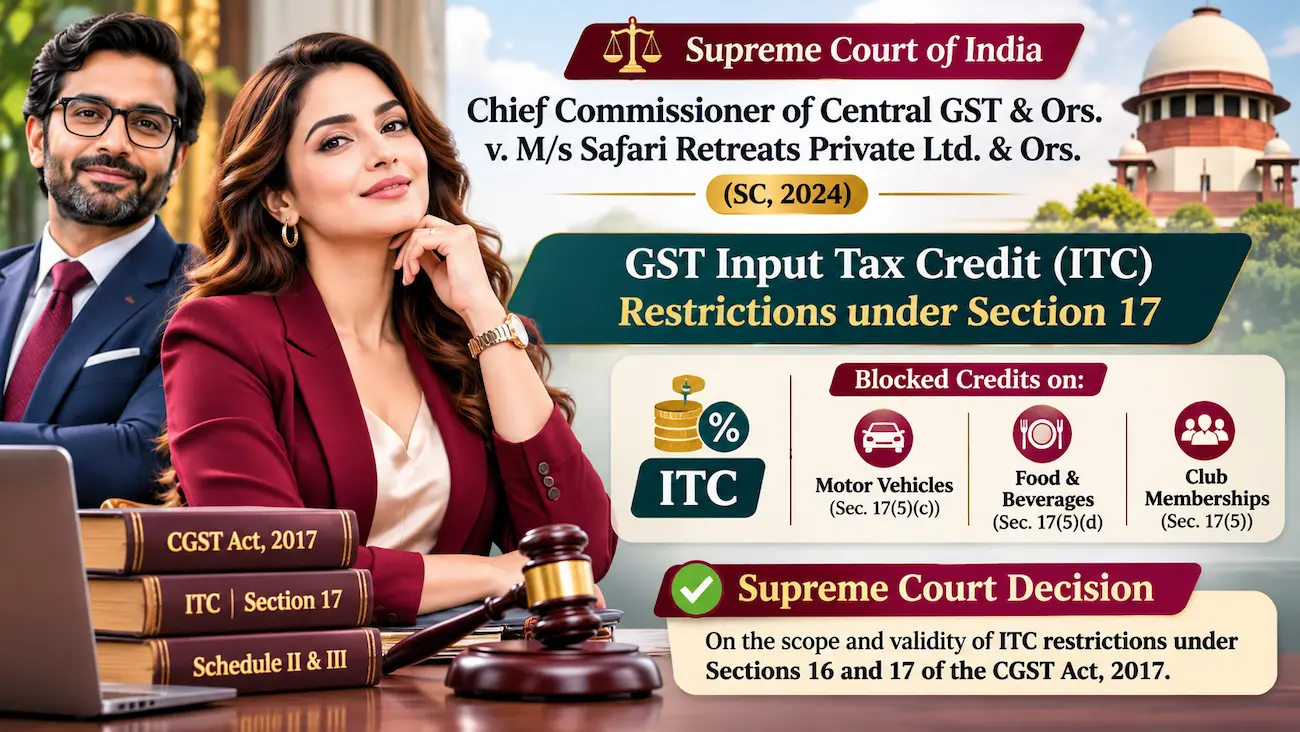
The Safari Retreats judgment is the leading Supreme Court authority on blocked credit for construction of immovable property, including ITC on construction of malls, warehouses and other buildings let out on rent. Its reading of “plant or machinery” has been overridden by Section 124 of the Finance Act, 2025, which substituted “plant and machinery” in Section 17(5)(d) with retrospective effect from 1 July 2017. Its rulings on constitutional validity and on the scope of Section 17(5)(c) still apply.
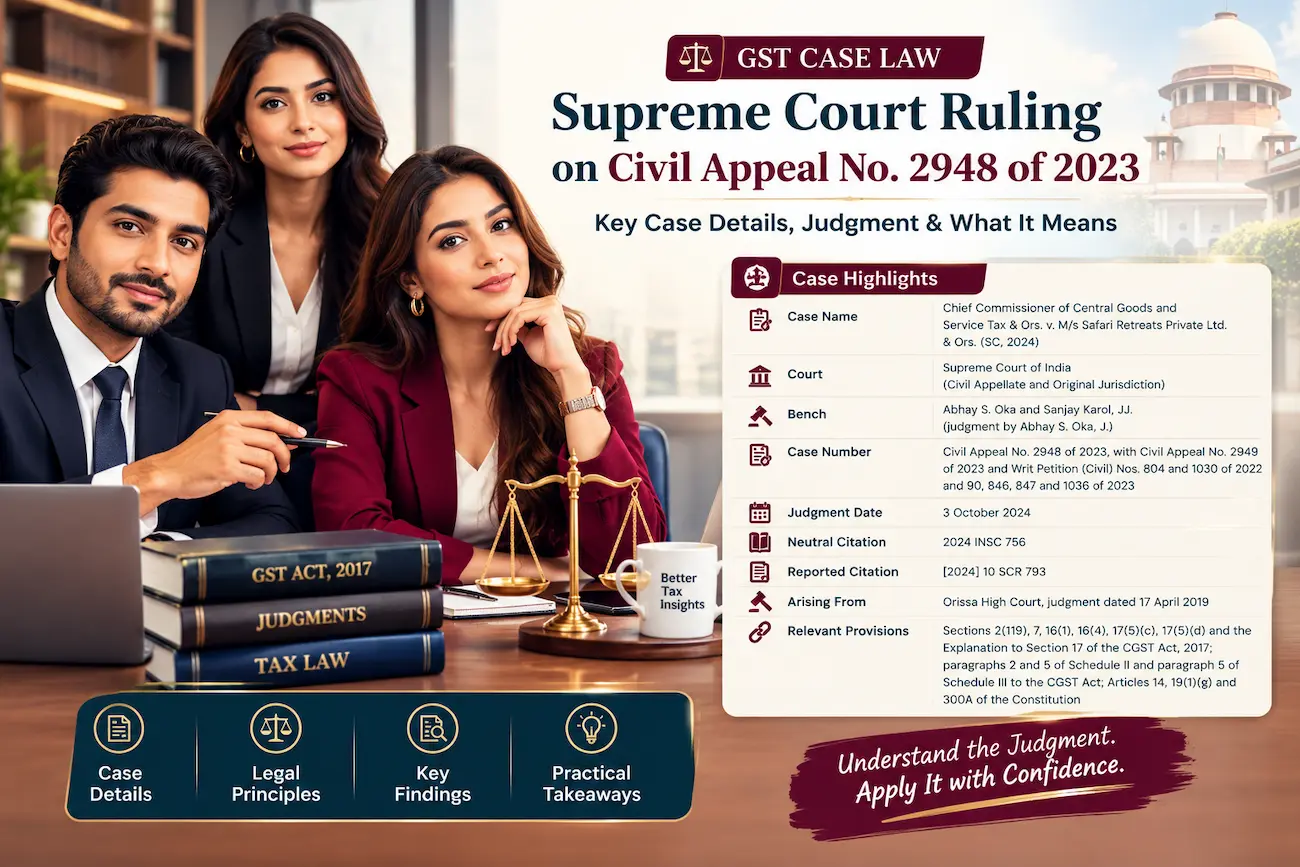
| Case Name | Chief Commissioner of Central Goods and Service Tax & Ors. v. M/s Safari Retreats Private Ltd. & Ors. (SC, 2024), with connected appeal and writ petitions |
| Court | Supreme Court of India (Civil Appellate and Original Jurisdiction) |
| Bench | Abhay S. Oka and Sanjay Karol, JJ. (judgment by Abhay S. Oka, J.) |
| Case Number | Civil Appeal No. 2948 of 2023, with Civil Appeal No. 2949 of 2023 and Writ Petition (Civil) Nos. 804 and 1030 of 2022 and 90, 846, 847 and 1036 of 2023 |
| Judgment Date | 3 October 2024 |
| Neutral Citation | 2024 INSC 756 |
| Reported Citation | [2024] 10 SCR 793 |
| Arising From | Orissa High Court, judgment dated 17 April 2019 |
| Relevant Provisions | Sections 2(119), 7, 16(1), 16(4), 17(5)(c), 17(5)(d) and the Explanation to Section 17 of the CGST Act, 2017; paragraphs 2 and 5 of Schedule II and paragraph 5 of Schedule III to the CGST Act; Articles 14, 19(1)(g) and 300A of the Constitution and Entry 49 of List II of the Seventh Schedule; Section 124 of the Finance Act, 2025 |
| Period | From 1 July 2017 |
| Judgment Source | Official judgment, Supreme Court of India (PDF) |
 01 · Background
Facts of the Case: Chief Commissioner of CGST v. Safari Retreats Pvt. Ltd. (SC, 2024)
The concept in brief. Section 16 of the CGST Act allows credit of GST paid on inputs and services used in business, and Section 17(5) blocks it in listed cases. Clause (c) blocks credit on works contract services used for construction of an immovable property, other than “plant and machinery”. Clause (d) blocks credit on goods and services used by a person for construction of an immovable property on his own account, other than “plant or machinery”, as the clause read when the case was decided. The Explanation to Section 17 defines “plant and machinery” to exclude land, buildings and other civil structures. The case turned on whether that definition also governs the different words used in clause (d).
- Safari Retreats Private Ltd. constructed a shopping mall in order to let out premises in it to tenants. It accumulated ITC of more than ₹34 crore on the goods and services used in the construction (para 2).
- Rent from tenants is a taxable supply of services, so the company wanted to use that ITC against GST on rent. The authorities advised it to pay GST on rent without using the ITC because of Section 17(5)(d) (para 2).
- The company filed a writ petition in the Orissa High Court, seeking a declaration that Section 17(5)(d) does not apply to a building constructed for letting out or, in the alternative, that it is unconstitutional (para 3).
- On 17 April 2019, the High Court read down Section 17(5)(d) (relying on Eicher Motors, SC, 1999) and held that an assessee who pays GST on rent from a mall is entitled to ITC on the GST paid on its construction (para 4). The Revenue appealed. Other taxpayers filed writ petitions directly in the Supreme Court challenging Sections 17(5)(c), 17(5)(d) and 16(4) (para 5).
Questions Before the Supreme Court on ITC for Construction
The Court framed three questions (para 24):
- Does the definition of “plant and machinery” in the Explanation to Section 17 apply to the expression “plant or machinery” in Section 17(5)(d)?
- If it does not, what is the meaning of the word “plant”?
- Are Sections 17(5)(c), 17(5)(d) and 16(4) of the CGST Act unconstitutional?
Arguments of the Assessee and the Revenue
Assessees’ Arguments
- “Plant and machinery” appears at least ten times in Chapters V and VI, but “plant or machinery” appears only in Section 17(5)(d), so the different wording was deliberate (para 9).
- “Plant” is undefined and takes its commercial meaning: a building that is an essential tool of the business, not merely its setting, is a plant (para 9).
- Renting a building is a taxable supply under Schedule II, so the tax chain does not break (paras 9 and 21).
Revenue’s Arguments
- The word “or” in Section 17(5)(d) is a legislative mistake and must be read as “and”, so that the defined meaning of “plant and machinery” applies (para 16).
- Different meanings would discriminate between clause (c) and clause (d), though both relate to immovable property (para 16).
- Parliament cannot tax land and buildings, which fall under Entry 49 of List II. Once goods and services become an immovable building, the tax chain breaks and no ITC is due (paras 16 and 53).
- If a mall is rented for some years and then sold, the ITC would be used up against GST on rent, and the later sale would bear no GST. That would cause a loss of revenue (para 16).
Supreme Court Decision and Reasoning
The Supreme Court partly allowed the Revenue’s appeals and upheld the constitutional validity of Sections 17(5)(c), 17(5)(d) and 16(4) of the CGST Act. On interpretation, it held that the expression “plant or machinery” in Section 17(5)(d) cannot be given the meaning of “plant and machinery” defined in the Explanation to Section 17. Whether a mall, warehouse or any building other than a hotel or cinema theatre is a “plant” is a question of fact, to be decided by the functionality test with reference to the business of the registered person and the role the building plays in that business. If construction of the building was essential for supplying services such as renting or leasing it, the building could be a plant, and the bar in Section 17(5)(d) would not apply (para 65). As the High Court had read down the provision without examining the facts, the Court set aside its judgment and remanded the case to decide whether the mall is a “plant” (para 66).
Clauses (c) and (d) of Section 17(5) operate in different fields
The Court noted that the two clauses have hardly anything in common except that both deal with construction of immovable property (paras 31 to 34). For that reason, it rejected the Revenue’s argument that giving the two expressions different meanings would be discriminatory (para 54).
| Point | Section 17(5)(c) | Section 17(5)(d) |
|---|---|---|
| What is blocked | Works contract services supplied for construction of an immovable property | Goods or services or both received by a taxable person for construction of an immovable property on his own account |
| Carve-out for plant | “Plant and machinery”, a defined expression | “Plant or machinery”, which the Act did not define (before the 2025 amendment) |
| Other carve-out | Where the works contract service is an input service for a further supply of works contract service | Where the construction is not on the taxable person’s own account |
| “Construction” | Includes reconstruction, renovation, additions, alterations or repairs, to the extent of capitalisation (Explanation to clauses (c) and (d)) | |
On clause (c), the Court held that its language is plain, because both “works contract” and “plant and machinery” are defined, so nothing can be added to or subtracted from it (para 41).
“Or” in clause (d) was used deliberately
The Court rejected the Revenue’s argument that “or” was a drafting mistake. The Model GST Law used “plant and machinery” in both clauses, but Parliament chose different words for clause (d). The legislature had also not corrected the alleged mistake in the more than five years since the High Court’s judgment, so the Court inferred that the different expression was intentional. Reading “or” as “and” would defeat the legislative intent (para 43). Applying the definition of “plant and machinery” to clause (d) would do “violence to the words used in the statute” (para 44).
A building can be a “plant” under clause (d)
“Plant and machinery”, as defined, means apparatus, equipment and machinery fixed to earth, and it expressly excludes land, buildings and other civil structures. The Court said that a plant alone is not covered by that expression unless there is an element of machinery, or vice versa. “Plant or machinery” can be either a plant or machinery (paras 45 and 46). Since clause (d) speaks of “an immovable property (other than plant or machinery)”, the Court held that a plant can itself be an immovable property. Because “plant” is not defined in the CGST Act, it must be given its ordinary commercial meaning (para 46). This follows the rule that an undefined word in a taxing statute is understood in its commercial sense (para 25).
The functionality test decides whether a building is a plant
The test comes from income tax decisions on “plant”. In CIT v. Karnataka Power Corporation (2002) 9 SCC 571, a three-judge bench held that whether a building is a plant is a question of fact, and that a building planned and constructed to serve the assessee’s special technical requirements qualifies as a plant. That bench confined CIT v. Anand Theatres (2000) 5 SCC 393, which held that hotel and cinema buildings are not plant, to hotels and cinema theatres, so Anand Theatres does not decide whether a mall or warehouse is a plant (paras 50 to 52).
How the test works. Look at (1) the business of the registered person and (2) the role the building plays in that business. A building whose construction is essential for supplying taxable services, such as renting it, could be a plant. Where a person constructs a building for his own use, the Court held that the tax chain breaks and ITC is not available (paras 53 and 65(c)).
The tax chain does not always break when a building is created
The Court did not accept the Revenue’s argument in its entirety. Schedule II treats renting or leasing a building as a supply of services. It also treats construction of a building intended for sale as a supply of services where consideration is received before the completion certificate or first occupation. If a building qualifies as a plant, ITC can be used against GST on its rent, subject to the other conditions of the Act. If the recipient constructs the building for his own use, the chain breaks and ITC is not available (paras 39 and 53).
The provisions are constitutional
The Court held that immovable property constitutes a class by itself for GST, and clauses (c) and (d) apply only to that class. ITC is a creation of statute, and the legislature can carve out exceptions to it. The classification has a rational nexus with the object of not encroaching on the States’ power to tax land and buildings under Entry 49 of List II (paras 57 to 61). The Court also rejected the challenge to the time limit for taking ITC in Section 16(4), holding that a provision is not arbitrary merely because it could have been drafted better (para 63). As the provisions were valid and clear, there was no occasion to read them down (para 64).
What the judgment decided, and what it left open (TaxProof analysis)
The Court did not decide that a mall is a plant; it laid down the test and left the facts to the High Court and to proceedings by each writ petitioner (paras 66 and 67). It also said that construction intended to be sold, leased or licensed is not on the person’s “own account” (para 32), but it did not hold that ITC is available on that ground alone. The 2025 amendment, discussed below, changes only the words “plant or machinery”; it does not change the words “on his own account”.
05 · Binding RuleRatio Decidendi: “Plant or Machinery” Is Wider Than “Plant and Machinery”
The definition of “plant and machinery” in the Explanation to Section 17 of the CGST Act does not apply to the expression “plant or machinery” in Section 17(5)(d). The word “plant” in Section 17(5)(d) takes its ordinary commercial meaning, and whether a building other than a hotel or cinema theatre is a plant must be decided on facts by the functionality test, considering the registered person’s business and the role of the building in it. Sections 17(5)(c), 17(5)(d) and 16(4) of the CGST Act are constitutionally valid.
Position After the Judgment: “Plant and Machinery” Substituted Retrospectively
Parliament has reversed the Court’s reading of clause (d) by a retrospective Section 17(5)(d) amendment. Section 124 of the Finance Act, 2025 (Act No. 7 of 2025, assented to on 29 March 2025) amended Section 17(5)(d) of the CGST Act in two ways:
- the words “plant or machinery” were replaced by “plant and machinery”, and are deemed to have been replaced with effect from 1 July 2017; and
- a new Explanation 2 to Section 17(5)(d) was inserted, which clarifies that, notwithstanding any judgment, decree or order of any court, tribunal or other authority, any reference to “plant or machinery” in clause (d) shall be construed, and shall always be deemed to have been construed, as a reference to “plant and machinery”.
Section 124 came into force on 1 October 2025, the date appointed by Notification No. 16/2025-Central Tax, dated 17 September 2025, issued under Section 1(2)(b) of the Finance Act, 2025. The defined meaning of “plant and machinery”, which excludes land, buildings and other civil structures, now governs clause (d) from 1 July 2017, so a mall or warehouse can no longer be treated as a “plant” under the functionality test. Writ challenges to the retrospective operation of the amendment have been reported, so check their current status before advising on a disputed period.
The judgment still applies on the constitutional validity of Sections 17(5)(c), 17(5)(d) and 16(4) and on the plain reading of clause (c).
 07 · Takeaways
Key Takeaways on ITC for Construction of Immovable Property
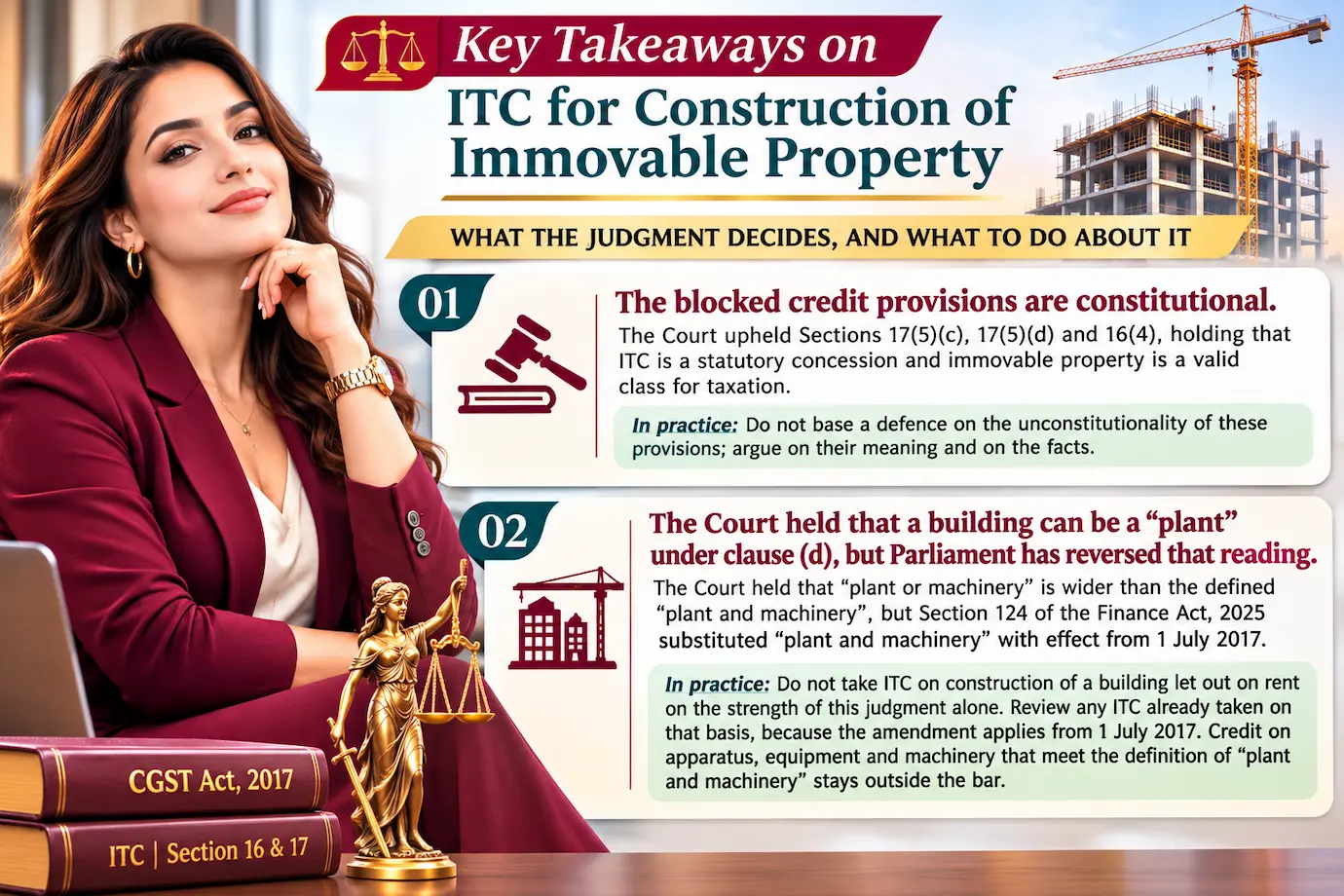
- The blocked credit provisions are constitutional. The Court upheld Sections 17(5)(c), 17(5)(d) and 16(4), holding that ITC is a statutory concession and immovable property is a valid class for taxation. In practice: do not base a defence on the unconstitutionality of these provisions; argue on their meaning and on the facts.
- The Court held that a building can be a “plant” under clause (d), but Parliament has reversed that reading. The Court held that “plant or machinery” is wider than the defined “plant and machinery”, but Section 124 of the Finance Act, 2025 substituted “plant and machinery” with effect from 1 July 2017. In practice: do not take ITC on construction of a building let out on rent on the strength of this judgment alone. Review any ITC already taken on that basis, because the amendment applies from 1 July 2017. Credit on apparatus, equipment and machinery that meet the definition of “plant and machinery” stays outside the bar.
- Whether a building is a plant is a question of fact under the functionality test. The Court looked at the business of the registered person and the role of the building in that business, and left hotels and cinema theatres to the earlier rule in Anand Theatres. In practice: the test matters again only if a court strikes down the retrospective amendment; until then, keep records of the building’s design and its role in the business.
- Clause (c) blocks credit on works contract services for construction, except plant and machinery. The Court read clause (c) by its plain words, which include an exception where the works contract service is an input service for a further supply of works contract service (paras 31 and 41). In practice: a main contractor’s ITC on a sub-contractor’s works contract service remains available under that exception.
- Construction for one’s own use breaks the tax chain. The Court held that ITC is not available where the recipient constructs a building for his own use (para 53). In practice: classify each construction project at the outset as own use, letting or sale, because the ITC position differs for each.
Related Posts
09 · SourcesAuthoritative Sources
- Original judgment: Chief Commissioner of CGST v. Safari Retreats Pvt. Ltd. (SC, 2024), Civil Appeal No. 2948 of 2023 (Supreme Court of India, PDF)
- Statutory provisions: Sections 2(119), 7, 16 and 17 and Schedules II and III, CGST Act, 2017 (India Code: select the section); Articles 14, 19(1)(g) and 300A of the Constitution of India
- Amending Act: Section 124 of the Finance Act, 2025 (No. 7 of 2025), Gazette of India, Extraordinary, Part II, Section 1, dated 29 March 2025 (e-Gazette, PDF)
- Notification: Notification No. 16/2025-Central Tax, dated 17 September 2025 (CBIC), bringing Section 124 into force from 1 October 2025
How to find this judgment on the Supreme Court website
On the Supreme Court of India website, open Case Status and use any one of three searches: Case Number (case type Civil Appeal, number 2948, year 2023), Diary Number (37367, year 2019) or Party Name (“Safari Retreats”). Complete the security code. The judgment dated 03-10-2024 in Chief Commissioner of Central Goods and Service Tax & Ors. v. M/s Safari Retreats Private Ltd. & Ors. appears in the Judgment column. It can also be found on the Digital SCR portal by searching the party name “Safari Retreats”: Civil Appeal No. 2948/2023, [2024] 10 SCR 793, 2024 INSC 756.
Editorial Note: This case law digest is intended for informational and educational purposes. Readers should consult the original judgment and applicable law before relying on the legal position for a specific matter.