Inverted duty structure refund under Section 54(3) of the CGST Act – Clause (ii) of the first proviso a restriction, not a condition of eligibility – “Inputs” means input goods, not input services – Refund of ITC on input services not allowed – Section 54(3) valid under Article 14 – Explanation (a) to Rule 89(5) valid – Formula anomaly referred to the GST Council – Gujarat High Court reversed, Madras High Court affirmed
Whether a registered person whose input tax credit (ITC) has accumulated because of an inverted duty structure can claim a refund of the ITC on input services, or only of the ITC on input goods, and whether Rule 89(5) of the CGST Rules, which counts only input goods in “Net ITC”, is valid.
The Union of India’s appeals against the Gujarat High Court’s judgment were allowed, and that judgment was set aside. The assessees’ appeals against the Madras High Court’s judgment in Tvl. Transtonnelstroy Afcons Joint Venture were dismissed, and the writ petition filed directly in the Supreme Court was also dismissed. The Court asked the GST Council to reconsider the Rule 89(5) formula.
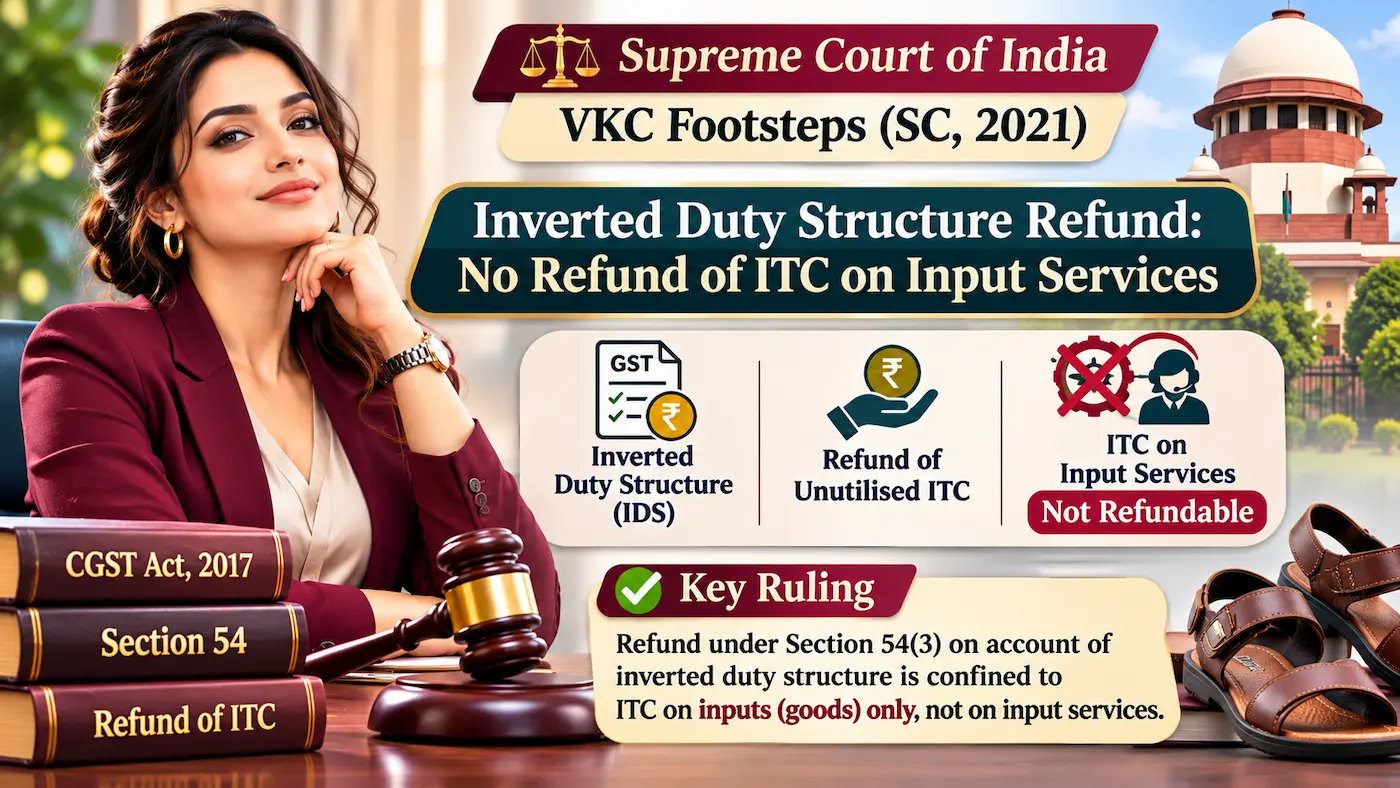
Clause (ii) of the first proviso to Section 54(3) restricts the refund of unutilised ITC to credit that has accumulated because the rate of tax on inputs is higher than the rate of tax on output supplies. “Inputs” means input goods only, so ITC on input services is not refundable in an inverted duty structure. A claim to refund is governed by statute, and there is no constitutional entitlement to it, so Parliament may treat goods and services differently for refund.
The leading Supreme Court judgment on inverted duty structure refund under GST. It settles that Net ITC in Rule 89(5) covers ITC on input goods only. The formula was amended from 5 July 2022, after the Court urged the GST Council to reconsider it, but the restriction to input goods remains.
| Case Name | Union of India & Ors. v. VKC Footsteps India Pvt. Ltd. (SC, 2021), with connected appeals and a writ petition |
| Court | Supreme Court of India (Civil Appellate and Original Jurisdiction) |
| Bench | Dr D.Y. Chandrachud and M.R. Shah, JJ. (judgment by Dr D.Y. Chandrachud, J.) |
| Case Number | Civil Appeal No. 4810 of 2021, with connected civil appeals and Writ Petition (Civil) No. 489 of 2021 |
| Judgment Date | 13 September 2021 |
| Neutral Citation | 2021 INSC 469 |
| Reported Citation | [2021] 15 SCR 169; (2022) 2 SCC 603 |
| Arising From | Gujarat High Court, VKC Footsteps India Pvt. Ltd. v. Union of India, Special Civil Application No. 2792 of 2019, judgment dated 24 July 2020; Madras High Court, Tvl. Transtonnelstroy Afcons Joint Venture v. Union of India, W.P. No. 8596 of 2019 and connected cases, judgment dated 21 September 2020 |
| Relevant Provisions | Sections 2(59), 2(60), 2(62), 2(63), 54(1), 54(3) and 164 and clause (1) of the Explanation to Section 54 of the CGST Act, 2017; Rules 89(4) and 89(5) of the CGST Rules, 2017; Articles 14 and 279A(6) of the Constitution |
| Period | From 1 July 2017 |
| Judgment Source | Official judgment, Supreme Court of India (PDF) |
 01 · Background
Facts of the Case: Union of India v. VKC Footsteps India Pvt. Ltd. (SC, 2021)
The concept in brief. An inverted duty structure exists when the GST rate on what a business buys is higher than the GST rate on what it sells. The ITC then exceeds the output tax, and the excess builds up in the electronic credit ledger. Section 54(3) of the CGST Act allows a refund of such ITC in limited cases, and Rule 89(5) of the CGST Rules gives the formula.
- As first framed on 1 July 2017, Rule 89(5) used the expression “Net ITC”, defined to mean ITC availed on inputs and input services (para 8).
- On 18 April 2018, Notification No. 21/2018-Central Tax amended Rule 89(5) so that Net ITC meant ITC availed on inputs only. That change was prospective. On 13 June 2018, Notification No. 26/2018-Central Tax substituted Rule 89(5) with the same definition with retrospective effect from 1 July 2017 (para 9).
- On 24 July 2020, the Gujarat High Court held in VKC Footsteps that Explanation (a) to Rule 89(5), which excludes input services from Net ITC, is ultra vires Section 54(3). It directed the Government to include ITC on input services in Net ITC (para 4).
- On 21 September 2020, the Madras High Court took the opposite view in Tvl. Transtonnelstroy Afcons Joint Venture. It held that Section 54(3)(ii) does not infringe Article 14 and that limiting refund to credit on input goods is a valid classification (para 5).
Questions Before the Supreme Court on Inverted Duty Structure Refund
- Does clause (ii) of the first proviso to Section 54(3) allow a refund of accumulated ITC on input services, or only on input goods? In other words, is the clause a condition of eligibility or a restriction (para 50)?
- If refund is limited to input goods, does Section 54(3) violate Article 14 (para 71)?
- Is Rule 89(5), which counts only ITC on input goods in Net ITC, beyond the rule-making power or contrary to Section 54(3) (paras 84, 87 and 91)?
- Should the Rule 89(5) formula be read down because it produces anomalous results (para 95)?
Arguments of the Assessee and the Revenue
Assessees’ Arguments
- The main part of Section 54(3) allows a refund of “any unutilised input tax credit”, which covers credit on both goods and services. The first proviso only states when a refund can be claimed; it is a condition of eligibility, not a restriction (para 50).
- “On account of” in clause (ii) means “due to”, so it is a threshold condition. CBIC Circular No. 79/53/2018-GST, dated 31 December 2018, itself counts ITC on all inputs in Net ITC, irrespective of their rate of tax (para 67).
- The formula wrongly assumes that the whole output tax is paid out of the credit on input goods. ITC on input services should be treated as used first (paras 96 and 99).
Revenue’s Arguments
- Goods and services are distinct under the Constitution and the CGST Act. “Input” in Section 2(59) means goods other than capital goods, and “input service” is separately defined in Section 2(60) (para 11).
- The first proviso to Section 54(3) is a restriction. A refund of taxes is a form of exemption, so the provision must be read strictly (paras 12 and 50).
- Once credits enter the electronic credit ledger, they mix and cannot be traced to their source. A formula is therefore needed to separate the refundable part (para 101).
- A formula in fiscal rules need not be perfect, though the Additional Solicitor General accepted it might have inadequacies (paras 101 and 102).
Supreme Court Decision on Refund of ITC on Input Services
The Supreme Court allowed the Union of India’s appeals against the Gujarat High Court and dismissed the assessees’ appeals against the Madras High Court. It held that clause (ii) of the first proviso to Section 54(3) of the CGST Act is a restriction, not a condition of eligibility, and that a refund of unutilised ITC is allowed only where the credit has accumulated because the rate of tax on inputs is higher than the rate of tax on output supplies. Since “input” means goods other than capital goods, ITC on input services is not refundable under clause (ii). The restriction is a valid classification under Article 14, because a claim to refund is governed by statute and goods and services are distinct species. Explanation (a) to Rule 89(5), which defines Net ITC to mean ITC on inputs, is in line with Section 54(3) and within the rule-making power in Section 164. The Court accepted that the formula is not perfect, but it refused to read it down and urged the GST Council to reconsider it (paras 70, 81, 92, 94, 111 and 113).
The first proviso is a restriction, not a condition of eligibility
Section 54(3), first proviso (as quoted in the judgment): “Provided that no refund of unutilised input tax credit shall be allowed in cases other than–– (i) zero rated supplies made without payment of tax; (ii) where the credit has accumulated on account of rate of tax on inputs being higher than the rate of tax on output supplies (other than nil rated or fully exempt supplies), except supplies of goods or services or both as may be notified by the Government on the recommendations of the Council”.
The Court read Section 54(3) in tiers. The main part allows a registered person to claim a refund of any unutilised ITC. The first proviso then says that no refund shall be allowed in cases other than clauses (i) and (ii). The Court contrasted “claim” with “allowed” and read “no refund … in cases other than” as a double negative. The proviso can therefore be read as: a refund shall be allowed only in the cases in clauses (i) and (ii) (paras 52, 55 and 69).
“Inputs” in clause (ii) means input goods only
Section 2(59) defines “input” as any goods other than capital goods used or intended to be used in the course or furtherance of business. The plural “inputs” is not defined, but the Court held that the plural must be read in the same sense as the singular. Reading “inputs” to include input services would do violence to Section 54(3) (para 62). The Court found support in the definition of “refund” in clause (1) of the Explanation to Section 54, which the judgment calls Explanation 1. For zero-rated supplies, that definition expressly covers tax paid on inputs or input services. For domestic supplies, it refers only to refund of unutilised ITC “as provided under sub-section (3)” (para 55).
Circulars and economic doctrines cannot widen the statute
The assessees relied on the doctrines of equivalence and tax neutrality, and on Article 279A(6). The Court held that these describe an ideal to be realised progressively, but they cannot justify redrawing a statutory provision. Fiscal policy is not to be dictated through judgments (paras 58 to 60). The Court also held that Circular No. 79/53/2018-GST cannot be used to read input services into “inputs” when the statutory language is to the contrary (para 69).
Section 54(3) does not violate Article 14
The Court held that a discriminatory provision in tax legislation is not invalid in itself. Invalidity arises only where equals are treated unequally, and goods and services are distinct species under both the Constitution and the CGST Act (para 75). There is no constitutional entitlement to a refund, so Parliament may decide whether refund of unutilised ITC traces to input goods, input services or both (paras 70 and 81). Registered persons with unutilised ITC are also not one homogeneous class, because credit accumulates for many reasons (para 61).
Rule 89(5) is valid
The Court rejected the argument that rules can be made only where a section uses the word “prescribed”. Section 164 gives a general power to make rules for carrying out the provisions of the Act, so long as the rules are consistent with it (para 85). A formula is needed to separate the part of unutilised ITC that relates to the inverted duty structure from credit accumulated for other reasons (paras 88 and 89). Defining Net ITC to mean ITC on inputs is “entirely in line” with Section 54(3), so Explanation (a) is not ultra vires (paras 92 and 94).
The formula’s anomaly was noted, but the Court did not rewrite it
The formula deducts the whole output tax from the credit on input goods. It assumes that none of the credit on input services was used to pay output tax. The Court said this “is at odds with reality” and “tilts the balance in favour of the Revenue” (para 105). The assessees’ proposal, to treat credit on input services as used first, would tilt it entirely the other way (para 105). Reading down the formula would mean recrafting it, which is for the executive or the legislature. The Court therefore strongly urged the GST Council to reconsider the formula (paras 106, 107, 111 and 113(iii)).
Workbook: The Formula in PracticeWorked example: the anomaly argued before the Court
Facts (the example given by counsel for an intervenor, Mr G. Natarajan, and recorded in paras 96 and 97 of the judgment). A taxpayer sells only goods taxed at 5%, worth ₹50,00,000 in the tax period. Its adjusted total turnover is also ₹50,00,000. ITC on inputs (goods) is ₹3,00,000 and ITC on input services is ₹50,000. Output tax payable is ₹2,50,000.
Rule 89(5) formula considered by the Court. Maximum Refund Amount = {(Turnover of inverted rated supply of goods and services) × Net ITC ÷ Adjusted Total Turnover} − tax payable on such inverted rated supply of goods and services.
Computation. (₹50,00,000 × ₹3,00,000 ÷ ₹50,00,000) − ₹2,50,000 = ₹3,00,000 − ₹2,50,000 = ₹50,000 refund.
Result. Total ITC is ₹3,50,000, output tax is ₹2,50,000 and the refund is ₹50,000. The remaining ₹50,000 of ITC on input services is neither refunded nor usable, because the taxpayer has no other output tax to pay. It stays blocked in the credit ledger. The Court described this result as an aberration (para 97) and accepted that the formula “tilts the balance in favour of the Revenue” (para 105).
The same example under the formula as amended in 2022 (TaxProof illustration)
Amended formula (Rule 89(5) as amended with effect from 5 July 2022). Maximum Refund Amount = {(Turnover of inverted rated supply of goods and services) × Net ITC ÷ Adjusted Total Turnover} − {tax payable on such inverted rated supply of goods and services × (Net ITC ÷ ITC availed on inputs and input services)}.
Computation. First part: ₹50,00,000 × ₹3,00,000 ÷ ₹50,00,000 = ₹3,00,000. Second part: ₹2,50,000 × (₹3,00,000 ÷ ₹3,50,000) = ₹2,14,286. Refund = ₹3,00,000 − ₹2,14,286 = ₹85,714.
Result. The output tax is now treated as paid from goods credit and services credit in proportion to their share of total ITC. The refund rises from ₹50,000 to ₹85,714. The credit left blocked falls from ₹50,000 to ₹14,286, which is the share of ITC on input services that the law still does not refund.
Two points the formula does not change. First, Net ITC counts ITC on all input goods, whatever their rate of tax; Circular No. 79/53/2018-GST, quoted in the judgment, says so (para 67). Second, ITC on capital goods is not refundable under clause (ii), because “input” excludes capital goods (paras 37 and 53).
Ratio Decidendi: Refund in an Inverted Duty Structure Is Limited to Input Goods
Clause (ii) of the first proviso to Section 54(3) of the CGST Act is a restriction on the grant of refund, not a condition of eligibility. A refund of unutilised ITC is allowed under it only where the credit has accumulated because the rate of tax on inputs, meaning input goods, is higher than the rate of tax on output supplies. ITC on input services is outside the refund. The restriction is a valid classification under Article 14, and Explanation (a) to Rule 89(5), which defines Net ITC to mean ITC availed on inputs, is valid.
Position After the Judgment: Formula Amended, Restriction Retained
The Court’s ruling on Section 54(3) still governs. Clause (ii) of the first proviso continues to refer to the rate of tax on “inputs”, so ITC on input services and capital goods remains outside an inverted duty structure refund.
- Formula amended from 5 July 2022. After the Court urged the GST Council to reconsider the formula, Rule 89(5) was amended by Notification No. 14/2022-Central Tax, dated 5 July 2022, issued on the recommendations of the GST Council. The amended formula reduces the deduction for output tax in proportion to the share of input goods in total ITC, as shown in the workbook example above.
- The amendment is prospective. Circular No. 181/13/2022-GST, dated 10 November 2022, clarifies that the amendment is not clarificatory and applies prospectively from 5 July 2022. Refund applications filed before 5 July 2022 are dealt with under the formula as it stood before the amendment.
- Provisional refund extended from 1 November 2026. Section 155 of the Finance Act, 2026 (4 of 2026) amended Section 54(6) of the CGST Act to allow a provisional refund of 90% for refunds of unutilised ITC under clause (ii) of the first proviso to Section 54(3). Notification No. 03/2026-Central Tax, dated 26 October 2026, brought Sections 153 to 155 of that Act into force from 1 November 2026. This changes how quickly an inverted duty structure refund is paid, but not how much is refundable.
 07 · Takeaways
Key Takeaways on Inverted Duty Structure Refund
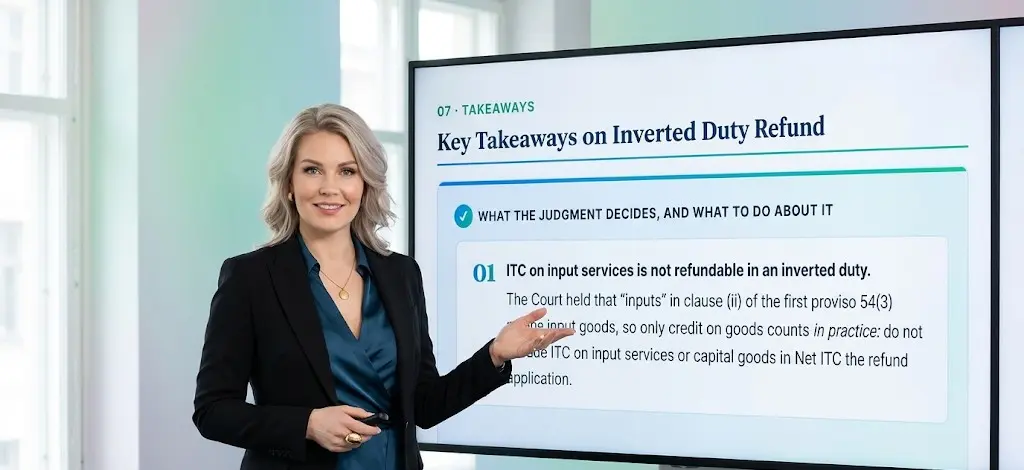
- ITC on input services is not refundable in an inverted duty structure. The Court held that “inputs” in clause (ii) of the first proviso to Section 54(3) means input goods, so only credit on goods counts in Net ITC. In practice: do not include ITC on input services or capital goods in Net ITC when filing the refund application.
- The first proviso to Section 54(3) restricts refund; it is not a mere condition. The words “no refund … shall be allowed in cases other than” confine refund to zero-rated supplies and inverted duty cases. In practice: credit accumulated for other reasons, such as heavy discounts, predatory pricing, bulk purchase of inputs or stock build-up, cannot be claimed as a refund under Section 54(3) (paras 53 and 88).
- Refund is governed by statute, so the restriction is constitutional. The Court upheld the different treatment of goods and services under Article 14 and upheld Explanation (a) to Rule 89(5). In practice: a fresh constitutional challenge to the exclusion of input services has little prospect; plan cash flow on the basis that this credit stays blocked.
- The Court found that the old formula “tilts the balance in favour of the Revenue”, but left the fix to the GST Council. The formula deducted the whole output tax from goods credit alone (para 105). In practice: use the amended formula for applications filed on or after 5 July 2022, and the old formula for applications filed earlier.
- Exports are treated differently from domestic inverted supplies. For zero-rated supplies, the definition of “refund” in the Explanation to Section 54 covers tax on inputs or input services, and the Court relied on that contrast. In practice: treat an export refund under Rule 89(4) and an inverted duty refund under Rule 89(5) as separate claims, because input services count in the first but not in the second.
Practitioner checklist: before filing an inverted duty structure refund
- Confirm that the output supply is not nil rated, fully exempt or notified as ineligible under clause (ii) of the first proviso to Section 54(3).
- Confirm that the accumulation is caused by the rate of tax on input goods being higher than the rate on output supplies.
- Take Net ITC as ITC on input goods only, at all rates, excluding input services and capital goods.
- Check the filing date: use the amended formula for applications filed on or after 5 July 2022.
- File within two years from the relevant date under Section 54(1). For an inverted duty refund, the relevant date is the due date for furnishing the return under Section 39 for the period in which the claim arises (clause (2)(e) of the Explanation to Section 54).
FAQs on Inverted Duty Structure Refund After VKC Footsteps
Can ITC on input services be refunded under an inverted duty structure?
No. In VKC Footsteps (SC, 2021), the Supreme Court held that clause (ii) of the first proviso to Section 54(3) allows a refund only where credit accumulates because the tax rate on input goods is higher than the tax rate on output supplies. ITC on input services and capital goods is not refundable under that clause.
What is the Rule 89(5) formula for an inverted duty structure refund today?
For applications filed on or after 5 July 2022: Maximum Refund Amount = {(Turnover of inverted rated supply of goods and services) × Net ITC ÷ Adjusted Total Turnover} − {tax payable on such inverted rated supply of goods and services × (Net ITC ÷ ITC availed on inputs and input services)}. Net ITC means ITC on input goods only.
Is a provisional refund available for an inverted duty structure refund?
Yes, from 1 November 2026. Section 54(6), as amended by Section 155 of the Finance Act, 2026, allows a provisional refund of 90% of a claim for unutilised ITC under clause (ii) of the first proviso to Section 54(3), subject to the prescribed conditions.
Related Posts
10 · SourcesAuthoritative Sources
- Original judgment: Union of India v. VKC Footsteps India Pvt. Ltd. (SC, 2021), Civil Appeal No. 4810 of 2021 (Supreme Court of India, PDF)
- Statutory provisions: Sections 2(59), 2(60), 54 and 164, CGST Act, 2017 (India Code: select the section); Rules 89(4) and 89(5), CGST Rules, 2017; Articles 14 and 279A(6) of the Constitution of India
- Notification: Notification No. 14/2022-Central Tax, dated 5 July 2022 (Central Goods and Services Tax (Amendment) Rules, 2022; amended formula in Rule 89(5))
- Amending Act: Section 155 of the Finance Act, 2026 (4 of 2026) (Section 54(6) of the CGST Act: 90% provisional refund extended to refunds under clause (ii) of the first proviso to Section 54(3))
- Notification: Notification No. 03/2026-Central Tax, dated 26 October 2026 (Sections 153 to 155 of the Finance Act, 2026 in force from 1 November 2026)
- Circular: Circular No. 181/13/2022-GST, dated 10 November 2022 (amended Rule 89(5) formula applies prospectively from 5 July 2022)
How to find this judgment on the Supreme Court website
On the Supreme Court of India website, open Case Status and use any one of three searches: Case Number (case type Civil Appeal, number 4810, year 2021), Diary Number (24110, year 2020) or Party Name (“VKC Footsteps”). Complete the security code. The judgment dated 13-09-2021 in Union of India & Ors. v. VKC Footsteps India Pvt. Ltd. appears in the Judgment column. On the Digital SCR portal, search the party name “VKC Footsteps”: Civil Appeal No. 4810/2021, [2021] 15 SCR 169, 2021 INSC 469.
Editorial Note: This case law digest is intended for informational and educational purposes. Readers should consult the original judgment and applicable law before relying on the legal position for a specific matter.