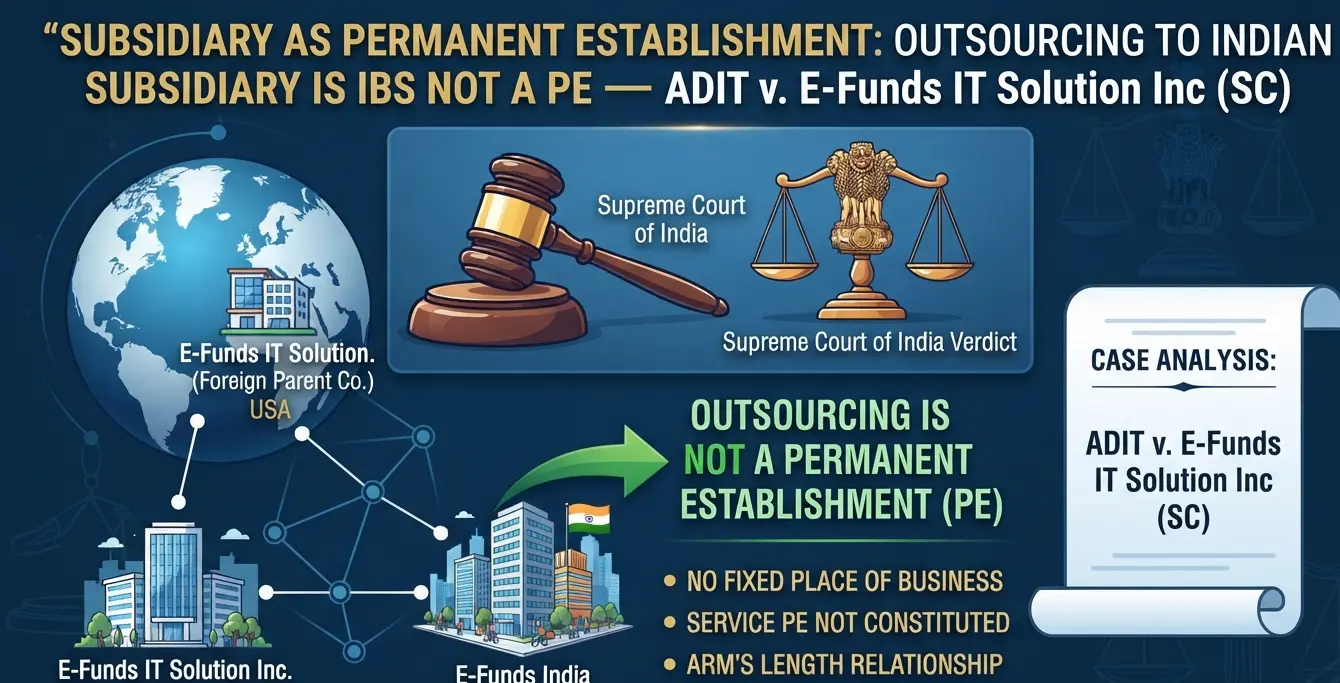
Subsidiary as permanent establishment – India-US DTAA, Article 5 – Fixed place PE: premises “at disposal” test (Formula One) – Outsourcing to a 100% Indian subsidiary – Service PE under Article 5(2)(l) – Agency PE – Arm’s length remuneration – Mutual agreement procedure not a precedent for later years
Whether two US companies that outsourced support work to their wholly owned Indian subsidiary had a fixed place, service or agency permanent establishment in India under Article 5 of the India-US DTAA.
The Revenue’s appeals were dismissed, and the Delhi High Court’s finding that the assessees had no permanent establishment in India was upheld.
A wholly owned Indian subsidiary does not become a permanent establishment of its foreign parent merely because the parent contracts with it, outsources work to it or controls it. A fixed place PE requires premises in India at the disposal of the foreign enterprise through which it carries on its own business; a service PE requires services furnished within India; and the burden of proving a PE lies initially on the Revenue.
The leading Supreme Court authority for multinational groups with captive Indian subsidiaries (call centres, software development and back-office centres). It was applied in 2025 by the Delhi High Court in Nokia Network OY to reject the “virtual projection” theory. The principle continues under Section 159 of the Income-tax Act, 2025.
| Case Name | Assistant Director of Income Tax-I, New Delhi v. M/s E-Funds IT Solution Inc. (SC, 2017) |
| Court | Supreme Court of India (Civil Appellate Jurisdiction) |
| Bench | R.F. Nariman and Sanjay Kishan Kaul, JJ. (judgment by R.F. Nariman, J.) |
| Case Number | Civil Appeal No. 6082 of 2015, with connected appeals (Diary No. 31382/2014) |
| Judgment Date | 24 October 2017 |
| Neutral Citation | 2017 INSC 1048 |
| Reported Citation | (2018) 13 SCC 294; [2017] 10 SCR 157 |
| Relevant Provision | Section 90, Income-tax Act, 1961; Articles 5, 7 and 27 of the India-US DTAA (1990) |
| Income-tax Act, 2025 | Section 159 (agreements for double taxation relief), which corresponds to Section 90 |
| Assessment Years | 2000-01 to 2002-03 and 2004-05 to 2007-08 (e-Funds Corp.); 2000-01 to 2002-03 and 2005-06 to 2007-08 (e-Funds IT Solution Inc.) |
| Judgment Source | Official judgment, Supreme Court of India (PDF) |
Facts of the Case: ADIT v. E-Funds IT Solution Inc (SC, 2017)
The concept in brief. Under a tax treaty, the business profits of a foreign company are taxable in India only if it has a permanent establishment (PE) here, and only to the extent attributable to that PE. The three common forms are a fixed place PE (an office or other place of business through which the foreign company carries on its own business), a service PE (services furnished in India through employees or other personnel) and an agency PE (a dependent agent concluding contracts for it). A subsidiary is a separate taxpayer. The question of a subsidiary as permanent establishment arises when the Revenue argues that the parent is, in substance, doing its own business in India through the subsidiary.
- The assessees, e-Funds Corporation and e-Funds IT Solutions Group Inc., were US companies taxed in the US on their global income. Through a chain of US and Dutch intermediate companies, the group held almost 100% of e-Funds International India Pvt Ltd, which was assessed in India on its own income.
- The US companies’ four businesses (ATM management, electronic payments, decision support and risk management, and global outsourcing) were carried on for customers outside India. e-Funds India ran call centres and software development centres and provided support services to the US companies under international transactions.
- The Transfer Pricing Officer, by an order dated 22 February 2006, accepted that these transactions were at arm’s length.
- The Assessing Officer held that the US companies had a fixed place PE in Delhi. The CIT(A) found fixed place, service and agency PEs. The Tribunal upheld the fixed place and service PE findings but, applying a different formula, computed nil income for all the years.
- The Delhi High Court allowed the assessees’ appeals, set aside the PE findings and dismissed the Revenue’s cross-appeals. The Revenue appealed to the Supreme Court.
Question Before the Supreme Court on Subsidiary as Permanent Establishment
The question was whether, on these facts, the US companies had a fixed place PE under Article 5(1) of the India-US DTAA, a service PE under Article 5(2)(l) or a dependent agent PE under Article 5(4), through their wholly owned Indian subsidiary to which they had outsourced work. The Court also considered whether a mutual agreement procedure (MAP) settlement for earlier years bound the assessees for the years in appeal.
03 · SubmissionsArguments of the Revenue and the Assessee
Assessee’s Arguments
- After Formula One, a fixed place PE requires premises “at the disposal” of the foreign enterprise, which it has a right to use for its own business; that was not shown.
- The TPO had accepted the transactions as being at arm’s length, so no further profit could be attributed even if a PE existed.
- Under Article 5(6), a 100% subsidiary carrying on business in India does not by itself make the parent’s business a PE.
- A service PE needs services to customers in India; all customers were outside India, and the Indian staff were employed by the Indian company.
- Agency PE was never argued before the Tribunal, and the MAP settlement was without prejudice and not binding on later years.
Revenue’s Arguments
- Relying on the group’s SEC Form 10-K, about 40% of the group’s employees were in India, and its call centres and software development centres were only in India.
- The US companies did mainly marketing work and assigned or sub-contracted their contracts to e-Funds India, whose personnel were under their control.
- A service PE arose because the Indian staff were de facto working under the US companies’ supervision, and two employees had been seconded to India (relying on Morgan Stanley).
- The assessees had admitted in the MAP settlement for AYs 2003-04 and 2004-05 that income was attributable to “Indian PEs”, which should bind later years; and an adverse inference should be drawn for non-disclosure of documents.
Supreme Court Decision and Reasoning
The Supreme Court dismissed the Revenue’s appeals and upheld the Delhi High Court’s finding that the assessees had no permanent establishment in India. The Court held that a PE is a creation of the DTAA, and that the burden of proving that a foreign assessee has a PE in India lies initially on the Revenue. Applying Formula One, it held that a fixed place PE exists only where premises in India are at the disposal of the foreign enterprise and it carries on its own business through them. There was no finding by any authority that premises had been put at the disposal of the US companies; the authorities had adopted a fundamentally erroneous approach in treating the outsourcing of work to a 100% subsidiary as creating a PE. The main revenue-earning business of the US companies was carried on outside India, and the Indian company only rendered support services, which did not give rise to a fixed place PE. There was no service PE because no customer received any service in India, and no agency PE because it had never been argued before the Tribunal and had no factual foundation. The Court further held that the MAP settlement for earlier years was not a precedent for later years, and declined to entertain the plea of adverse inference raised for the first time.
The burden is on the Revenue
Section 90 of the Act does not speak of a PE; the concept is a creation of the DTAA. Under Article 7(1), the business income of a US company is taxable only in the US unless it has a PE in India, and then only to the extent attributable to it. Article 5 sets out specific criteria for each type of PE, and the burden of proving that a foreign assessee has a PE in India is initially on the Revenue.
Fixed place PE: the “at disposal” test
Following Formula One World Championship Ltd v. CIT (SC, 2017), the Court held that there must be a fixed place of business in India, at the disposal of the US companies, through which they carry on their own business. The authorities below had made no such finding. Instead, they relied on the close association between the companies and applied a functions, assets and risks analysis. The Court approved the High Court’s view that this is not the test for a fixed place PE: a subsidiary does not become a PE merely because of cross transactions with its parent, its dependence on the parent for revenue, the reimbursement of its costs, or the parent’s saving of expenditure by shifting back-office work to it. The Tribunal’s view that the companies were a joint venture or partnership with the subsidiary was rejected as perverse.
100% subsidiary + outsourcing + close association + FAR analysis → PE
Premises in India at the foreign company’s disposal + its own business carried on through them → fixed place PE
Group-wide data and support services do not make a PE
The SEC Form 10-K spoke of the e-Funds group worldwide and its consolidated assets, so reliance on it was misplaced. A report of Deloitte Haskins & Sells showed that the four main businesses of the US companies were carried on outside India, through ATM networks, software and infrastructure located outside India. The Indian company only rendered support services that enabled the US companies to serve their clients abroad, and such outsourcing did not give rise to a fixed place PE.
Service PE needs services furnished within India
Article 5(2)(l) requires the enterprise to furnish services within India through employees or other personnel. None of the assessees’ customers was located in India or received services in India; only auxiliary operations facilitating those services were carried out here. The Court held that paragraph 42.31 of the OECD Commentary, relied on by the Revenue, does not dispense with services being rendered in India, so the first ingredient of a service PE was not met and it was unnecessary to examine whether the Indian staff were the assessees’ “other personnel”.
Agency PE, MAP and adverse inference
Agency PE had not been argued before the Tribunal, and it was never the Revenue’s case that e-Funds India had or exercised authority to conclude contracts for the US companies. The MAP resolution of 23 April 2007 for AYs 2003-04 and 2004-05 was reached with a view to avoiding double taxation; the US Department of the Treasury had recorded that it did not agree on the technical merits and that the determination was not binding on later years. Relying on paragraph 3.6 of the OECD Manual on MAP, the Court held that such agreements are case and time specific and not precedents. The plea of adverse inference for non-disclosure, raised for the first time, was not entertained.
Applied in Nokia Network OY (Delhi HC, 2025) (TaxProof analysis)
In CIT (International Taxation) v. Nokia Network OY (Delhi HC, 2025), ITA 785/2019 and connected appeals, decided on 21 February 2025 by Yashwant Varma and Ravinder Dudeja, JJ., the High Court applied Formula One and E-Funds to a Finnish telecom equipment supplier whose wholly owned subsidiary, Nokia India Pvt Ltd, carried out installation under its own contracts with Indian operators. A Special Bench of the Tribunal had earlier treated the subsidiary as a PE on the “perception” that it was a “virtual projection” of the parent. The High Court rejected that test: Article 5(8) of the India-Finland DTAA (the counterpart of Article 5(6) in E-Funds) bars any presumption that a subsidiary is a PE, and the existence of a PE must rest on evidence measured against Article 5, not on perception. It also noted that there is no rule that a subsidiary can never be a PE; the tests in Article 5 must be applied to the facts. The Revenue failed to show a fixed place PE or that the subsidiary had authority to conclude contracts, and its income was taxed in its own hands. The software question was conceded in the assessee’s favour in light of Engineering Analysis (SC, 2021).
05 · Binding RuleRatio Decidendi: Outsourcing to a Subsidiary Does Not Create a Permanent Establishment
A foreign company does not have a fixed place PE in India merely because it contracts with, outsources work to or controls a wholly owned Indian subsidiary; there must be premises in India at its disposal through which it carries on its own business, and the functions, assets and risks of the subsidiary are not the test. A service PE under Article 5(2)(l) requires services to be furnished within India. The burden of establishing a PE lies initially on the Revenue, and a MAP settlement for earlier years is not a precedent for later years.
Relying on Morgan Stanley, the Court accepted that where the arm’s length principle is satisfied, no further profits would be attributable even if a PE existed in India. Since no PE was found, this observation was not necessary to the result.
Position Under the Income-tax Act, 2025 (Section 159)
The concept of a PE comes from the DTAA, not from the Act, and the Act gives effect to treaties through its relief provision. Under the Income-tax Act, 2025, that provision is Section 159. Section 159(4) retains the rule that, where an agreement applies, the provisions of the Act apply only to the extent they are more beneficial to the assessee. The tests laid down in E-Funds for fixed place, service and agency PEs therefore continue to govern treaty cases.
Each treaty must be read on its own terms. The subsidiary clause (Article 5(6) of the India-US DTAA, Article 5(8) of the India-Finland DTAA) and the wording of the service PE and agency PE clauses differ between treaties, so the article applicable to the assessee’s country of residence must always be checked.

Key Takeaways on Subsidiary as Permanent Establishment
- A captive subsidiary is not automatically a PE. Outsourcing call centre, software or back-office work to a wholly owned Indian company, and controlling it, does not by itself create a PE of the foreign parent. The Revenue must show premises at the parent’s disposal through which the parent carries on its own business.
- FAR analysis decides pricing, not PE. Functions, assets and risks, cost-plus remuneration and dependence on the parent are transfer pricing questions. Where the subsidiary is remunerated at arm’s length, keep the TPO order and transfer pricing documentation ready, as they also answer any attribution claim.
- Service PE turns on where services are furnished. If the foreign company’s customers receive services outside India and the Indian entity only performs support work, Article 5(2)(l) of the India-US DTAA is not met. Check the exact wording of the service PE clause in the relevant treaty.
- Evidence, not perception. As Nokia Network OY confirms, a PE cannot be inferred from a “virtual projection” or group impressions. Contest PE findings that rest on group reports or assumptions about control, and insist on findings on premises, authority to conclude contracts and the place where services are furnished. A MAP settlement for one year does not bind later years.
Related Posts
09 · SourcesAuthoritative Sources
- Original judgment: ADIT v. E-Funds IT Solution Inc (SC, 2017), Civil Appeal No. 6082 of 2015 (Supreme Court of India, PDF)
- Judgment applying it: CIT (International Taxation) v. Nokia Network OY (Delhi HC, 2025), ITA 785/2019 and connected appeals (Delhi High Court, PDF)
- Statutory provisions: Section 159, Income-tax Act, 2025 · Section 90, Income-tax Act, 1961 (Income Tax Department)
- Authorities referred to: Formula One World Championship Ltd v. CIT (SC, 2017) · DIT v. Morgan Stanley & Co. Inc. (SC, 2007), (2007) 7 SCC 1 · Engineering Analysis Centre of Excellence Pvt Ltd v. CIT (SC, 2021), (2022) 3 SCC 321
How to find these judgments on the official websites
Supreme Court. On the Supreme Court of India website, go to Case Status → Case Number and select Case type: Civil Appeal · Number: 6082 · Year: 2015, then complete the security code. The case appears as Diary No. 31382/2014, Asstt. Director of Income Tax I New Delhi vs. M/s E Funds IT Solution Inc; the judgment dated 24-10-2017 is under the Judgments tab.
Delhi High Court. On the Delhi High Court website, search judgments by case type ITA, number 785, year 2019, or by the judgment date 21-02-2025. The common judgment covers the connected appeals of Nokia Network OY.
Editorial Note: This case law digest is intended for informational and educational purposes. Readers should consult the original judgment and applicable law before relying on the legal position for a specific matter.