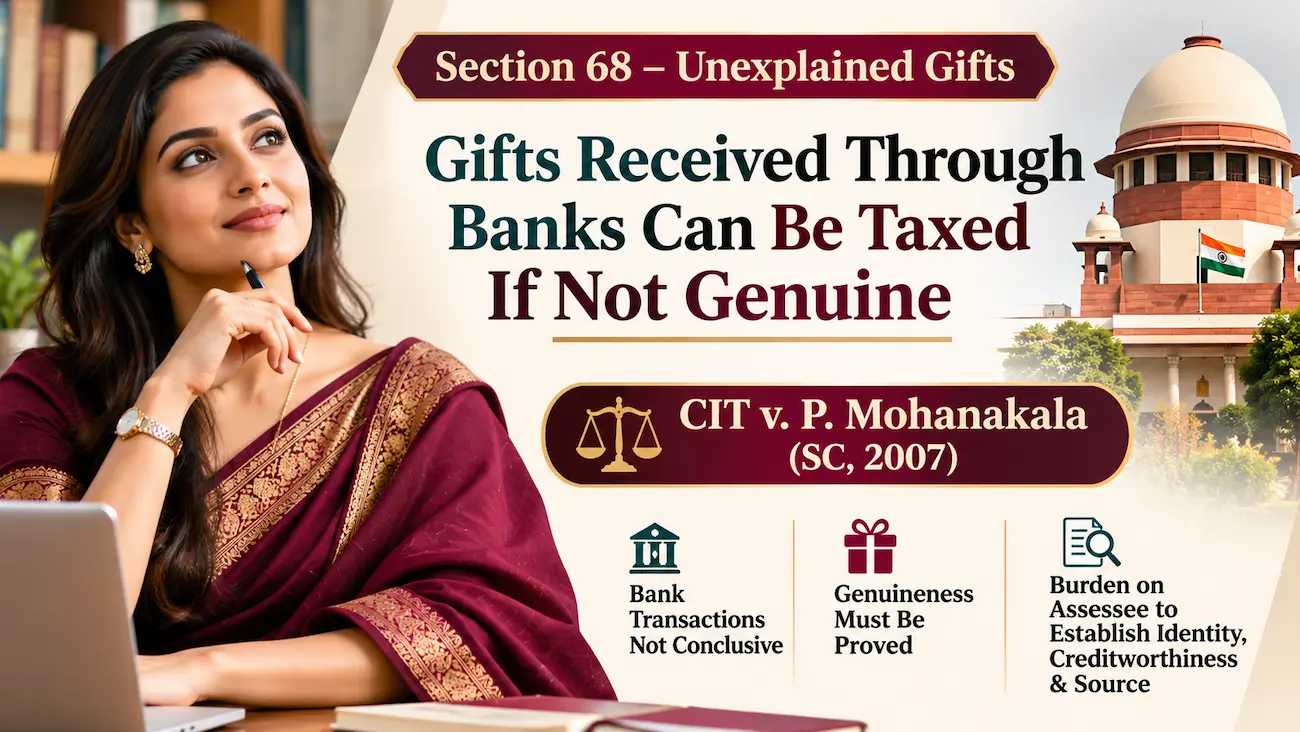
Section 68 unexplained gifts – Foreign gifts of ₹1,79,27,703 credited to five members of one family through banking channels – Donor’s names later said to be aliases of one person – Explanation that the sums were gifts rejected by the Assessing Officer, CIT (Appeals) and Tribunal – Gifts “though apparent” held “not real” – Payment by bank cheques “of no consequence” – Unsatisfactory explanation is prima facie evidence that the receipt is income – Burden on the assessee to rebut – High Court cannot re-appreciate evidence under Section 260A – Sumati Dayal applied
Whether sums received through banking channels and claimed as gifts from a foreign donor could be added as income under Section 68 where the Assessing Officer, the CIT (Appeals) and the Tribunal found, on the material and surrounding circumstances, that the gifts were not genuine.
The Revenue’s appeals were allowed. The Madras High Court’s judgment was set aside and the additions confirmed by the Assessing Officer, the CIT (Appeals) and the Tribunal were restored.
Yes. Where the explanation about the nature and source of a sum credited in the books is not satisfactory, that opinion is prima facie evidence against the assessee that the receipt is income, and the burden is on the assessee to rebut it. A gift that is apparent but not real may be taxed under Section 68 even if the money came through banking channels. Findings of fact based on material and surrounding circumstances cannot be re-appreciated by the High Court under Section 260A.
The leading Supreme Court authority on Section 68 unexplained gifts, cited in later judgments including NRA Iron & Steel (SC, 2019). Section 102 of the Income-tax Act, 2025 carries forward Section 68, so the principles continue to apply.
| Case Name | Commissioner of Income Tax v. P. Mohanakala (SC, 2007) |
| Court | Supreme Court of India (Civil Appellate Jurisdiction) |
| Bench | S.H. Kapadia and B. Sudershan Reddy, JJ. (judgment by B. Sudershan Reddy, J.) |
| Case Number | Civil Appeal No. 2540 of 2007 (arising from SLP (C) No. 17358 of 2006), with Civil Appeal Nos. 2541 to 2547 of 2007 |
| Judgment Date | 15 May 2007 |
| Neutral Citation | 2007 INSC 580 |
| Reported Citation | [2007] 6 SCR 680; (2007) 291 ITR 278 |
| Arising From | Madras High Court, Tax Case (Appeal) Nos. 74 to 76 and 78 to 82 of 2002, judgment of March 2006 |
| Relevant Provisions | Sections 68 and 260A, Income-tax Act, 1961 |
| Income-tax Act, 2025 | Section 102 (unexplained credits), which corresponds to Section 68 |
| Assessment Years | 1995-96 and 1996-97 (gifts received from assessment years 1993-94 to 1996-97) |
| Judgment Source | Official judgment (Supreme Court of India, PDF) |
Facts of the Case: CIT v. P. Mohanakala (SC, 2007)
The concept in brief. Section 68 of the Income-tax Act, 1961 applies where a sum is found credited in the books of an assessee for a previous year. If the assessee offers no explanation about the nature and source of the sum, or the Assessing Officer finds the explanation not satisfactory, the sum “may be charged to income-tax as the income of the assessee of that previous year”. A gift is a common explanation for a credit. Whether the gift is real is a question of fact, decided on the evidence and the surrounding circumstances. Section 68 unexplained gifts disputes therefore turn on what the assessee can prove about the donor and the transaction.
- Five members of one family, A. Srinivasan, his wife, his son, his brother A. Rajendran and Smt. P. Mohanakala, received foreign remittances which they claimed were gifts from a non-resident (para 2).
- The credits were made between 8 July 1992 and 19 October 1995 and totalled ₹1,79,27,703. The payments were made by instruments issued by a foreign bank, mostly cheques drawn on Citibank, N.A., Singapore, and credited to the assessees’ accounts through a bank in India (paras 2 and 3).
- The gifts were sent in the names of “Ariavan Thotan” and “Suprotoman”. Only after the department’s enquiries was it stated, in a letter of 25 April 1996, that these were one person. The name Sampathkumar appeared for the first time in a letter of 30 August 1996, which described the two names as his other names (paras 2 and 7).
- In his statement, Sampathkumar said he had worked abroad and that the family had supported him when he was poor. He did not disclose his Indian bank account details, although he said he would provide them. When asked whether any evidence showed he was known by another name, he answered “no evidence”. As recorded in the judgment, apart from his self-serving statement there was no material evidence of his financial status (para 6).
- The Assessing Officer found the gifts “though apparent are not real”. He relied on letters suggesting that Sampathkumar had reserved a right to suitable compensation, and held that he may have received compensatory payments. The sums were added as income from undisclosed sources (paras 3 and 7).
- The CIT (Appeals) dismissed the appeals. The two members of the Tribunal differed, and on a reference under Section 255(4), the Senior Vice President agreed with the Assessing Officer. The Madras High Court, in appeals under Section 260A, reversed these findings as “surmises, conjectures and suspicions” (paras 8, 9 and 11).
Question Before the Supreme Court on Section 68 Unexplained Gifts
Could the sums claimed as foreign gifts be taxed as income under Section 68, once the Assessing Officer, the CIT (Appeals) and the Tribunal had all found the explanation unsatisfactory, and could the High Court re-appreciate the evidence and substitute its own findings under Section 260A?
03 · SubmissionsArguments of the Revenue and the Assessee
Revenue’s Arguments
- Under Section 260A, the High Court can interfere only on a substantial question of law. Re-appreciating the evidence and disturbing concurrent findings of fact exceeded its jurisdiction (para 12).
- Once the explanation is found unsatisfactory, the sums credited are to be charged to tax as income. A heavy duty lies on the assessee to give a reasonable explanation of the nature and source of the credits (para 12).
Assessee’s Arguments
- The authorities’ conclusions rested on surmises, conjectures and suspicion, and an improper inference from proved facts gives rise to a substantial question of law (para 13).
- Even if the explanation is not accepted, the credits cannot automatically be treated as income unless the question whether the unexplained credit was the assessee’s income is framed and answered (para 13).
Supreme Court Decision and Reasoning
The Supreme Court allowed the Revenue’s appeals and restored the additions under Section 68. It held that the expression “the assessee offers no explanation” means that the assessee offers no proper, reasonable and acceptable explanation, and that the Assessing Officer’s opinion must be formed objectively on the material on record. Where the explanation is found not satisfactory, that opinion is prima facie evidence against the assessee, namely the receipt of money, and the assessee must rebut it. On the facts, the gifts came from names later claimed to be aliases of one person, the donor’s financial capacity was not established, and the letters suggested an expectation of compensation, so the authorities had rightly held the gifts “though apparent” to be “not real”. That the money came through bank cheques was “of no consequence”. As these were findings of fact based on material and surrounding circumstances, no substantial question of law arose and the High Court erred in disturbing them (paras 15, 23, 24 and 25).
What “offers no explanation” means
The Court read Section 68 as requiring four things: a credit in the assessee’s books, of a sum during the previous year, with either no explanation of its nature and source or an explanation the Assessing Officer finds unsatisfactory. “No explanation” means no “proper, reasonable and acceptable explanation”. The Assessing Officer’s opinion must rest on a proper appreciation of the material and the attending circumstances, and “application of mind is the sine qua non for forming the opinion” (para 15).
An unsatisfactory explanation is prima facie evidence of income
Applying Sumati Dayal v. CIT (SC, 1995), the Court held that once the explanation is found unsatisfactory there is, prima facie, evidence against the assessee, namely the receipt of money. If the assessee fails to rebut it, the receipt can be held to be of an income nature. The Court called Sumati Dayal “the complete answer” to the assessees’ submissions (paras 16, 17 and 23).
The “may be charged” discretion and the burden on the assessee
The assessees relied on CIT v. P.K. Noorjahan (SC, 1999), which held under Section 69 that the Assessing Officer is not obliged to treat an unexplained investment as income in every case. The Court accepted that the same principle applies to Section 68. But it held that the assessees had never pleaded that, even if their explanation was rejected, the credits should not be treated as income. The burden of making that plea was on them, and they made no attempt before any authority (paras 18 and 23).
Earlier decisions read in the light of Sumati Dayal
The Court distinguished the decisions relied on by the assessees, including K.S. Kannan Kunhi (Ker HC, 1969), CIT v. Bharat Engineering & Construction Co. (SC, 1972), CIT v. Orissa Corporation (SC, 1986) and CIT v. Deviprasad Khandelwal & Co. (Bom HC, 1971). Kannan Kunhi did not make it the Assessing Officer’s duty to enquire on his own where the assessee raised no plea. Bharat Engineering and Deviprasad Khandelwal treated the inference to be drawn from the facts as a question of fact for the Tribunal, and Orissa Corporation upheld a Tribunal finding as not perverse. All of them, the Court said, must be understood in the light of Sumati Dayal (paras 19 to 23).
Gifts “though apparent” were “not real”
The Court found the authorities’ findings to be based on material and not on conjecture. The gifts came from names whose link to Sampathkumar was disclosed only as an afterthought, and the authorities took into account “the doubtful nature of the transaction and the manner in which the sums were found credited”. The Court added: “May be the money came by way of bank cheques and paid through the process of banking transaction but that itself is of no consequence” (paras 24 and 25).
No substantial question of law under Section 260A
The assessees argued that an improper inference from proved facts raises a question of law. The Court rejected this because the findings rested on a proper appreciation of the facts and the surrounding circumstances. The High Court had re-appreciated the evidence and substituted its own findings, which is not permitted under Section 260A. It “misdirected itself and committed error in disturbing the concurrent findings of facts” (paras 25 and 26).
Applying the reasoning (TaxProof illustration). An assessee shows ₹20,00,000 received by bank transfer from a family friend abroad as a gift. The donor’s name in the bank records differs from the name given later, the donor’s bank statements are not produced, and correspondence mentions “settling up” later.
Under Mohanakala. Payment through a bank proves only that money moved. The Assessing Officer may find the explanation unsatisfactory on these circumstances. That opinion is prima facie evidence that the receipt is income, and the assessee must rebut it with evidence of the donor’s identity, capacity and the genuineness of the gift. If the Tribunal confirms the finding on this material, a High Court appeal under Section 260A will not reopen the facts.
Ratio Decidendi: A Gift That Is Apparent but Not Real Can Be Taxed Under Section 68
Where the explanation offered by an assessee about the nature and source of a sum credited in its books is, in the Assessing Officer’s opinion formed objectively on the material on record, not satisfactory, that opinion is prima facie evidence against the assessee that the receipt is of an income nature, and the burden is on the assessee to rebut it. A credit claimed as a gift may be taxed under Section 68 if the authorities find on the material and surrounding circumstances that the gift, though apparent, is not real, even if the money came through banking channels. Such findings of fact cannot be re-appreciated by the High Court under Section 260A.
The Court accepted that, as held for Section 69 in P.K. Noorjahan, the Assessing Officer is not bound to treat every unexplained credit as income. Even after an explanation is rejected, the question whether the sum constituted income of the previous year must be considered, “provided the assessees rebut the evidence” (para 23). In this case the point did not arise because no such plea was raised.
Position Under the Income-tax Act, 2025 (Section 102)
Section 102 of the Income-tax Act, 2025 carries forward Section 68. Under Section 102(1), a sum credited in the books for a tax year is charged to tax as income where the assessee offers no explanation of its nature and source, or the explanation is not satisfactory to the Assessing Officer. The principles in Mohanakala continue to apply to credits explained as gifts.
Two later changes affect gift cases. First, Section 102(2) applies a “source of source” rule to loans and borrowings, and Section 102(3) applies a similar rule to share capital of closely held companies; neither applies to gifts in terms. Second, from 1 September 2004 the 1961 Act began to tax sums of money received without consideration from non-relatives above a threshold. The rule is now in Section 56(2)(x), which taxes such sums exceeding ₹50,000 in aggregate in a year and excludes gifts from relatives, and Section 92(2)(m) of the 2025 Act carries it forward. For the assessment years in Mohanakala, a genuine gift was not taxable, so the whole dispute was whether the gifts were real.
TaxProof analysis. Today, a large gift from a non-relative is taxable even if it is genuine, so the practical value of Mohanakala now lies mainly in gifts claimed from relatives, which Section 56(2)(x) excludes, and in the general rule that banking channels do not prove a transaction to be real.
Key Takeaways on Section 68 Unexplained Gifts
- A gift paid by bank cheque can still be held not real. The Court said payment through banking channels was “of no consequence” once the surrounding circumstances showed the gifts were not genuine. In practice: do not rely on the bank entry alone; prove who the donor is, that the donor could afford the gift, and why the gift was made.
- An unsatisfactory explanation shifts the burden to the assessee. The Assessing Officer’s opinion that the explanation is not satisfactory is prima facie evidence that the receipt is income. In practice: file the donor’s identity documents, bank statements showing the source of the funds, tax returns and a gift deed at the first stage, not in appeal.
- The Assessing Officer’s opinion must be objective. The Court required a proper appreciation of the material, with “application of mind” as the sine qua non. In practice: if an addition rests only on an assertion that the explanation is not acceptable, without dealing with the evidence filed, challenge the absence of reasons.
- Plead the alternative case expressly. The assessees lost the argument that the credits were not income because they never raised it before the authorities. In practice: where the explanation may be rejected, also plead, with evidence, why the sum still cannot be the assessee’s income of that year.
- Win on facts before the Tribunal. The Court held that findings based on material and surrounding circumstances raise no substantial question of law, so the High Court could not disturb them under Section 260A. In practice: put every document and witness before the Assessing Officer, the CIT (Appeals) and the Tribunal; the High Court is not a second chance on facts.

Practitioner checklist: defending a gift under Section 68 (now Section 102)
- Identify the donor exactly as named in the bank records, and explain any difference in names at the outset.
- Obtain a gift deed or letter stating the amount, date, occasion and relationship.
- Produce the donor’s bank statements showing the source of the funds and the donor’s income tax returns or overseas tax records.
- Establish the relationship; for a non-relative, check whether the gift is taxable in any case under Section 56(2)(x) (now Section 92(2)(m)).
- Confirm that no money flowed back to the donor and that the correspondence does not suggest repayment or compensation.
- Offer to produce the donor for examination, or file an affidavit if the donor is abroad.
- If the explanation is rejected, plead in the alternative why the sum is not income of that year, and place all evidence before the Tribunal.
FAQs on Section 68 Unexplained Gifts After Mohanakala
Can a gift received through a bank be added as income under Section 68?
Yes, according to CIT v. P. Mohanakala (SC, 2007). The Supreme Court upheld additions of foreign gifts received by bank cheques, because the authorities found on the surrounding circumstances that the gifts were “though apparent” not real. Payment through banking channels was held to be “of no consequence”.
Who must prove that a gift is genuine under Section 68?
The assessee. Once the Assessing Officer, on an objective view of the material, finds the explanation about the nature and source of the credit not satisfactory, that opinion is prima facie evidence that the receipt is income, and the burden lies on the assessee to rebut it with evidence of the donor’s identity, capacity and the genuineness of the gift.
Does Mohanakala still apply under the Income-tax Act, 2025?
Yes. Section 102 of the Income-tax Act, 2025 carries forward Section 68, so an unexplained credit claimed as a gift can still be taxed. In addition, a gift of money above ₹50,000 from a non-relative is taxable even if genuine under Section 56(2)(x) of the 1961 Act, which Section 92(2)(m) of the 2025 Act carries forward.
Related Posts
10 · SourcesAuthoritative Sources
- Original judgment: CIT v. P. Mohanakala (SC, 2007), Civil Appeal No. 2540 of 2007 (Supreme Court of India, PDF)
- Statutory provisions: Sections 68, 56(2)(x) and 260A, Income-tax Act, 1961; Section 102, Income-tax Act, 2025 and Section 92, Income-tax Act, 2025 (Income Tax Department)
- Authorities referred to: Sumati Dayal v. CIT (SC, 1995), 1995 Supp (2) SCC 453 · CIT v. P.K. Noorjahan (SC, 1999), (1999) 237 ITR 570 · K.S. Kannan Kunhi v. CIT (Ker HC, 1969), (1969) 72 ITR 757 · CIT v. Bharat Engineering & Construction Co. (SC, 1972), (1972) 83 ITR 187 · CIT v. Orissa Corporation P. Ltd. (SC, 1986), (1986) 159 ITR 78 · CIT v. Deviprasad Khandelwal & Co. Ltd. (Bom HC, 1971), (1971) 81 ITR 460
How to find this judgment on the Supreme Court website
On the Supreme Court of India website, open the judgment search and choose Case Number. Select Civil Appeal, enter 2540 and the year 2007, and complete the captcha. The case Commissioner of Income Tax v. P. Mohanakala appears with the bench S.H. Kapadia and B. Sudershan Reddy and the judgment dated 15-05-2007. You can also search Party Name for “Mohanakala”. On the Digital SCR portal, the judgment is reported as [2007] 6 S.C.R. 680, with the neutral citation 2007 INSC 580.
Editorial Note: This case law digest is intended for informational and educational purposes. Readers should consult the original judgment and applicable law before relying on the legal position for a specific matter.