
Section 263 plausible view – Revision only where the order is erroneous and prejudicial to the Revenue – Commissioner not sitting in appeal – Two views possible – Firm dissolved on the death of a partner but business continued by the surviving partner – Closing stock valued at cost accepted by the Assessing Officer – A.L.A. Firm distinguished – Revision set aside
Whether the Commissioner could revise under Section 263 an assessment that accepted closing stock at cost, where the firm was dissolved on the death of a partner but the surviving partner continued the business.
The Revenue’s appeals were dismissed with costs, so the Revenue had to pay the assessee’s costs. The High Court’s judgment setting aside the Commissioner’s revision order of 20 March 1997 was upheld.
No, the Commissioner could not revise the assessment. Where the Assessing Officer takes a plausible and permissible view, the order is not erroneous and prejudicial to the Revenue merely because the Commissioner prefers another view. Valuing closing stock at cost was such a view here, because the business did not come to an end on the dissolution, so the rule in A.L.A. Firm requiring market value did not apply.
A clear Supreme Court application of the two-view limit laid down in Malabar Industrial, showing how a court tests whether the Assessing Officer’s view was plausible. The valuation point has since been affected by ICDS II, which values inventory at net realisable value on the dissolution of a firm whether or not the business continues; the Section 263 principle is unchanged and continues in Section 377 of the Income-tax Act, 2025.
| Case Name | Commissioner of Income Tax-Gujarat-II v. Kwality Steel Suppliers Complex (SC, 2017) |
| Court | Supreme Court of India (Civil Appellate Jurisdiction) |
| Bench | A.K. Sikri and Ashok Bhushan, JJ. (judgment of the Court; no individual author named) |
| Case Number | Civil Appeal No. 815 of 2007 with Civil Appeal No. 4923 of 2007 |
| Judgment Date | 21 March 2017 |
| Neutral Citation | 2017 INSC 1273 |
| Reported Citation | [2017] 3 SCR 1022 |
| Arising From | Judgment of the High Court in the assessee’s appeal under Section 260A against the Tribunal’s order dated 28 April 2000 |
| Relevant Provisions | Sections 263 and 145, Income-tax Act, 1961 |
| Income-tax Act, 2025 | Section 377 (revision of orders prejudicial to the revenue), which corresponds to Section 263 |
| Assessment Year | 1993-94 |
| Judgment Source | Official judgment (Supreme Court of India, PDF) |
Facts of the Case: CIT v. Kwality Steel Suppliers Complex (SC, 2017)
The concept in brief. Section 263 allows the Commissioner to revise an order of the Assessing Officer that is “erroneous in so far as it is prejudicial to the interests of the revenue”. It is not an appeal. Where the law permits more than one view and the Assessing Officer has taken one of them, the Commissioner cannot revise the order only because he prefers the other. A Section 263 plausible view dispute therefore turns on one question: was the Assessing Officer’s view one that the law permitted?
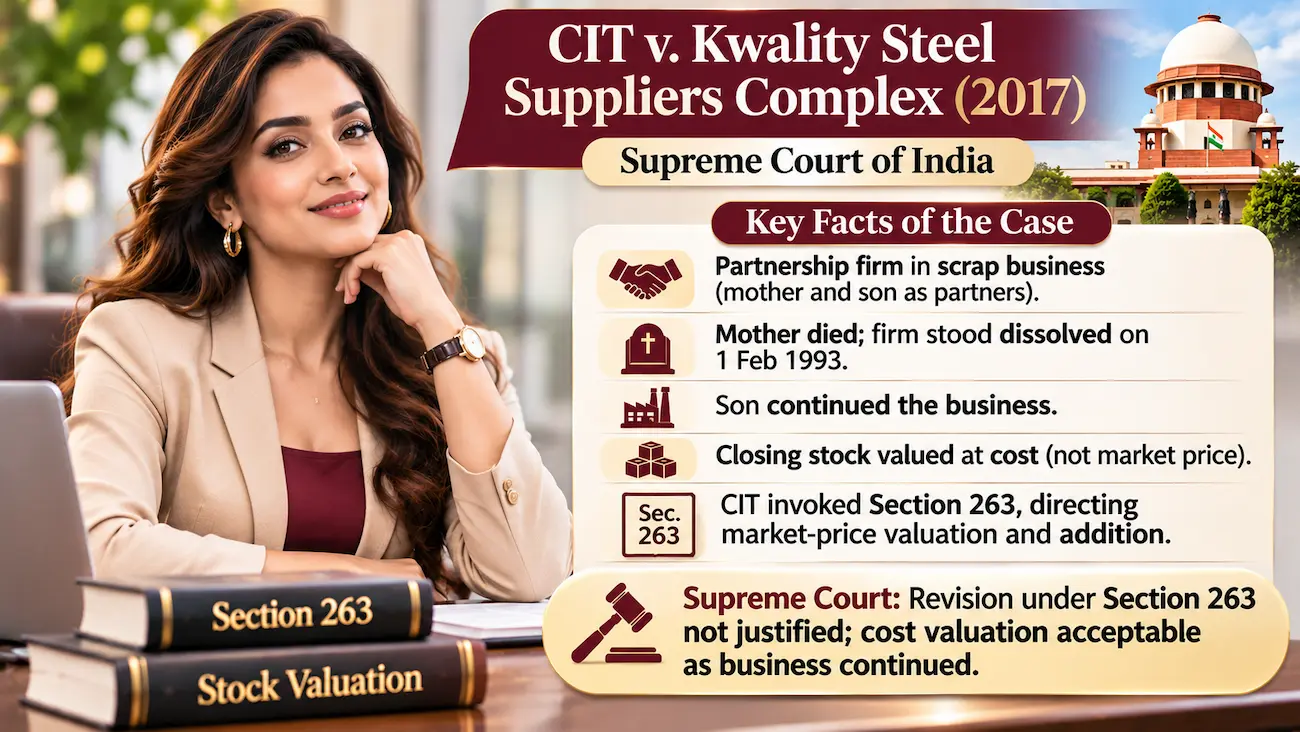
- The assessee was a registered firm dealing in scrap of ship materials. It had two partners, a mother and her son. The firm was dissolved on 1 February 1993 on the death of the mother (paras 1, 10).
- For assessment year 1993-94, the assessee valued its closing stock at cost and returned a total income of ₹16,41,760. The Assessing Officer completed the assessment under Section 143(3) on 24 February 1995 and accepted that method of valuation (para 1).
- The Commissioner issued a show cause notice under Section 263 on 27 February 1997. Relying on A.L.A. Firm v. CIT (SC), (1991) 189 ITR 285, he held that on dissolution the closing stock had to be valued at market rate (para 1).
- The Commissioner added an average gross profit of 15 per cent to the disclosed value of the closing stock of ₹12 crores. The judgment records the resulting addition as “Rs.1,82 crores” (para 1).
- By order dated 20 March 1997, the Commissioner rejected the assessee’s objection, set aside the assessment and directed a fresh assessment in line with his order (para 2).
- The Tribunal dismissed the assessee’s appeal on 28 April 2000. The High Court allowed the assessee’s appeal under Section 260A, relying on Sakthi Trading Co. v. CIT (SC), (2001) 250 ITR 871, and set aside the revision order (para 2).
Question Before the Supreme Court on Section 263 Plausible View
The Court framed the “moot question” as “whether the view taken by the Assessing officer in accepting the valuation of the closing stock at cost price was a plausible view in the circumstances of this case”. If it was, the Commissioner “could not exercise his revisionary jurisdiction under Section 263” (para 11).
03 · SubmissionsArguments of the Assessee and the Revenue
Revenue’s Arguments
- Counsel for the Revenue “basically rested his arguments adopting the reasons given by the ITAT”, which had upheld the revision (para 3).
- The Commissioner’s order, which the Revenue sought to restore, rested on A.L.A. Firm: on dissolution, closing stock must be valued at market rate, so an assessment accepting cost was erroneous and prejudicial to the Revenue (paras 1, 4).
Assessee’s Arguments
- Counsel for the assessee asked the Court to uphold the High Court’s judgment “having regard to the discussion contained” in it (para 3).
- The High Court had relied on Sakthi Trading Co., and had considered whether A.L.A. Firm applied where “the business was continued after the dissolution of the firm” (paras 4–5).
Supreme Court Decision and Reasoning
The Supreme Court dismissed the Revenue’s appeals with costs, so the Revenue had to pay the assessee’s costs. It found no fault with the High Court’s judgment, which had set aside the Commissioner’s revision order of 20 March 1997 (para 21).
The Supreme Court held that Section 263 can be invoked only when both conditions are met: the Assessing Officer’s order is erroneous, and it is prejudicial to the interests of the Revenue. The provision “cannot be invoked to correct each and every type of mistake or error”. Where two views are possible and the Assessing Officer has taken one, the order cannot be revised only because the Commissioner disagrees, because “the CIT is not sitting in appeal” (paras 7–9).
The Court accepted that, if accepting the cost valuation “was totally impermissible”, the Commissioner “was perhaps right”. The decision therefore turned on whether the Assessing Officer’s view was plausible (paras 10–11).
A.L.A. Firm did not make it impermissible. That judgment proceeds on the basis that, on dissolution, “the business of the firm comes to an end”, so the cost method is not allowed. Here the firm was dissolved by operation of law on the mother’s death, but the son, who inherited her share, continued the business. There was no question of selling the stock-in-trade, so it was not necessary to value it at market price (paras 13–16).
Finally, valuing closing stock at cost or market price, whichever is lower, serves to match costs in a continuing business, as explained in Sampatram v. CIT and reiterated in Sakthi Trading Co. The Assessing Officer’s acceptance of the book value of the stock was therefore “a plausible and permissible view”, and the Commissioner “could not exercise his powers under Section 263” (paras 17–20).
Why Section 263 exists, and its limits
The Court explained the purpose of the power. The Department has “no right of appeal to the CIT (A)” against an order of the Assessing Officer, and Section 263 fills that gap by letting the Commissioner revise an order “where the order is erroneous and the error has resulted in prejudice to the interests of the Revenue”. There must be “a proper application of mind by the Commissioner to come to a firm conclusion” on both conditions (para 7).
The two-view limit, from Malabar and Arvind Jewellers
The Court relied on Malabar Industrial Co. Ltd. v. CIT (SC, 2000) for the twin conditions and quoted its explanation of “erroneous” and “prejudicial to the interests of the Revenue”. It relied on CIT v. Arvind Jewellers, (2003) 259 ITR 502, for the rule that an order is not prejudicial merely because the Assessing Officer adopted one of the courses permissible in law, or took one of two possible views with which the Commissioner disagrees (paras 7–9).
What A.L.A. Firm actually decided
The Court read A.L.A. Firm with the Madras High Court decision it discussed, Ramchari (G.R.) and Co. v. CIT, (1961) 41 ITR 142. The privilege of valuing opening and closing stock on a consistent basis “is available only to continuing business”. Where the business comes to an end, the stock has to be disposed of, and the partners settle accounts on a real basis, at market value on the date of dissolution. Over- or under-valuation can no longer be adjusted in a later year (paras 13–15).
A dissolution is not always a closure of business
The facts here were different. The partnership stood dissolved by the operation of law, but the business did not end. The surviving partner continued it, so the stock-in-trade was not sold and the reason for market valuation did not arise. The Court concluded that “when a business continues, it may not be necessary to follow the market rate to value the closing stock as the reasons because of which the same is to be done are not available” (paras 16, 19).
The purpose of valuing closing stock
The Court quoted Sampatram v. CIT, West Bengal, (1953) 24 ITR 481. The closing stock entry exists to cancel the cost of goods bought but not sold, so that only actual sales show a profit or loss. Market value is used only where it is lower than cost, because a prudent trader anticipates losses but not profits. Unrealised profit in the appreciated value of unsold stock in a continuing business is not brought to tax (para 17).
Reading the ruling with Malabar and Amitabh Bachchan (TaxProof analysis)
This judgment shows the other side of the Section 263 cases already on TaxProof. In Malabar Industrial, the order fell because the Assessing Officer accepted a claim without any material or enquiry. In Amitabh Bachchan, it fell because the Assessing Officer dropped an enquiry the facts required. In Kwality Steel, the Assessing Officer accepted a valuation that the law, as the Court read it, permitted, so the revision failed. The test is the same in all three: whether the Assessing Officer’s order is unsustainable in law or on the record, not whether the Commissioner would have decided differently.
Applying the ruling (TaxProof illustration). A firm of two partners is dissolved on 31 December 2015 on the death of one partner, and the surviving partner continues the business as a proprietor. The firm values closing stock of ₹2,00,00,000 at cost, and the Assessing Officer accepts it. The Commissioner proposes revision under Section 263 to value the stock at market price.
Under Kwality Steel. Because the business continued, the cost valuation was a plausible view for that year, and the revision should fail. For years governed by the Income Computation and Disclosure Standards, however, the assessee must also deal with ICDS II, which values inventory at net realisable value on the dissolution of a firm irrespective of whether the business continues. An Assessing Officer who accepts cost in such a year may no longer be taking a view the law permits.
Ratio Decidendi: A Plausible View of the Assessing Officer Cannot Be Revised
The Commissioner can revise an order under Section 263 only if it is both erroneous and prejudicial to the interests of the Revenue. Where the Assessing Officer has taken a plausible and permissible view, the order cannot be revised merely because the Commissioner prefers another view. Where a firm is dissolved by the death of a partner but the business is continued by the surviving partner, the rule in A.L.A. Firm requiring market valuation of closing stock does not apply, and the Assessing Officer’s acceptance of valuation at cost is a plausible view that cannot be revised (paras 7–11, 16, 19–20).
The Court did not lay down that closing stock may always be valued at cost on dissolution. It held only that, on these facts, accepting cost was a plausible view, which was enough to defeat the revision. The connected Civil Appeal No. 4923 of 2007 was dismissed with the lead appeal, but the judgment does not set out its facts (para 21).
 06 · New Law
Position Under the Income-tax Act, 2025 (Section 377)
The Section 263 principle still applies. Section 377 of the Income-tax Act, 2025 carries forward Section 263. Under Section 377(1), the Competent Authority may revise an order that is “erroneous in so far as it is prejudicial to the interests of the revenue”, after giving the assessee an opportunity of being heard. The two-view limit applied in this judgment continues to govern that power.
The valuation point has changed. The Income Computation and Disclosure Standards, notified under Section 145(2) of the 1961 Act by Notification No. 87/2016 dated 29 September 2016, include ICDS II on valuation of inventories. As the Income Tax Department’s summary of ICDS II states, on the dissolution of a firm, association of persons or body of individuals, inventory is valued at net realisable value “irrespective of business continuation”. For years governed by ICDS, the continuation of business no longer supports valuation at cost on dissolution, so an Assessing Officer who accepts cost on dissolution may no longer be taking a view the law permits.
Deemed error. Section 377(3), which carries forward Explanation 2 to Section 263, also deems an order erroneous and prejudicial where it is not made in accordance with an order, direction or instruction issued by the Board, or with a decision prejudicial to the assessee rendered by the jurisdictional High Court or the Supreme Court. An Assessing Officer’s view that departs from such a direction or ruling is therefore unlikely to be treated as a plausible view.
Key Takeaways on Section 263 Plausible View
- A plausible view of the Assessing Officer cannot be revised. Section 263 requires an order that is both erroneous and prejudicial; a view the law permits is neither, even if the Commissioner prefers another. In practice: in reply to a Section 263 notice, show the legal basis on which the Assessing Officer’s view was permissible.
- The Commissioner does not sit in appeal. Section 263 fills the gap left by the Department’s lack of an appeal against the Assessing Officer, but it is a revisional power, not an appellate one. In practice: where the record shows the Assessing Officer examined the point, argue that the revision only substitutes the Commissioner’s opinion for the Assessing Officer’s.
- A.L.A. Firm applies where the business ends on dissolution. Market valuation of closing stock was required there because the business came to an end; it was not required where the surviving partner continued the business. In practice: before applying A.L.A. Firm, establish on the facts whether the business actually ended.
- ICDS II has changed the valuation rule. For years governed by ICDS, inventory on the dissolution of a firm is valued at net realisable value whether or not the business continues. In practice: do not rely on Kwality Steel for the valuation point in such years; rely on it only for the Section 263 principle.
- The rule continues under Section 377. The 2025 Act keeps the same words “erroneous in so far as it is prejudicial to the interests of the revenue”. In practice: cite Kwality Steel with Malabar Industrial when a revision under Section 377 rests only on a difference of opinion.

Practitioner checklist: testing whether the Assessing Officer’s view was plausible
- Identify the precise issue the Commissioner proposes to revise.
- Find the statutory provision, rule, ICDS or judgment that supports the Assessing Officer’s view.
- Check whether any binding CBDT direction, jurisdictional High Court ruling or Supreme Court ruling goes the other way.
- Check from the assessment record that the issue was examined, with queries and replies on file.
- Distinguish, on its facts, the authority the Commissioner relies on, as the Court distinguished A.L.A. Firm.
- In appeal, frame the ground as want of jurisdiction under Section 263 (now Section 377), citing Malabar Industrial and Kwality Steel.
FAQs on Section 263 Plausible View After Kwality Steel
Can the Commissioner revise an assessment because he prefers a different view?
No. In CIT v. Kwality Steel Suppliers Complex (SC, 2017), the Supreme Court held that where the Assessing Officer has taken a plausible and permissible view, the order is not erroneous and prejudicial to the Revenue, and cannot be revised under Section 263.
Must closing stock be valued at market price when a firm is dissolved?
Not where the business continues after dissolution, according to Kwality Steel (SC, 2017): A.L.A. Firm applies where the business comes to an end. For years governed by ICDS II, however, inventory on the dissolution of a firm is valued at net realisable value irrespective of whether the business continues.
Does Kwality Steel apply under the Income-tax Act, 2025?
Yes, for the revision principle. Section 377 of the 2025 Act uses the same test of an order “erroneous in so far as it is prejudicial to the interests of the revenue”, and the two-view limit continues to apply.
Related Posts
10 · SourcesAuthoritative Sources
- Original judgment: CIT-Gujarat-II v. Kwality Steel Suppliers Complex (SC, 2017), Civil Appeal No. 815 of 2007 with Civil Appeal No. 4923 of 2007 (Supreme Court of India, PDF)
- Statutory provisions: Section 377, Income-tax Act, 2025 (Income Tax Department); Sections 145 and 263, Income-tax Act, 1961; Income Computation and Disclosure Standards (ICDS), Income Tax Department
- Authorities referred to in the judgment: Malabar Industrial Co. Ltd. v. CIT (SC), (2000) 243 ITR 83 · CIT v. Arvind Jewellers, (2003) 259 ITR 502 · A.L.A. Firm v. CIT (SC), (1991) 189 ITR 285 · Sakthi Trading Co. v. CIT (SC), (2001) 250 ITR 871 · Sampatram v. CIT, West Bengal (SC), (1953) 24 ITR 481 · Ramchari (G.R.) and Co. v. CIT (Mad HC), (1961) 41 ITR 142
How to find this judgment on the Supreme Court website
On the Supreme Court of India website, use the judgment search by Judgment Date (21-03-2017) or Case Number (Civil Appeal 815 of 2007) and complete the captcha. On the Digital SCR portal, search “Kwality Steel”; it is reported as [2017] 3 S.C.R. 1022, with the neutral citation 2017 INSC 1273.
Editorial Note: This case law digest is intended for informational and educational purposes. Readers should consult the original judgment and applicable law before relying on the legal position for a specific matter.