
Assessment on directions of higher authority – Assessing Officer performs a quasi-judicial function – Note in the assessment order recording that the Commissioner directed the case to be assessed as returned – Supervisory authority cannot decide the merits – Order passed at the dictates of a higher authority without jurisdiction and a nullity – Section 263 revision order and consequential Section 148 notices not maintainable – Limited power to give directions for other years – Fresh assessment directed under Article 142
Whether an assessment order is valid when the Assessing Officer’s own note records that it was passed at the instance of the Commissioner and the Additional Commissioner. A connected question was whether the later revision order under Section 263, with its directions to reopen other years, was maintainable.
Both appeals were disposed of with directions and no order as to costs, so each side bore its own costs. The Section 263 order and the Section 148 notices issued under it were held not maintainable. The original assessment, passed at the dictates of higher authorities, was held a nullity, and the Court directed under Article 142 that the assessment be reopened by the Commissioner of Income-tax, Delhi-VII.
No, such an order is not valid. An Assessing Officer performs a quasi-judicial function and must pass an independent order of assessment. A higher authority may supervise and the Assessing Officer is bound by statutory CBDT circulars, but the merits of an assessment cannot be decided at the instance of a superior. An assessment passed on the dictates of higher authorities is wholly without jurisdiction and a nullity, even if the authorities acted bona fide.
A leading Supreme Court authority on the independence of the Assessing Officer. It can be relied on where an assessment, a reassessment or a penalty order shows that the decision was taken by a superior officer rather than by the officer who signed it. The only binding directions an Assessing Officer can receive on a pending assessment are those the statute allows, now under Section 272 of the Income-tax Act, 2025.
| Case Name | Commissioner of Income Tax, Shimla v. M/s Greenworld Corporation, Parwanoo (SC, 2009) |
| Court | Supreme Court of India (Civil Appellate Jurisdiction) |
| Bench | S.B. Sinha and Dr. Mukundakam Sharma, JJ. (judgment by S.B. Sinha, J.) |
| Case Number | Civil Appeal No. 3312 of 2009 (arising out of SLP (C) No. 1789 of 2007), with the assessee’s appeals arising out of SLP (C) Nos. 16922–16925 of 2007 |
| Judgment Date | 6 May 2009 |
| Neutral Citation | 2009 INSC 720 |
| Reported Citation | [2009] 8 SCR 175 |
| Arising From | Himachal Pradesh High Court, ITA No. 50 of 2005 and CWP No. 800 of 2005, judgment dated 2 March 2006; review order dated 3 April 2007 |
| Relevant Provisions | Sections 148, 150, 263, 120 and 127, Income-tax Act, 1961; Article 142, Constitution of India |
| Income-tax Act, 2025 | Section 377 (revision of orders prejudicial to the revenue), which corresponds to Section 263; Section 272 (power of Joint Commissioner to issue directions in certain cases) |
| Assessment Year | 2000-01 (directions also issued for assessment years 1996-97 to 1999-2000 and 2001-02 to 2003-04) |
| Judgment Source | Official judgment (Supreme Court of India, PDF) |
Facts of the Case: CIT v. Greenworld Corporation (SC, 2009)
The concept in brief. The Income-tax Act sets up a hierarchy of authorities. The Board and senior officers supervise, issue circulars and transfer cases, but the assessment itself is made by the Assessing Officer, whose order can then be tested in appeal or revision. An assessment on directions of higher authority, where a superior decides the merits and the Assessing Officer only signs, defeats that scheme. This judgment decides what happens to such an order.
- The assessee, a partnership of Shri R.S. Gupta and his wife, set up units at Parwanoo, Himachal Pradesh in 1995 to make exercise books and writing pads, after a tax holiday was announced. For assessment year 2000-01 it showed total sales of ₹1,51,69,515, with net profit at 49% of sales; the ratio was 66% in the earlier year and 81% to 95% in the next three years (para 3).
- A survey under Section 133A was conducted on 7 February 2000. The return for assessment year 2000-01 declared nil income after deduction under Section 80-IB. By order dated 19 December 2002, the Assessing Officer accepted the returned income (para 4).
- Below the order, the Assessing Officer recorded a note. She had been called to the Commissioner’s office at Shimla on 4 December 2002 with the records. There, in the presence of the Additional Commissioner, Solan, the Commissioner “directed that since the reply submitted by the assessee is satisfactory and upto the mark, no more information is required to be called for and to assess the case as such”. The draft order was sent to the Additional Commissioner for approval, which was received by telephone (para 4).
- The Commissioner was transferred. His successor issued a notice under Section 263 on 5 December 2003, and by order dated 12 July 2004 estimated the income at 5% of turnover, treated the income declared above 5% of turnover as undisclosed income and denied the deduction under Sections 80-IA/80-IB. He also directed the Assessing Officer to initiate Section 148 proceedings for the earlier and later years “within a week” (paras 5–6).
- Notices under Section 148 were issued for assessment years 1996-97 to 1999-2000, 2001-02 and 2002-03. A notice for assessment year 2000-01 followed on 5 July 2005 (paras 6, 8).
- The Tribunal, by order dated 15 April 2005, set aside the revision order on jurisdiction alone. It held that the assessment was made after proper enquiries and that directions for other years were beyond the Commissioner’s jurisdiction (para 8).
- On the assessee’s application, the CBDT transferred the case to the Commissioner, Delhi with effect from 5 September 2005 (para 10). The High Court, by judgment dated 2 March 2006, allowed the Revenue’s appeal and dismissed the assessee’s writ petition, holding the assessment bad because it was passed under the dictates of the Commissioner (para 12). On review, it expunged its remarks against the former Commissioner (paras 15–16).
Question Before the Supreme Court on Assessment on Directions of Higher Authority
The Court identified the principal question as “whether the order of assessment was passed at the instance of the Higher Authority” (para 19). It also had to decide whether the Commissioner’s revision order and the Section 148 notices issued under it were valid, and whether the Commissioner, Shimla could maintain the appeal after the case was transferred to Delhi (paras 23, 33).
03 · SubmissionsArguments of the Assessee and the Revenue
Assessee’s Arguments
- After the CBDT transferred the case to Delhi, the Commissioner, Shimla had no locus standi to appeal to the High Court (para 17).
- The Section 263 notice covered assessment year 2000-01 only, so directions for past and future years could not be issued, and some were time-barred. The Section 148 notices issued under those directions were not maintainable (para 17).
- A mere error of law or a different view from the Assessing Officer could not justify revision under Section 263 (para 17).
- The Commissioner, Shimla had not raised any question that the assessment was passed at the behest of the Commissioner. The note was made in view of a CBDT circular of 3 July 2001, and the High Court erred in relying on it (para 17).
Revenue’s Arguments
- The Commissioner, Shimla could appeal because he had passed the revision order before the transfer (para 18).
- The assessee had shown huge profits without enough workers or electricity consumption, only to enjoy the tax holiday, so the Commissioner rightly interfered (para 18).
- The profits were disproportionate to the investment, and the assessee was not prejudiced even if the appeal was improperly filed (para 18).
Supreme Court Decision and Reasoning
The Supreme Court disposed of both appeals with directions and made no order as to costs, so each side bore its own. The Section 263 order and the Section 148 notices issued under it fell. At the same time, the original assessment of 19 December 2002 was held a nullity, and the Court directed under Article 142 that the assessment be reopened by the Commissioner of Income-tax, Delhi-VII (paras 35, 37–38).
The Supreme Court held that an Assessing Officer, while passing an order of assessment, “performs judicial function”. A higher authority may have supervisory jurisdiction under CBDT circulars, and the Assessing Officer is bound by statutory circulars. But it is “another thing to say” that the Assessing Officer “would lose its independence to pass an independent order of assessment” (paras 20, 31).
The Assessing Officer’s note was specific. It recorded that the merits were discussed and decided at the instance of the Commissioner, a supervisory authority. Where a statute provides different forums for original and appellate orders, “by no stretch of imagination a higher authority can interfere with the independence which is the basic feature of any statutory scheme involving adjudicatory process” (paras 31–32).
The revision did not survive either. The Commissioner, Shimla “had no jurisdiction to issue directions”, and notices issued under them “would be bad in law”. Relying on earlier rulings that a finding or direction must be necessary for deciding the year before the authority, the Court held that “jurisdiction to issue directions is limited” (paras 29–30).
Finally, the Court did not go into whether the officers acted bona fide. Even if they did, the assessment “passed by the Assessing Officer on the dictates of the higher authorities being wholly without jurisdiction, it was a nullity”. To do complete justice, the assessment had to be gone through again by the appropriate authority (para 35).
The Assessing Officer performs a quasi-judicial function
The Court began with the nature of the assessment. An appeal lies against the Assessing Officer’s order, and a revision lies to the Commissioner, so the order is an adjudication open to correction within the statute (para 20). The Court then examined the hierarchy of authorities under the Act, which provides for classes of authorities (Section 116), control by Board notification (Section 118), Board instructions (Section 119), jurisdiction exercised in accordance with Board directions (Section 120) and transfer of cases (Section 127) (para 21). The Court read this scheme as leaving the assessment itself to the Assessing Officer (paras 21, 31–32).
Supervision is not decision
The Court accepted that, under the CBDT circular, the Commissioner “may have supervisory jurisdiction”. It held, however, that “it is difficult to conceive that even the merit of the decision shall be discussed and the same shall be rendered at the instance of the higher authority” (para 31). It contrasted statutory circulars, which bind the department as held in State of Kerala v. Kurian Abraham (P) Ltd. (SC), (2008) 3 SCC 582, with directions on the merits of a particular case (para 31).
The administrative-law principle behind the ruling
The Court relied on two general authorities. In Commissioner of Police, Bombay v. Gordhandas Bhanji (SC), AIR 1952 SC 16, the Commissioner of Police had cancelled a permission stating that he was “directed by Government” to do so, and the Court held that public orders must be construed objectively, by the language of the order itself. In Purtabpur Company Ltd. v. Cane Commissioner of Bihar (SC), AIR 1970 SC 1896, an officer exercising a statutory power “cannot abdicate his responsibility in favour of anyone”, unless “explicit statutory provision has been made for them to be given binding instructions by a superior” (para 32).
The revision and the directions for other years
The Court recalled the twin conditions in Malabar Industrial Co. Ltd. v. CIT (SC, 2000) and the two-view limit in CIT v. Max India Ltd. (SC, 2007): both conditions are “conjunctive and not disjunctive”, and an assessment should not be disturbed “only because another view is possible” (paras 23–24, 29). On the directions for other years, it held that Section 150(1) lifts the bar of limitation only where reopening is needed to comply with a higher authority’s order within the proceeding before it. Relying on ITO v. Murlidhar Bhagwan Das (SC), 52 ITR 335 and Rajinder Nath v. CIT (SC), 120 ITR 14, it concluded that “jurisdiction to issue directions is limited” (para 30).
The Commissioner, Shimla could appeal
The assessee’s objection to the Commissioner’s locus standi failed. The Commissioner had passed the revision order and his right to appeal arose when the Tribunal set it aside. Applying the principle in Section 21 of the Code of Civil Procedure, an objection to territorial jurisdiction needs proof of prejudice, and “nothing has been shown as to how the assessee was prejudiced” (paras 33–34).
Why the Court used Article 142
Setting aside only the revision order would have left in place an assessment the Court had found to be a nullity. Under Article 136, the Court may refuse relief, or quash both orders, where setting aside one illegal order would give rise to another illegality. It therefore directed a fresh assessment by the Commissioner, Delhi-VII, the authority that now had jurisdiction (paras 35–37).
Applying the ruling (TaxProof illustration). During an assessment, the Assessing Officer’s order sheet records: “Discussed with the Range Head. As directed, the addition of ₹60,00,000 under Section 68 is to be made.” The final order makes the addition without any independent reasoning on the assessee’s replies, and no directions were issued under the statutory procedure after hearing the assessee.
Under Greenworld. The assessee can argue that the addition was decided at the instance of a superior, so the order is without jurisdiction and a nullity. The order sheet is the evidence: in Greenworld, the Court acted on the Assessing Officer’s own note. The assessee should also note the cost: the Court there did not simply quash the assessment, but directed a fresh one.
Ratio Decidendi: An Assessment Must Be the Assessing Officer’s Own Decision
An Assessing Officer exercising quasi-judicial functions must pass an independent order of assessment. A superior authority may exercise supervisory jurisdiction, and the Assessing Officer is bound by statutory CBDT circulars, but a superior cannot decide the merits of an assessment. An assessment order passed on the dictates of higher authorities is wholly without jurisdiction and a nullity, whether or not the authorities acted bona fide. The Commissioner’s revisional power under Section 263 is supervisory and subject to the twin conditions, and his power to give directions for years outside the revision is limited (paras 20, 29–32, 35).
Article 142 direction. The direction to reopen the assessment through the Commissioner, Delhi-VII was made “with a view to do complete justice between the parties” in this case (paras 35, 37). It is relief under Article 142, not a rule that every assessment found to be a nullity must be redone. Merits. The Court did not decide whether the assessee was entitled to the deduction under Sections 80-IA/80-IB or whether the Commissioner’s findings on its units were right (paras 24, 35).
Position Under the Income-tax Act, 2025 (Sections 377 and 272)
The independence of the Assessing Officer is not a rule of one section. It follows, as the Court held, from the statutory scheme of original assessment, appeal and revision, and that scheme continues under the Income-tax Act, 2025. Revision of orders prejudicial to the revenue is now in Section 377, which keeps the twin conditions and the opportunity of hearing.
The 2025 Act also contains the kind of “explicit statutory provision” the Court referred to. Under Section 272(1), a Joint Commissioner may, on his own motion, on a reference by the Assessing Officer or on the assessee’s application, issue directions in a pending assessment “for the guidance of the Assessing Officer to enable him to complete the assessment”, and such directions are binding. Under Section 272(2), directions prejudicial to the assessee cannot be issued without first giving the assessee an opportunity of being heard. A direction issued under this procedure is lawful; an informal direction on the merits, like the one recorded in Greenworld, is not.
 07 · Takeaways
Key Takeaways on Assessment on Directions of Higher Authority
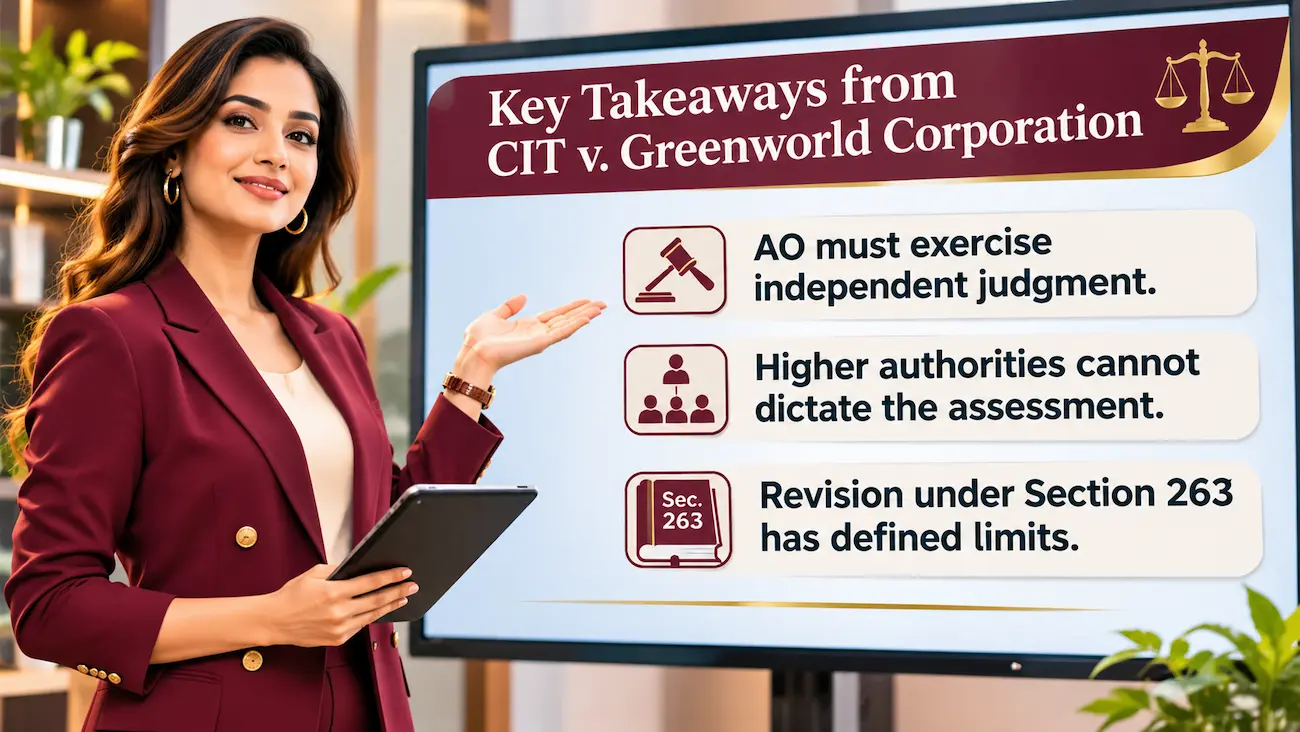
- An assessment decided by a superior is a nullity. An order passed on the dictates of higher authorities is wholly without jurisdiction, even if the officers acted bona fide. In practice: obtain certified copies of the order sheet and file notings; they are the evidence, as the Assessing Officer’s own note was in this case.
- Supervision and binding circulars are allowed; deciding the merits is not. The Assessing Officer is bound by statutory CBDT circulars, but no superior can decide the merits of an individual assessment. In practice: distinguish a general circular or administrative approval from a direction on the merits of your case.
- Binding directions in a pending case must come through the statute. Binding directions on a pending assessment must come through the statutory route, now Section 272 of the 2025 Act, with a hearing if they are prejudicial. In practice: if a direction against you was issued without a hearing, challenge it on that ground as well.
- Revision cannot be used to reopen other years at will. The Commissioner had no jurisdiction to issue the directions, and notices issued under them were bad; Section 150(1) does not lift limitation for years outside the proceeding. In practice: where reopening notices cite a revision order for another year, check whether that year was before the revising authority.
- Winning on nullity may lead to a fresh assessment. The Court did not leave the assessee with an accepted return; it directed a fresh assessment under Article 142. In practice: weigh this before pressing a nullity argument against an order in your favour.
Practitioner checklist: where the record shows a superior decided the assessment
- Inspect the assessment record and obtain the order sheet and file notings.
- Identify any note that a superior discussed or decided the merits.
- Check whether any direction was issued under the statutory procedure (now Section 272 of the 2025 Act) and whether you were heard.
- Separate administrative approval of a draft order from a decision on the merits.
- Raise lack of jurisdiction as a distinct ground in appeal, citing Greenworld (SC, 2009).
- For reopening notices issued on a revision order’s directions, test them against Section 150 and the year actually revised.
FAQs on Assessment on Directions of Higher Authority After Greenworld
Is an assessment order passed on the directions of the Commissioner valid?
No. In CIT v. Greenworld Corporation (SC, 2009), the Supreme Court held that an assessment passed on the dictates of higher authorities is wholly without jurisdiction and a nullity, because the Assessing Officer must pass an independent order.
Can a senior officer ever give binding directions in a pending assessment?
Only through the statutory route. Under Section 272 of the Income-tax Act, 2025, a Joint Commissioner may issue binding directions for the guidance of the Assessing Officer, but not directions prejudicial to the assessee without first giving a hearing. Informal directions on the merits are not covered.
Does Greenworld still apply under the Income-tax Act, 2025?
Yes. The rule rests on the statutory scheme of independent assessment, appeal and revision, which continues under the 2025 Act, with revision now in Section 377.
Related Posts
10 · SourcesAuthoritative Sources
- Original judgment: CIT, Shimla v. Greenworld Corporation, Parwanoo (SC, 2009), Civil Appeal No. 3312 of 2009 (Supreme Court of India, PDF)
- Statutory provisions: Section 377, Income-tax Act, 2025 · Section 272, Income-tax Act, 2025 (Income Tax Department); Sections 148, 150 and 263, Income-tax Act, 1961
- Authorities referred to in the judgment: Malabar Industrial Co. Ltd. v. CIT (SC), 243 ITR 83 · CIT v. Max India Ltd. (SC), (2007) 295 ITR 282 · ITO v. Murlidhar Bhagwan Das (SC), 52 ITR 335 · Rajinder Nath v. CIT (SC), 120 ITR 14 · State of Kerala v. Kurian Abraham (P) Ltd. (SC), (2008) 3 SCC 582 · Commissioner of Police, Bombay v. Gordhandas Bhanji (SC), AIR 1952 SC 16 · Purtabpur Company Ltd. v. Cane Commissioner of Bihar (SC), AIR 1970 SC 1896
How to find this judgment on the Supreme Court website
On the Supreme Court of India website, use the judgment search by Judgment Date (06-05-2009) or Case Number (Civil Appeal 3312 of 2009) and complete the captcha. On the Digital SCR portal, search “Greenworld Corporation”; it is reported as [2009] 8 S.C.R. 175, with the neutral citation 2009 INSC 720.
Editorial Note: This case law digest is intended for informational and educational purposes. Readers should consult the original judgment and applicable law before relying on the legal position for a specific matter.