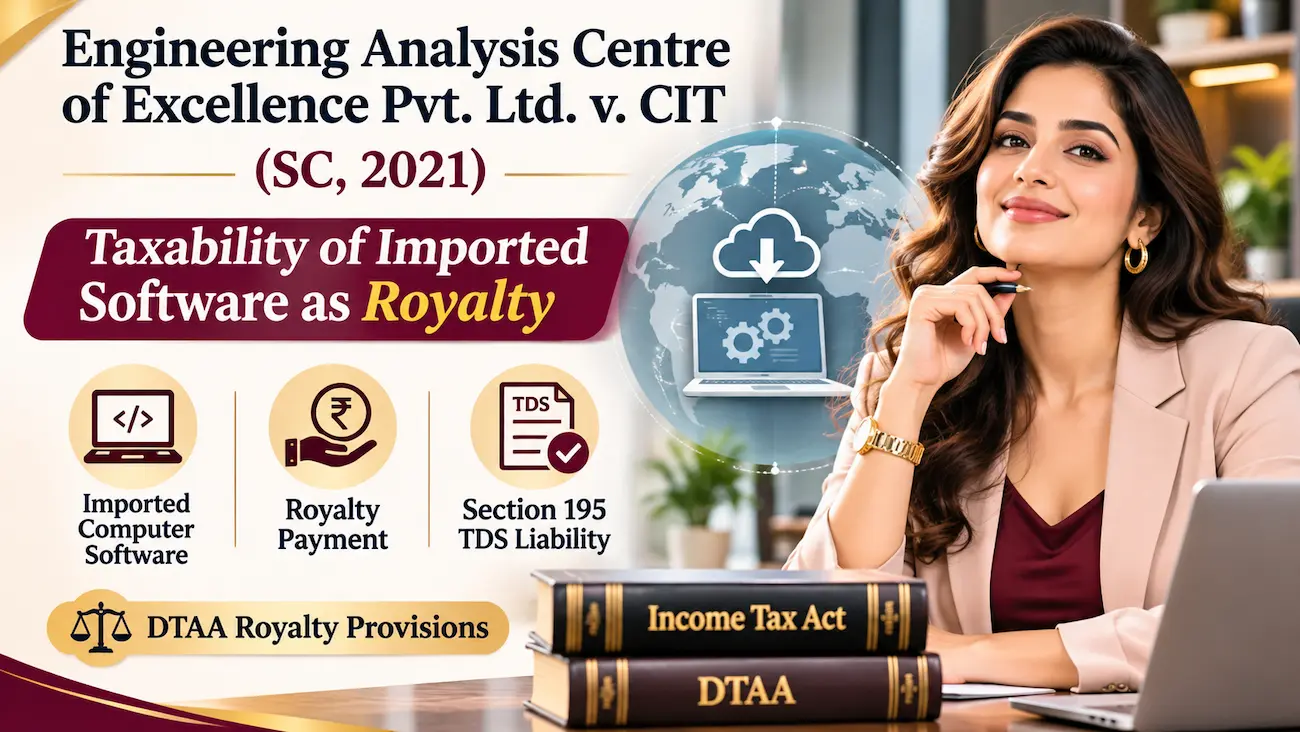
Computer software royalty – Payments by resident end-users and distributors to non-resident software suppliers – End-user licence agreements and distribution agreements – Article 12 of the DTAA: “use of, or the right to use, any copyright” – Sections 14, 30 and 52(1)(aa) of the Copyright Act, 1957 – Explanation 4 to Section 9(1)(vi) – No obligation to deduct tax under Section 195
Whether amounts paid by resident Indian end-users and distributors to non-resident suppliers for computer software, under end-user licence agreements (EULAs) or distribution agreements, are royalty for the use of copyright, so that tax had to be deducted at source under Section 195.
The assessees’ appeals against the Karnataka High Court were allowed and those judgments, including CIT v. Samsung Electronics Co. Ltd., were set aside. The AAR ruling in Citrix Systems was set aside. The Revenue’s appeals against the Delhi High Court were dismissed.
A non-exclusive, non-transferable licence to use or resell computer software does not transfer any right in the copyright under Section 14 of the Copyright Act. Payment for it is not royalty for “the use of, or the right to use, any copyright” under Article 12 of the DTAA, and the wider definition in the Income-tax Act, including Explanation 4 to Section 9(1)(vi), cannot be applied as it is not more beneficial to the assessee. No tax was deductible under Section 195.
Settled by a three-judge bench for all four categories before it: direct imports by end-users, resident distributors, non-resident distributors, and software embedded in hardware. It applies where the payee’s treaty follows the OECD royalty definition.
| Case Name | Engineering Analysis Centre of Excellence Private Limited v. The Commissioner of Income Tax & Anr. (SC, 2021), with connected appeals |
| Court | Supreme Court of India (Civil Appellate Jurisdiction) |
| Bench | R.F. Nariman, Hemant Gupta and B.R. Gavai, JJ. (judgment by R.F. Nariman, J.) |
| Case Number | Civil Appeal Nos. 8733–8734 of 2018 and connected appeals |
| Judgment Date | 2 March 2021 |
| Neutral Citation | 2021 INSC 137 |
| Reported Citation | [2021] 2 SCR 321 |
| Arising From | Karnataka High Court in CIT v. Samsung Electronics Co. Ltd. (Kar HC, 2011), (2012) 345 ITR 494, and later judgments; Delhi High Court judgments including DIT v. Ericsson A.B. (Delhi HC, 2011), (2012) 343 ITR 470; AAR ruling in Citrix Systems |
| Relevant Provision | Sections 9(1)(vi) (Explanations 2 and 4), 90 and 195, Income-tax Act, 1961; Article 12 of the DTAAs; Sections 14, 30 and 52(1)(aa), Copyright Act, 1957 |
| Income-tax Act, 2025 | Section 9(6) (royalty deemed to accrue in India), Section 159 (double taxation agreements) and Section 393(2) (deduction of tax on payments to non-residents) |
| Assessment Year | 2001-02 and 2002-03 (lead appeal) |
| Judgment Source | Official judgment, Supreme Court of India (PDF) |
Computer Software Royalty Under the Act and the DTAA
A payment to a non-resident is taxable in India only if it is chargeable under the Act and, where a treaty applies, only as the treaty allows. Under Section 90(2), the assessee may choose whichever of the Act or the treaty is more beneficial. For software, the treaty and the Act define royalty differently.
The term “royalties” as used in this Article means payments of any kind received as a consideration for the use of, or the right to use: (a) any copyright of a literary, artistic or scientific work, … any patent, trade mark, design or model, plan, secret formula or process …
| Point | DTAA (Article 12) | Income-tax Act (Explanation 2(v) and 4 to Section 9(1)(vi)) |
|---|---|---|
| Nature of definition | Exhaustive (“means”) | Wider: includes lump-sum consideration |
| What must be paid for | “Use of, or the right to use” a copyright | “Transfer of all or any rights (including the granting of a licence) in respect of” a copyright |
| Software | Covered only if a right in the copyright is used or licensed | From 2012, Explanation 4: includes any right to use computer software, irrespective of the medium |
| Which prevails | Under Section 90(2), the treaty, unless the Act is more beneficial to the assessee | |
Copyright versus a copy. Copyright under Section 14 of the Copyright Act is the exclusive right to do certain acts in respect of a work, such as reproducing it, issuing copies to the public, adapting or translating it, and, for a computer programme, selling or renting copies. Buying a copy of a book or a CD makes the buyer the owner of that copy, not of the copyright in the work. This distinction decides the case.
How the Courts Read Software Payments Before Engineering Analysis
- 2010 · AARDassault Systems K.K., In re, (2010) 322 ITR 125; Geoquest Systems B.V., In re, (2010) 327 ITR 1
Payments by distributors for software were not royalty; the distributor acquired no right in the copyright.
- 2010 · Supreme CourtGE India Technology Centre (P) Ltd. v. CIT, (2010) 10 SCC 29
Set aside the Karnataka High Court’s view that tax must be deducted under Section 195 on every remittance, and sent the cases back to decide on merits whether the payments were royalty.
- 2011 · Karnataka HCCIT v. Samsung Electronics Co. Ltd., (2012) 345 ITR 494
Held the payments to be royalty, deemed to accrue in India, with tax deductible under Section 195.
- 2011 · Delhi HCDIT v. Ericsson A.B., (2012) 343 ITR 470
Software embedded in hardware supplied to cellular operators: no copyright transferred, so not royalty.
- 2012 · AARCitrix Systems Asia Pacific Pty. Ltd., In re, (2012) 343 ITR 1
Departed from Dassault and held that the grant of a licence was itself enough to make the payment royalty.
- 2012 · Finance ActExplanation 4 to Section 9(1)(vi)
Inserted with retrospective effect from 1 June 1976 to state that royalty “includes and has always included” a right to use computer software.
- 2 March 2021 · Supreme CourtEngineering Analysis Centre of Excellence Pvt. Ltd. v. CIT
Approved Dassault, Geoquest, Ericsson, Nokia Networks, Infrasoft and ZTE, and set aside Samsung and Citrix.
Question Before the Supreme Court on Computer Software Royalty
The question, framed in GE India Technology, was whether amounts paid to foreign software suppliers were royalty giving rise to income taxable in India, so that tax had to be deducted at source. The appeals fell into four categories (para 4):
- software bought directly by a resident end-user from a non-resident supplier;
- software bought by a resident distributor for resale to resident end-users;
- software bought by a non-resident distributor and resold to resident distributors or end-users; and
- software affixed onto hardware and sold as an integrated unit by non-resident suppliers.
In the lead appeal, Engineering Analysis Centre of Excellence, a resident end-user, imported shrink-wrapped software from the USA. For AYs 2001-02 and 2002-03, the Assessing Officer, by order dated 15 May 2002, held the payments to be royalty and treated the company as liable for ₹1,03,54,784 not deducted at source, with interest of ₹15,76,567 under Section 201(1A). The Tribunal allowed the assessee’s appeal, but the Karnataka High Court, applying Samsung Electronics, reversed it.
04 · SubmissionsArguments of the Assessees and the Revenue
Assessees’ Arguments
- No right in the copyright under Section 14 of the Copyright Act was transferred; the EULAs and distribution agreements expressly prohibited reproduction, modification and sub-licensing, and the payment was the price of goods.
- The DTAA definition of royalty is narrower and more beneficial, so it prevails under Section 90(2), and Explanation 4 cannot be read into the treaty.
- A payer could not have deducted tax on the basis of Explanation 4 for years before it was enacted in 2012.
Revenue’s Arguments
- “In respect of” in Explanation 2(v) must be read widely, and Explanation 4 is clarificatory of the law since 1976, relying on CBDT Circular No. 152 of 1974 and the Finance Minister’s statement of 1990.
- Deduction under Section 195 is distinct from assessment; the payer is not an assessee, so the DTAA does not apply at that stage (relying on Article 30 of the India-USA DTAA and PILCOM v. CIT (SC, 2020)).
- India’s stated positions on the OECD Commentary show that such payments may be royalty, and distribution of software involves the right under Section 14(b)(ii) of the Copyright Act.
Supreme Court Decision and Reasoning
The Supreme Court allowed the assessees’ appeals and held that amounts paid by resident end-users and distributors to non-resident suppliers for computer software under EULAs and distribution agreements are not royalty for the use of copyright, do not give rise to income taxable in India, and did not require deduction of tax under Section 195. The Court held that copyright is the exclusive right to do the acts listed in Section 14 of the Copyright Act, chief among them reproduction, and that a licence which merely permits use of a copy, subject to restrictions, transfers no interest in those rights and is not a licence under Section 30. In each agreement before it, the supplier granted only a non-exclusive, non-transferable right to use or resell the software, expressly retaining all copyright and prohibiting reproduction, so the payment was consideration for the sale of goods. Under Article 12 of the DTAAs, royalty requires payment for “the use of, or the right to use” a copyright, which was absent, and since the treaty was more beneficial, the wider definition in Section 9(1)(vi), including Explanation 4, had no application. The Court further held that Explanation 4 expanded the law from 2012 rather than clarifying it, and that a payer could not have been required to deduct tax on the basis of a provision that was not on the statute book when the payments were made. The answer applied to all four categories of cases.
Copyright is the right to reproduce, not the ownership of a copy
Under Section 14 of the Copyright Act, copyright in a computer programme is the exclusive right to reproduce, adapt or translate it, and to issue, sell or rent copies. Making copies or adaptations of a programme only to use it for the purpose for which it was supplied, or as a back-up, is not infringement under Section 52(1)(aa) (paras 35 to 38). A licence conferring no proprietary interest does not part with copyright, and the right to reproduce and the right to use software are distinct (para 117).
The EULAs and distribution agreements transferred no right in the copyright
The distribution agreements granted only a non-exclusive, non-transferable licence to resell, stating expressly that no copyright passed to the distributor or end-user, and the distributor could not even use the software. The EULAs allowed the end-user only to install and use the software, with no right to reproduce, sub-license or modify it (paras 45 to 47). The Court explained this with a book: an Indian distributor that buys 2,000 copies from an English publisher and resells them pays no royalty, while an Indian publisher that pays for the right to reproduce and sell the book does (para 47). The real transaction was a sale of goods, as held in Tata Consultancy Services v. State of A.P. (SC, 2004) (para 52).
The treaty definition governs, and it is narrower
Article 12(3) defines royalty exhaustively as payment for “the use of, or the right to use” a copyright. Explanation 2(v) to Section 9(1)(vi) is wider, covering the transfer of “all or any rights (including the granting of a licence) in respect of” a copyright (para 63). Since Section 90(2) applies the treaty unless the Act is more beneficial, the treaty definition applied (paras 42 and 168). The Court added that even under Explanation 2(v), a licence must transfer an interest in the rights under Section 14 of the Copyright Act (paras 72 and 73).
Explanation 4 expanded the law and could not be applied retrospectively to deductors
The Court rejected the claim that Explanation 4 was clarificatory: the term “computer software” entered Section 9(1)(vi) only in 1991 and the Copyright Act only in 1994, so the Explanation could not have described the law as it stood in 1976 (paras 77 and 78). Applying the maxims lex non cogit ad impossibilia (the law does not demand the impossible) and impotentia excusat legem, the Court held that a person under Section 195 could not be expected to apply the expanded definition for years before it was actually on the statute book (paras 81 and 85).
The DTAA applies at the deduction stage too
Following GE India Technology, the Court held that Section 195 applies only if the sum is chargeable to tax in the non-resident’s hands, and the payer must take the DTAA into account (paras 53 to 61).
Resale by distributors, and India’s OECD positions
Section 14(b)(ii) of the Copyright Act, after its 1999 amendment, is aimed at reproducing copies of a programme and selling them, not at a distributor reselling copies it has bought, so distribution is not the grant of an interest in copyright (paras 141 to 144). India’s stated positions on the OECD Commentary did not alter the treaties, which had not been renegotiated on this point, so the Commentary remained persuasive (paras 155 to 158).
 06 · Binding Rule
Ratio Decidendi: A Licence to Use Software Is Not a Licence of Copyright
Where a non-resident supplier grants a resident end-user or distributor only a non-exclusive, non-transferable licence to use or resell computer software, without any right to reproduce it or any other right under Section 14 of the Copyright Act, the consideration is not royalty for “the use of, or the right to use, any copyright” under Article 12 of the DTAA. The wider definition in Section 9(1)(vi), including Explanation 4, does not apply because it is not more beneficial to the assessee, and the payer is not liable to deduct tax under Section 195.
The Court’s view that, even under Explanation 2(v) alone, a licence must transfer an interest in the Section 14 rights (para 73) was reached in addition to the treaty analysis that decided the appeals.
Applying Engineering Analysis to a Software Purchase
- An Indian engineering company buys 200 user licences of design software from a US company for USD 60,000. The EULA permits installation and use on the company’s own computers only, and prohibits copying, modification and sub-licensing.
- The US company is resident in the USA (with a tax residency certificate) and has no permanent establishment in India.
- Under Article 12 of the India-USA DTAA, the payment is not for the use of, or the right to use, the copyright, so it is not royalty. It is business profit under Article 7, which India cannot tax without a permanent establishment.
- Contrast: if the Indian company paid for the right to reproduce and sell copies of the software in India, it would be paying for a right in the copyright, and the payment would be royalty taxable at the treaty rate.
On the facts at step 3, no income is chargeable in India and no tax is deductible under Section 393(2) of the Income-tax Act, 2025 (formerly Section 195), subject to the treaty documentation being in order.
Read the licence, not the label. Calling a contract a “licence” decides nothing. The test is whether it grants a right that the Copyright Act reserves to the owner, chiefly reproduction, adaptation or distribution of copies. If it does, the payment may be royalty; if it only allows use of the copy, it is not.
Position Under the Income-tax Act, 2025 (Sections 9, 159 and 393)
The ruling rests on the DTAA definition of royalty, which no change in domestic law can alter. Under Section 159 of the Income-tax Act, 2025, which carries forward Section 90, the treaty continues to apply where it is more beneficial, so for payees resident in treaty countries with an OECD-style royalty article, payments for software under a licence to use or resell remain outside royalty.
The domestic definition is wider. Section 9(6) carries forward Section 9(1)(vi) and its Explanations, including the old Explanation 4, which treats the transfer of any right to use computer software, irrespective of the medium, as royalty. For payees with no treaty, or whose treaty defines royalty more widely, that definition applies to payments made after the 2012 amendment. Tax on such payments is now deducted under Section 393(2), still only if the sum is chargeable to tax in India.
 09 · Takeaways
Key Takeaways on Computer Software Royalty
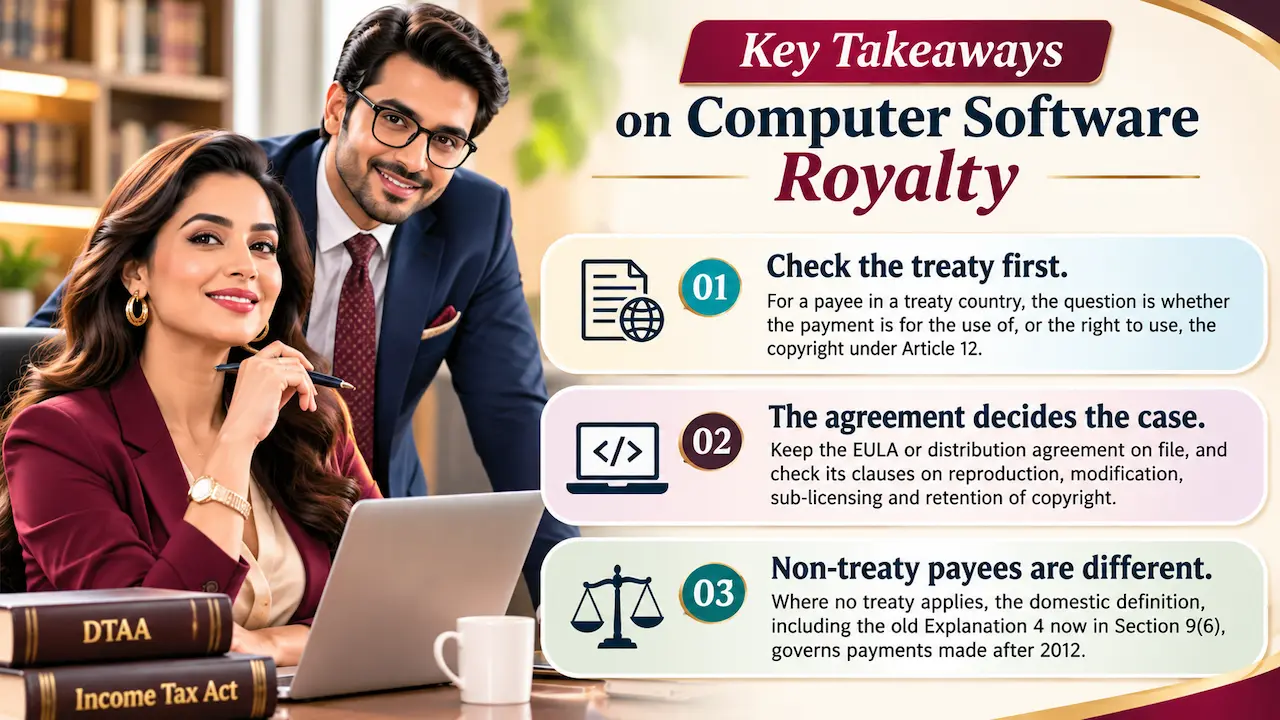
- Check the treaty first. For a payee in a treaty country, the question is whether the payment is for the use of, or the right to use, the copyright under Article 12. If the agreement grants only a right to use or resell copies, the answer is no.
- The agreement decides the case. Keep the EULA or distribution agreement on file, and check its clauses on reproduction, modification, sub-licensing and retention of copyright before treating the payment as royalty or business profit.
- Non-treaty payees are different. Where no treaty applies, the domestic definition, including the old Explanation 4 now in Section 9(6), governs payments made after 2012, and the payment is likely to be royalty.
Practitioner Checklist for Software Payments to Non-Residents
- Identify the payee’s country of residence and read the royalty article of the DTAA: does it follow the OECD “use of, or the right to use” wording, or does it expressly include software?
- Review the agreement: is any right to reproduce, adapt, modify, sub-license or distribute copies granted, or only a right to use or resell?
- Check whether the payee has a permanent establishment in India to which the income is attributable.
- Obtain the tax residency certificate and other treaty documentation before payment.
- Record the basis for deducting or not deducting tax under Section 393(2), citing the treaty article and the relevant clauses of the agreement.
Frequently Asked Questions on Engineering Analysis
Is payment for imported software royalty under a tax treaty?
Not where the agreement grants only a non-exclusive, non-transferable right to use or resell the software. The Supreme Court held that such a payment is not for the use of, or the right to use, the copyright under Article 12 of the DTAA.
Does Explanation 4 to Section 9(1)(vi) change the answer?
Not for treaty cases, because the treaty definition is more beneficial and prevails. The Court also held that Explanation 4 expanded the law in 2012 and could not be applied to payers for earlier years.
What if the payee is in a country with no tax treaty?
Then only the Income-tax Act applies. For payments made after the 2012 amendment, the domestic definition, now in Section 9(6) of the Income-tax Act, 2025, treats a right to use computer software as royalty.
Related Posts
13 · SourcesAuthoritative Sources
- Original judgment: Engineering Analysis Centre of Excellence Pvt. Ltd. v. CIT (SC, 2021), Civil Appeal Nos. 8733–8734 of 2018 (Supreme Court of India, PDF)
- Statutory provisions: Section 9 · Section 159 · Section 393, Income-tax Act, 2025 (Income Tax Department)
- Authorities referred to: GE India Technology Centre (P) Ltd. v. CIT (SC, 2010), (2010) 10 SCC 29 · CIT v. Samsung Electronics Co. Ltd. (Kar HC, 2011), (2012) 345 ITR 494 (set aside) · DIT v. Ericsson A.B. (Delhi HC, 2011), (2012) 343 ITR 470 · DIT v. Infrasoft Ltd. (Delhi HC, 2013), (2014) 264 CTR 329 · CIT v. ZTE Corporation (Delhi HC, 2017), (2017) 392 ITR 80 · Dassault Systems K.K., In re (AAR, 2010), (2010) 322 ITR 125 · Citrix Systems Asia Pacific Pty. Ltd., In re (AAR, 2012), (2012) 343 ITR 1 (set aside) · State Bank of India v. Collector of Customs (SC, 2000), (2000) 1 SCC 727 · Tata Consultancy Services v. State of A.P. (SC, 2004), 2005 (1) SCC 308 · DIT v. New Skies Satellite BV (Delhi HC, 2016), (2016) 382 ITR 114
How to find this judgment on the Supreme Court website
On the Supreme Court of India website, go to Case Status → Diary Number, enter 38137 and year 2011, and complete the security code. The judgment dated 02-03-2021 in Engineering Analysis Centre of Excellence Pvt. Ltd. v. The Commissioner of Income Tax appears in the Judgment column. It can also be found on the Digital SCR portal by searching the party name “Engineering Analysis”: Civil Appeal No. 8733/2018, [2021] 2 SCR 321, 2021 INSC 137.
Law stated as on 11 November 2026.
Editorial Note: This explainer is intended for informational and educational purposes. Readers should consult the original judgment and applicable law before relying on the legal position for a specific matter.