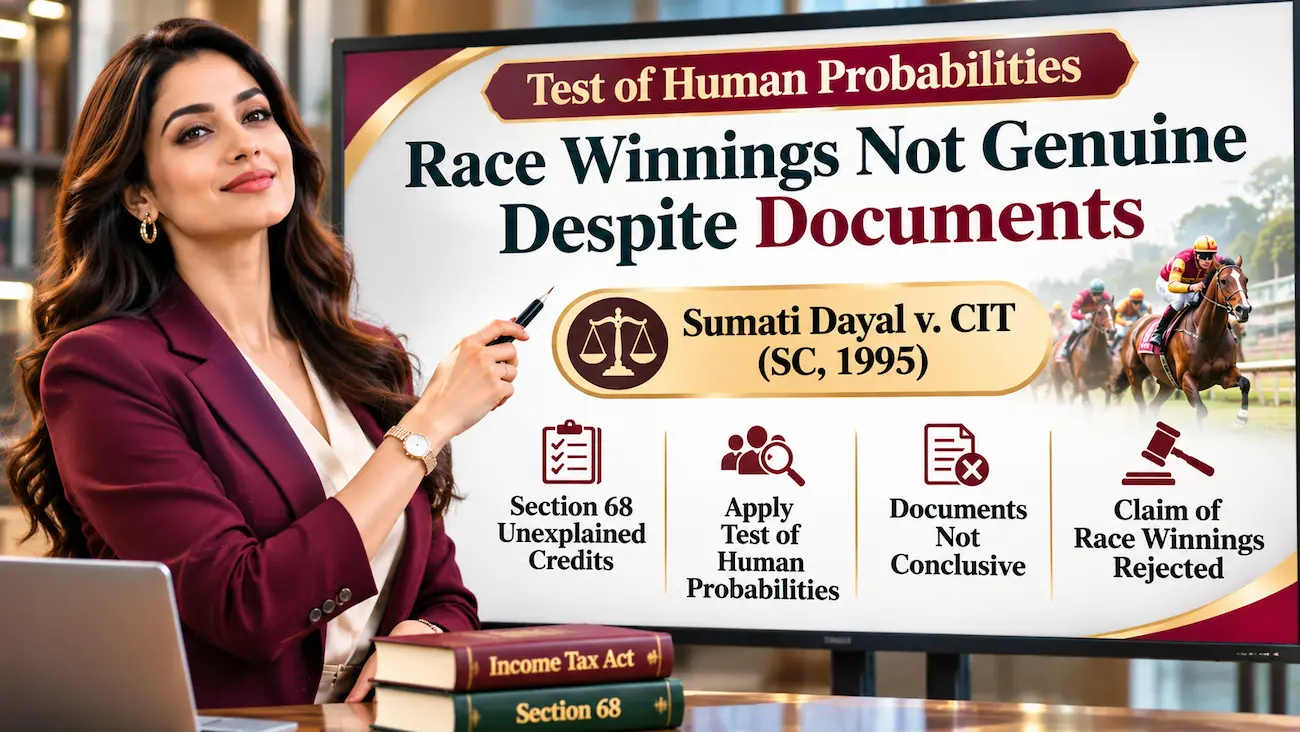
Test of human probabilities – Section 68 – ₹3,11,831 and ₹93,500 credited to capital account as race winnings, then exempt – 15 wins in Jackpot and Treble events at three race clubs in under two years – Race club certificates and crossed cheques produced – Settlement Commission majority held the winnings not genuine – Apparent must be considered real unless there are reasons to believe otherwise – Authorities may look into surrounding circumstances – Possession of winning ticket a “neutral circumstance” – Inference of purchase of winning tickets after the event upheld – Unsatisfactory explanation is prima facie evidence of income
Whether amounts received from race clubs on winning tickets and credited in the assessee’s books could be taxed as income from other sources under Section 68, when the authorities found on the surrounding circumstances that the claimed race winnings were not genuine.
The assessee’s appeals were dismissed with costs. The Supreme Court upheld the majority view of the Settlement Commission that the receipts were income from undisclosed sources.
Yes. The apparent must be considered real until there are reasons to believe that it is not, and the taxing authorities may look into the surrounding circumstances and apply the test of human probabilities to find the reality. Where the explanation for a credit is found unsatisfactory on that basis, the receipt may be taxed as income under Section 68, even if documents such as race club certificates and crossed cheques support it.
The leading Supreme Court authority on the test of human probabilities in tax. It is often applied beyond race winnings, for example to claimed lottery wins and penny-stock capital gains, and was relied on in CIT v. P. Mohanakala (SC, 2007) as “the complete answer” on Section 68.
| Case Name | Sumati Dayal v. Commissioner of Income-tax, Bangalore (SC, 1995) |
| Court | Supreme Court of India (Civil Appellate Jurisdiction) |
| Bench | S.C. Agrawal, B.L. Hansaria and Sujata V. Manohar, JJ. (judgment by S.C. Agrawal, J.) |
| Case Number | Civil Appeal No. 1344 of 1977 |
| Judgment Date | 28 March 1995 |
| Neutral Citation | 1995 INSC 221 |
| Reported Citation | [1995] 2 SCR 1173; 1995 Supp (2) SCC 453; (1995) 214 ITR 801 |
| Arising From | Order of the Income Tax Settlement Commission dated 24 February 1977 (appeal under Article 136 of the Constitution) |
| Relevant Provisions | Sections 2(24), 68 and 245M, Income-tax Act, 1961 |
| Income-tax Act, 2025 | Section 102 (unexplained credits), which corresponds to Section 68 |
| Assessment Years | 1971-72 and 1972-73 |
| Judgment Source | Official judgment (Supreme Court of India, PDF) |
Facts of the Case: Sumati Dayal v. CIT (SC, 1995)
The concept in brief. Tax authorities usually accept a transaction for what it appears to be. But where there are reasons to believe that the appearance is not the reality, they may look into the surrounding circumstances and ask what is most likely to have happened in ordinary human experience. This is the test of human probabilities. Under Section 68, it decides whether the assessee’s explanation for a credit is satisfactory. Until 1 April 1972, winnings from races were not taxable, so a receipt shown as race winnings escaped tax if the claim was accepted (para 8).
- The assessee, a dealer in art pieces, antiques and curios at Bangalore, credited ₹3,11,831 to her capital account for assessment year 1971-72 as winnings in Jackpot and Treble events at the turf clubs in Bangalore, Madras and Hyderabad. Her return declared income of ₹27,829 (para 1).
- For assessment year 1972-73, she credited ₹93,500 as winnings in two Jackpots, against a declared income of ₹3,827 (para 1).
- Between 6 April 1970 and 20 March 1971 she claimed 13 wins, 10 from Jackpots and 3 from Treble events, followed by 2 Jackpot wins the next year (para 9). The Commissioner’s report to the Settlement Commission put the number of winning occasions at 16 in less than two years (para 2).
- In her sworn statement of 6 January 1973, she said she first went to the races at the end of 1969 and won a Jackpot on her first day. She worked out combinations on her husband’s advice, admitted she knew nothing of the horses’ performance before December 1969, bought tickets costing ₹2,000 to ₹3,000, claimed no losses, and kept no record of her expenditure at the race course. She had not gone to the races in 1972 (para 9).
- The Income Tax Officer treated both sums as income from undisclosed sources, and the Appellate Assistant Commissioner confirmed the additions. The assessee withdrew her appeals before the Tribunal under Section 245M(2) and applied to the Settlement Commission (paras 1 and 2).
- Two members of the Settlement Commission held the winnings not genuine. The Chairman dissented, relying on the race club certificates and the crossed cheques. The assessee appealed to the Supreme Court (paras 3 and 12).
Question Before the Supreme Court on the Test of Human Probabilities
The assessee proved that she received the money from race clubs on winning tickets. The question was whether those receipts were really her winnings from races, or whether the authorities could treat the apparent position as not real and tax the sums as income from other sources (para 7).
03 · SubmissionsArguments of the Assessee and the Revenue
Assessee’s Arguments
- The source of the receipts was established by the race club certificates, so the burden lay on the department to prove that the sums were not race winnings (para 4).
- The department led no evidence, and the majority view rested on suspicion and surmise. Reliance was placed on Parimisetti Seetharamamma (SC, 1965), Sreelekha Banerjee (SC, 1963) and Orissa Corporation (SC, 1986) (para 4).
Revenue’s Arguments
- Having regard to the facts and circumstances, the receipts claimed as race winnings were income from other sources (para 4).
- No case was made out for interference by the Supreme Court in an appeal under Article 136 (para 4).
Supreme Court Decision and Reasoning
The Supreme Court dismissed the assessee’s appeals with costs. It held that under Section 68, where the explanation about a sum credited in the books is not satisfactory, there is prima facie evidence against the assessee, namely the receipt of money, which can be used against her if unrebutted, though the department cannot act unreasonably. It held that the apparent must be considered real until there are reasons to believe otherwise, and that the authorities may look into the surrounding circumstances and apply the test of human probabilities. Possession of the winning tickets was a “neutral circumstance”, because a person who bought winning tickets after the event would also hold them. On the assessee’s own statement and the other material, the inference that she bought the winning tickets after the events was reasonable, the explanation was not rejected unreasonably, and the finding that the sums were income from other sources was based on evidence (paras 5, 7, 13 and 14).
Burden of proof and Section 68
The Court accepted that, in general, the department must prove that a receipt falls within the taxing provision. But Section 68 changes the position for sums credited in the books. If the explanation is not satisfactory, “there is, prima facie, evidence against the assessee, viz., the receipt of money”, and if the assessee fails to rebut it, it can be used to hold that the receipt is of an income nature. The department, however, “cannot act unreasonably” in considering the explanation (para 5).
The apparent and the real
Applying CIT v. Durga Prasad More (SC, 1971), the Court held that the apparent “must be considered real until it is shown that there are reasons to believe that the apparent is not the real”. The taxing authorities are entitled to look into the surrounding circumstances to find the reality, and the matter “has to be considered by applying the test of human probabilities” (para 7).
Why the 1972 amendment mattered
The Court noted that the Finance Act, 1972 brought winnings from lotteries, races and similar games within the definition of income in Section 2(24) from 1 April 1972, on the recommendation of the Wanchoo Committee. The exemption had “provided scope for conversion of ‘black’ money into ‘white’ income”. The assessee’s winnings fell in the last two years of the exemption, and she stopped going to the races from 1972 (paras 8 and 10).
The five circumstances found by the majority
The Settlement Commission majority relied on five circumstances: the assessee’s meagre knowledge of racing; the improbability of winning many Jackpots, each a stake on five events in one day, at three different centres; the absence of drawings in her books on or before race days to buy tickets costing ₹2,000 to ₹3,000; the credit of gross winnings with no debits for tickets, expenses or losses; and her loss of interest in racing once winnings became taxable. It inferred that she had bought the winning tickets after the events with unaccounted funds (paras 10 and 11).
Documents are a neutral circumstance
The Court called the Chairman’s dissent “a superficial approach to the problem”. Holding the winning ticket and receiving a crossed cheque from the race club was “a neutral circumstance”, because a person who bought a winning ticket after the event would also hold it. The Chairman’s view that the person alleging fraud must prove it “ignores the reality”: the purchase of a winning ticket “takes place in secret and direct evidence about such purchase would be rarely available”, so the inference has to be drawn from the circumstances on record (para 13).
No unreasonable rejection of the explanation
The majority, after considering the surrounding circumstances and applying this test, had rightly concluded that the claim was not genuine. The explanation was not rejected unreasonably, and the finding that the sums were income from other sources was based on evidence (para 13).
Applying the test (TaxProof illustration). An assessee with modest declared income reports long-term capital gains of ₹40,00,000 on shares of a little-known company bought at ₹2 and sold at ₹180 within 20 months, through a recognised exchange, with contract notes and bank receipts. The company has no significant business, and the price rise is not explained by its results.
Under Sumati Dayal. The contract notes and bank receipts, like the race club certificates, show only that the transaction happened on paper; they are a neutral circumstance. The Assessing Officer may weigh the surrounding circumstances, including the assessee’s profile, the company’s fundamentals and the pattern of trading, and ask what is probable in ordinary human experience. If the explanation is found unsatisfactory on that basis, the gain may be taxed under Section 68. The assessee must answer the circumstances, not just produce the documents.
Ratio Decidendi: The Test of Human Probabilities Decides What Is Real
The apparent must be considered real until there are reasons to believe that it is not. Where there are such reasons, the taxing authorities may look into the surrounding circumstances and apply the test of human probabilities to find the reality. Where, on that basis, the explanation for a sum credited in the books is found unsatisfactory, the receipt is prima facie evidence of income under Section 68 and may be taxed if the assessee fails to rebut it. Documents that would exist in any event, whether the transaction is genuine or not, are a neutral circumstance and do not by themselves prove the explanation.
The Court remarked that in transactions such as the purchase of winning tickets, which take place in secret, direct evidence “would be rarely available”, so an inference has to be drawn from the circumstances on record. TaxProof note: the same point applies to accommodation entries and bogus gains, where the Revenue rarely has direct proof. But the Court also said the department “cannot act unreasonably”: the test calls for an inference from the circumstances of the case, not a general suspicion.
Position Under the Income-tax Act, 2025 (Section 102)
Section 102 of the Income-tax Act, 2025 carries forward Section 68. Under Section 102(1), a sum credited in the books for a tax year is charged to tax as income where the assessee offers no explanation of its nature and source, or the explanation is not satisfactory to the Assessing Officer. The same test continues to apply in deciding whether an explanation is satisfactory.
The particular reason for this dispute no longer exists. Race winnings have been income under Section 2(24) of the 1961 Act since 1 April 1972, so a genuine winning is now taxable in any case. The principle of the judgment, however, is not limited to race winnings. It is applied to other receipts where the documents are in order but the surrounding circumstances suggest that the transaction is not what it appears to be.
 07 · Takeaways
Key Takeaways on the Test of Human Probabilities
- Documents alone do not prove a transaction is real. Race club certificates and crossed cheques were a “neutral circumstance” because they would exist even if the tickets had been bought after the event. In practice: do not stop at paper evidence; explain why the transaction makes sense in the assessee’s circumstances.
- The authorities may look beyond the apparent. Once there are reasons to believe the apparent is not real, the authorities may examine the surrounding circumstances. In practice: anticipate the questions on capacity, pattern and timing, and answer them in the first reply.
- The assessee’s own statement can decide the case. The sworn statement, with its admissions about knowledge, ticket costs, losses and records, was central to the inference. In practice: prepare carefully before any statement on oath, and make sure it is consistent with the books.
- Gaps in the books weigh against the claim. No drawings to buy tickets and no debits for expenses or losses supported the finding. In practice: where income is claimed from an activity, the books should show the costs and losses of that activity as well as the receipts.
- The inference must still be reasonable. The department “cannot act unreasonably” in rejecting an explanation. In practice: where an addition rests on general suspicion rather than the circumstances of the case, challenge the absence of a reasoned link to the facts.
Practitioner checklist: meeting a human probabilities case
- List every circumstance the Assessing Officer relies on, and answer each one with evidence.
- Show the assessee’s capacity and experience in the activity that produced the receipt.
- Reconcile the books: costs, drawings and losses of the activity, not just the receipts.
- Explain the timing of the transaction, especially if it is close to a change in law or a tax event.
- Review any earlier sworn statement for admissions, and address them directly.
- Ask for the specific material behind any general allegation, such as a report on a scheme or racket, and rebut its link to the assessee.
FAQs on the Test of Human Probabilities After Sumati Dayal
What is the test of human probabilities in income tax?
It is the rule, applied in Sumati Dayal v. CIT (SC, 1995), that the apparent must be considered real until there are reasons to believe otherwise, and that the authorities may then look into the surrounding circumstances and decide what is probable in ordinary human experience. On that basis the Supreme Court upheld the taxation of claimed race winnings as income from other sources.
Can income be taxed under Section 68 even if the assessee has documentary proof?
Yes. In Sumati Dayal the assessee had race club certificates and crossed cheques, but the Supreme Court treated them as a neutral circumstance and upheld the finding that the winnings were not genuine. The explanation must be satisfactory in the light of all the circumstances, not just supported by documents.
Does Sumati Dayal still apply under the Income-tax Act, 2025?
Yes. Section 102 of the Income-tax Act, 2025 carries forward Section 68, and the test of human probabilities continues to guide whether an explanation for a credit is satisfactory. The principle is applied to many kinds of receipts, not only race winnings.
Related Posts
10 · SourcesAuthoritative Sources
- Original judgment: Sumati Dayal v. CIT, Bangalore (SC, 1995), Civil Appeal No. 1344 of 1977 (Supreme Court of India, PDF)
- Statutory provisions: Sections 2(24), 68 and 245M, Income-tax Act, 1961; Section 102, Income-tax Act, 2025 (Income Tax Department)
- Authorities referred to: Parimisetti Seetharamamma v. CIT (SC, 1965), (1965) 57 ITR 532 · Sreelekha Banerjee v. CIT (SC, 1963), (1963) 49 ITR 112 · CIT v. Orissa Corporation P. Ltd. (SC, 1986), (1986) 159 ITR 78 · CIT v. Durga Prasad More (SC, 1971), (1971) 82 ITR 540
- Later reference: CIT v. P. Mohanakala (SC, 2007), (2007) 291 ITR 278
How to find this judgment on the Supreme Court website
On the Supreme Court of India website, open the judgment search and choose Case Number. Select Civil Appeal, enter 1344 and the year 1977, and complete the captcha; the judgment dated 28-03-1995 appears. You can also search by Judgment Date (28-03-1995) or Party Name (“Sumati Dayal”). On the Digital SCR portal, it is reported as [1995] 2 S.C.R. 1173, with the neutral citation 1995 INSC 221.
Editorial Note: This case law digest is intended for informational and educational purposes. Readers should consult the original judgment and applicable law before relying on the legal position for a specific matter.